The Mirror of Imitation: Who Hides Behind Your Mask?
One of the things that strikes me most when I "taste" the essence of a monkey dream is the sensation of a distorted reflection. In the world of sleep, the monkey is the master of imitation. He apes you, literally.
If he looks at you intently or reproduces your gestures, it is likely your unconscious pointing a finger at a lack of authenticity in your current life. You might be going through a phase where you are trying too hard to fit in, adopting the slang, the habits, or the values of a group that doesn't truly resonate with your soul.
It saddens me sometimes to see how much time we spend copying the behaviors of others just to feel accepted. The monkey in your dream isn’t there to mock you unkindly. He is there to ask: "Where are you, the real you, in all this theater?"
It is an invitation to let go of social expectations. Just as you might explore the depth of your emotions when being pregnant, the monkey asks you to look at what you are "birthing" into the world—is it a genuine expression of yourself, or a carbon copy of someone else?
Sometimes, the monkey is the one wearing your professional clothes or scrolling through your phone. This is a powerful image of how you might become a caricature of yourself when you forget your essence. If the monkey in your dream seems ridiculous, ask yourself: In what situation in my life do I feel forced to play a role that doesn't fit me?
---
Sacred Mischief: When the Shadow Decides to Play
Many dreamers wake up irritated by monkeys. "He stole my keys," or "He trashed my living room," they tell me. But I see a form of turbulent wisdom in this. The monkey’s mischief is a medicine.
It comes to break the rigid structures you have built around yourself. If your life has become a series of serious tasks, heavy responsibilities, and strict rules, your mind will conjure a monkey to throw everything into the air.
In psychology, this is often linked to the "Trickster" archetype—a force that disrupts the status quo to allow for new growth. If you find yourself fighting with a monkey, you aren't just battling an animal; you are battling your own need for control.
🌙 Yume's Echo: Sometimes, chaos is not an enemy, but an invitation to dance under the rain of our own broken certainties.
There is an important nuance to grasp depending on the primate's size:
- The small monkey (macaque, marmoset): He often represents scattered curiosity—a desire to learn or have fun that can't seem to focus. This is pure mental restlessness.
- The great ape (gorilla, chimpanzee): Here, we touch upon something more visceral. It is raw strength, an emotional power that has been contained for too long. A gorilla isn't "mean" in a dream; he is simply the guardian of a strength you do not dare express in your waking hours.
I am often wary of simple dream dictionaries that claim a monkey means "betrayal." That feels too narrow. The monkey speaks of you, not others. He speaks of your ability to laugh at your own quirks and to accept your shadow side with a knowing smile.
---
Concrete Example: The Librarian and the Chimpanzee
Consider the case of a young architect who felt trapped by the rigid demands of her firm. She dreamed she was in a silent, pristine library when a chimpanzee entered, wearing her glasses. The chimpanzee didn't attack; it simply began throwing heavy, leather-bound books into a pile and jumping on them like a trampoline.
Initially, she felt intense shame in the dream. However, as she watched, she realized the "important" books were actually empty. This dream was her unconscious mind's way of showing her that the "weight" of her professional responsibilities was an illusion she had created. The chimpanzee was her own repressed desire for play, showing her that her creativity was being suffocated by the "silence" of her current environment.
---
Taming the "Monkey Mind": From Branch to Branch
It also happens that the monkey symbolizes what some traditions call the "monkey mind." You know that feeling—the moment you try to fall asleep, and your thoughts leap from a worry to an idea, then to a memory, never giving you a moment's peace.
Seeing a troop of monkeys screaming and jumping everywhere in your dream is often a sign of mental exhaustion. Some specialists in sleep psychology suggest that this kind of dream activity reflects a brain that is struggling to "file away" the day's information because there is simply too much of it.
In these moments, my advice as a Baku is not to try and chase the monkeys away by force. The more you fight them, the more agitated they become. The key is to become the observer.
Why are they running? What is making them so excited? Sometimes, simply dedicating a little time to your creativity or a simple game during the day is enough for these dream-monkeys to calm down and fall asleep by your side at night.
Never forget that dreams are fluid landscapes. Nothing is set in stone. A monkey that bites you might seem like a threat, but it is perhaps just his way of "waking you up" to a situation you are stubbornly ignoring. The monkey’s teeth are the needles of your conscience, pricking you so that you finally react to your own needs.
Learn to love the monkey within you. He is the one who holds the key to your freedom and your purest joy—the kind that needs no reason to exist. If you want to explore your dreams more deeply, your Baku is waiting for you.
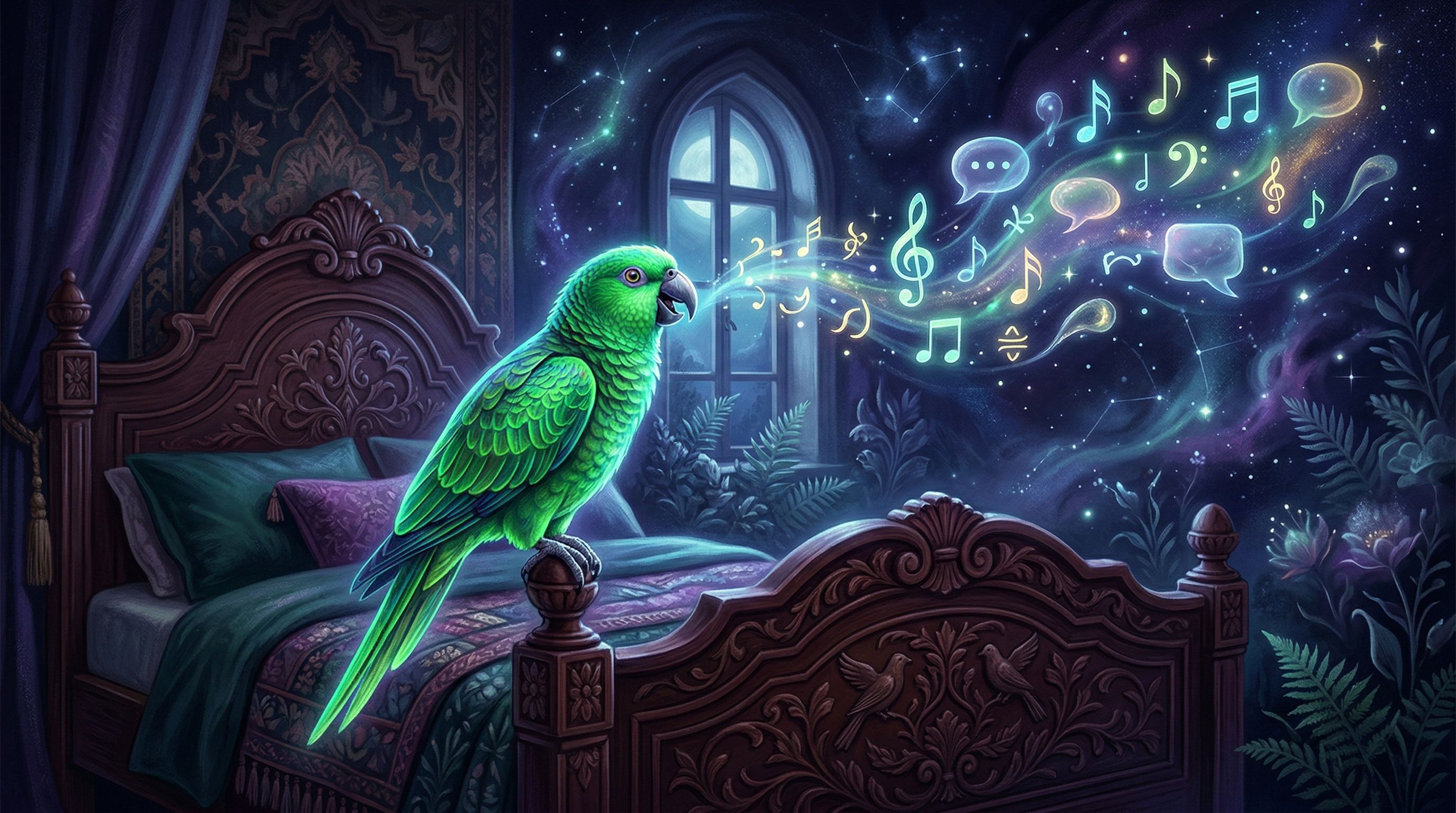
Have you ever woken up with the shrill, chaotic chatter of a monkey ringing in your ears? That unbearable noise isn't just random static; it is the sound of your thoughts when they are left to run wild, untied to any real purpose. I often compare this messy, organic noise to the hollow echo some people feel when dreaming of a parrot, where words are repeated back without any real heart behind them. But while the bird merely mimics, the monkey screams to get your attention. It is an exhausting, raw sound. Sometimes, when I taste these dreams, the essence is metallic and sharp because the dreamer is so desperately trying to silence their own internal critics. If the dream monkey is making a racket, stop trying to quiet him. Ask yourself instead what truth you are trying to drown out with all that mental noise.
In the lands I wander, we have an ancient name for this: the Mind Monkey. It represents the restless, unsettled state of human consciousness that leaps endlessly from branch to branch, never pausing to taste the fruit. I get gently irritated when modern interpretations try to 'tame' or discipline this creature as if it were a disease to be cured. You cannot leash a spirit of the forest. Old Eastern sages knew this well—they did not try to cage the monkey; they simply watched it swing until it grew tired. When you dream of a primate leaping through the canopy of your mind, it is a quiet reminder that your thoughts are not you. They are just temporary visitors passing through the green leaves of your awareness. Let them swing. The branches will hold them, and eventually, the forest will grow quiet again.
I once met a dreamer who had spent years in a state of profound emotional numbness after a sudden loss. She felt completely marooned, much like the lonely survivor in dreams of being a castaway on a barren shore. One night, a small, wet macaque appeared in her dream. It sat on her lap and began to pull tiny, colorful threads out of her skin, one by one. She woke up crying for the first time in years. It was a bizarre, almost uncomfortable image, but that little creature was doing what she could not do herself—gently picking at the scabs of her hidden grief. The monkey, with its nimble, tiny fingers, does not respect our emotional boundaries, and honestly? Thank goodness for that. Sometimes we need a touch that is wild, uncivilized, and entirely unbothered by our polite rules of mourning to remind us that we are still alive.