The Architecture of the Green Labyrinth: When the Mind Overflows
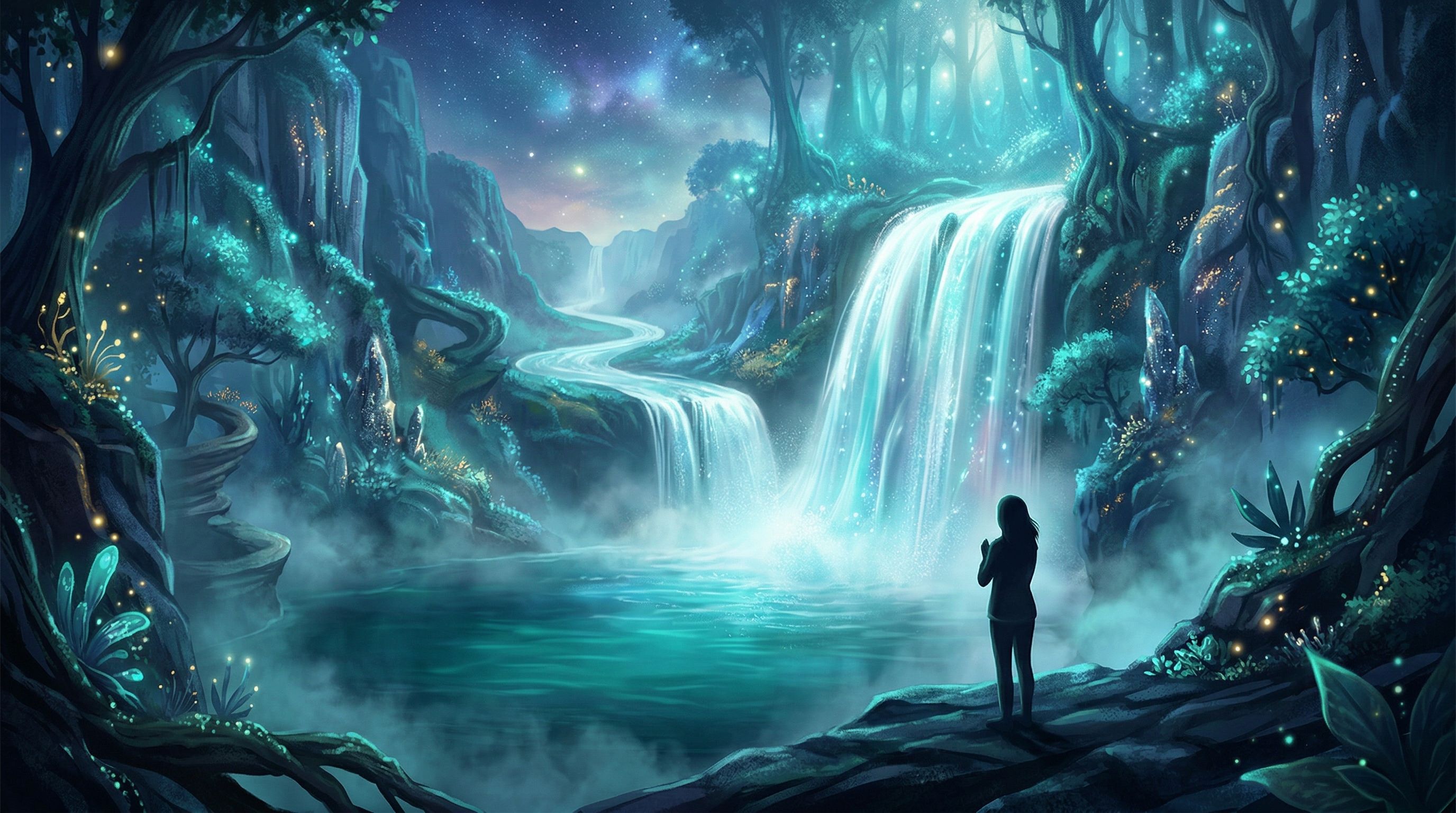
I have a secret to share with you: as a Baku, I find jungle dreams to be among the most "flavorful" to encounter. They are complex, vibrant, and deeply textured. Unlike an orderly, manicured park or a familiar forest, the jungle is an explosion of life that refuses to be contained. In the theater of your nights, this botanical chaos is a direct reflection of your internal ecosystem.
If you find yourself wandering through vines that seem to move or trees that block out the sun, it is rarely a sign of literal danger. Instead, it suggests a state of emotional abundance. You might be at a stage in your life where your creative potential is peaking, or perhaps you are juggling so many projects and desires that your mind no longer knows where to focus. It’s like looking at a canvas painted with a thousand shades of green; the beauty is undeniable, but the eye needs a place to rest.
Some psychologists suggest that such dreams occur when our "cognitive load" is heavy. When your daily life feels like a series of intertwined responsibilities—much like aerial roots—your subconscious uses the jungle as a metaphor for this entanglement. You aren't just seeing trees; you are seeing the complexity of your own choices. If the vegetation feels suffocating, ask yourself: are you trying to control every leaf, or can you learn to breathe with the forest?
---
The Shadow in the Ferns: Meeting Your Instincts
The most fascinating aspect of the jungle is its complete lack of human morality. In the wild, there is no "good" or "bad," only the rhythm of survival and growth. When you dream of this place, you are invited to shed your social costume—your titles, your polite smiles, and your carefully constructed persona. You become, once again, a being of pure vibration and instinct.
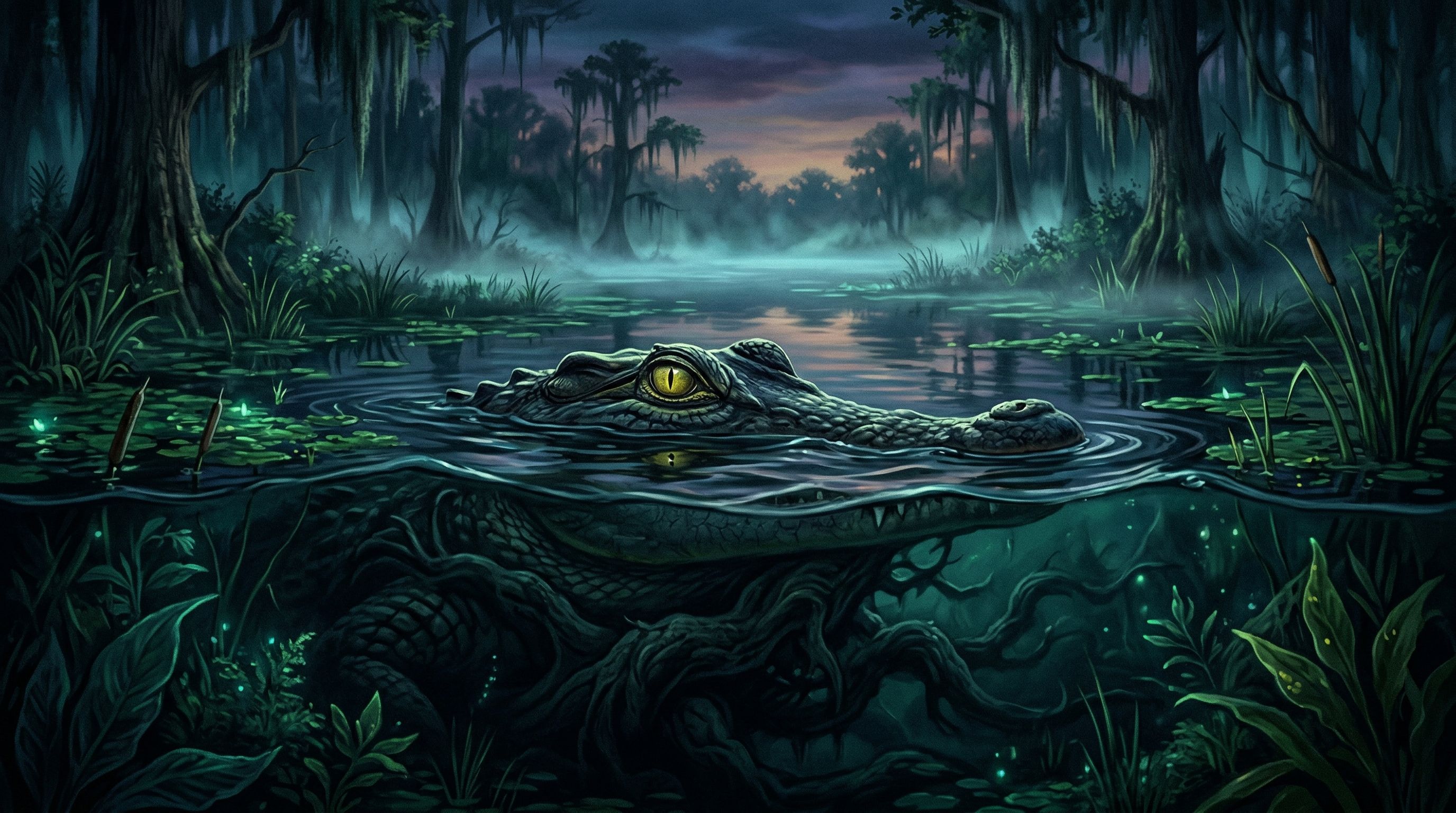
Many dreamers feel a surge of anxiety when they spot a predator between the ferns. However, from a Jungian perspective, that tiger or snake is often a "shadow" aspect of yourself. It represents a force—perhaps ambition, sexuality, or even healthy aggression—that you have deemed too "raw" for your civilized life.
🌙 The echo of Yume : The tiger does not apologize for its hunger, and the vine does not feel guilty for seeking the light. Why should you?
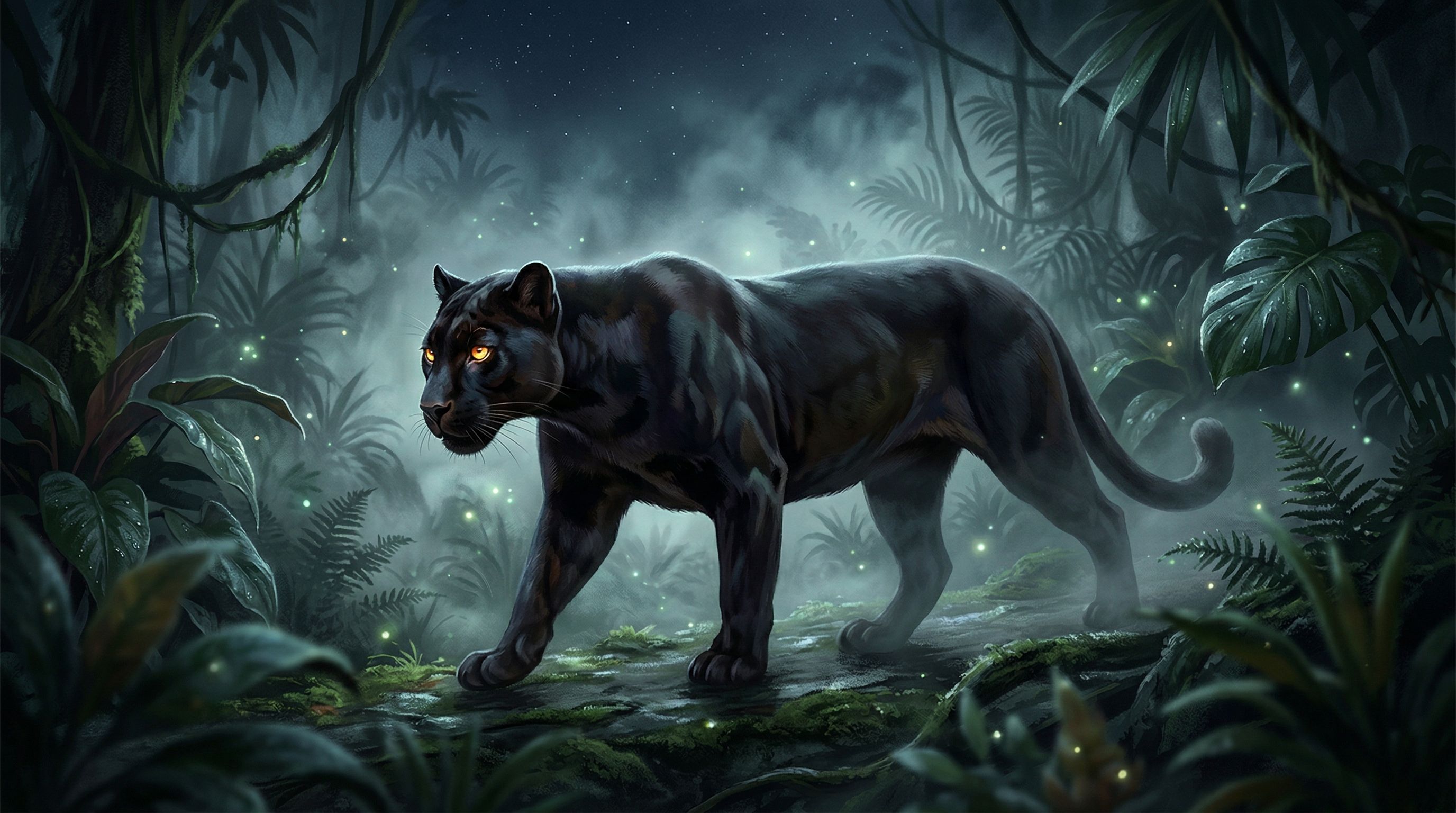
If you find yourself fleeing from a creature, you might actually be running away from your own power. I once encountered a dreamer who was terrified of a black panther stalking her through a misty rainforest. She felt she was being hunted by a failure in her career. In reality, the panther was her own untapped leadership—a fierce, elegant strength she was afraid to claim because she didn't want to appear "too much" to others. Perhaps you, too, are burying something vital beneath the soil of your consciousness, waiting for the courage to let it breathe.
---
Concrete Example: The Machete and the Path
Consider the dreamer who finds themselves holding a tool, like a machete, trying to clear a path through the brush. This is a classic "use case" of the jungle dream.
The Scenario: You are standing before an impenetrable wall of green. You feel a sense of urgency. You begin to hack away at the vines, but for every branch you cut, two more seem to grow back.
The Interpretation: This often reflects a struggle for self-assertion. In your waking life, you may be trying to "force" a solution to a complex problem. The dream is showing you that your current approach—brute force and logic—might be exhausting you. The jungle doesn't want to be conquered; it wants to be navigated.
If you find yourself struggling to see the way forward, you might even experience the sensation of closing your eyes within the dream, a reflex of the mind when the "visual noise" of life becomes too loud. The lesson here is often about agility. Instead of cutting down the forest, can you climb a tree to see the horizon? Can you follow a stream instead of fighting the thorns?
---
The Science of the Wild: Why the Brain Chooses the Jungle
While the symbolic meaning is rich, there is also a fascinating biological layer to these visions. Some researchers in the field of evolutionary psychology believe in the "Threat Simulation Theory." This hypothesis suggests that our brains use dreams to practice navigating dangerous environments, a vestige of our ancestors' lives.
However, modern sleep science also points toward emotional regulation. During REM sleep, the amygdala (the brain's emotional center) is highly active, while the prefrontal cortex (the seat of logic) is dampened. This creates the perfect "biological soup" for a jungle to grow. Without the constraints of logic, your brain is free to map out your fears and desires in their most vivid, untamed forms.
The jungle is the ultimate "stress test" for the soul. It asks you: Who are you when the map is gone? It forces you to rely on your senses rather than your certainties. If you feel lost, it is not a failure of your internal GPS. It is your mind creating a space where you are allowed to be "found" by something new.
---
From Chaos to Sanctuary: Integrating the Dream
Never fear the damp warmth of these nights. The jungle is, after all, the cradle of life. If you can reach a point in your dream where you stop fighting and start observing, the atmosphere often shifts. You might notice the exquisite detail of a wild orchid or the iridescent wings of a bird you've never seen before.
This shift marks a moment of inner reconciliation. You are accepting that not everything in your life can be neatly tucked away in boxes. You are acknowledging that you are a vast, complex being, capable of containing both the shadow and the light.
My advice to you, as you reflect on your journey under the canopy, is to look at your attitude within the dream:
- Were you a victim of the environment, or a participant in it?
- Did you seek an exit, or did you seek a center?
- What was the "vibe" of the air—was it suffocating or life-giving?
The answers to these questions are the compass needles that will guide you through your waking days. The jungle is not a place to escape; it is a primordial garden that you are invited to explore whenever you need to rediscover your own strength.
If the images from your night—the rustle of leaves, the hidden eyes, the scent of rain—still linger in your mind, take a moment to honor them. Your subconscious has gone to great lengths to build this world for you. If you want to explore these wild landscapes further and keep a record of your journey through the green mist, your Baku is waiting for you to continue the conversation.
---
Related articles:
Have you noticed the smell of your jungle? I often ask dreamers about this, because the night-mind doesn't just paint pictures; it breathes. If your dream-jungle is heavy with the scent of damp earth, decaying leaves, and sweet, overripe fruit, you are touching something ancient. Some dream dictionaries—which I frankly find exhausting in their rigidness—will tell you that rot in a dream means failure. What nonsense. In the wild, decay is the very cradle of life. That fallen giant of a tree, covered in moss and mushrooms, is simply nourishing the young shoots at its feet. If you are going through a painful transition, perhaps a quiet ending in your waking life, this humid air isn't a threat. It is a promise of composting. Your mind is recycling old grief to feed the wild flowers of your tomorrow.
Honestly, it puzzles me how modern dreamers panic when they cannot find a paved road in their sleep. We have become so accustomed to sterile, right-angled spaces that the organic asymmetry of the jungle feels like a crisis. Unlike the quiet, structured guidance you might seek when dreaming of crossing a forest, the jungle offers no trails, no signposts, and no compromise. It demands that you stop looking for a ceiling. I once listened to a dreamer who spent his entire night trying to build a small wooden shelter inside a bamboo thicket, desperately trying to keep the heavy rain off his shoulders. He woke up exhausted. His dream wasn't telling him he was in danger; it was gently mocking his need to build walls everywhere he went. Sometimes, the most spiritual thing you can do is let yourself get wet, trusting that your skin knows exactly how to handle the rain.