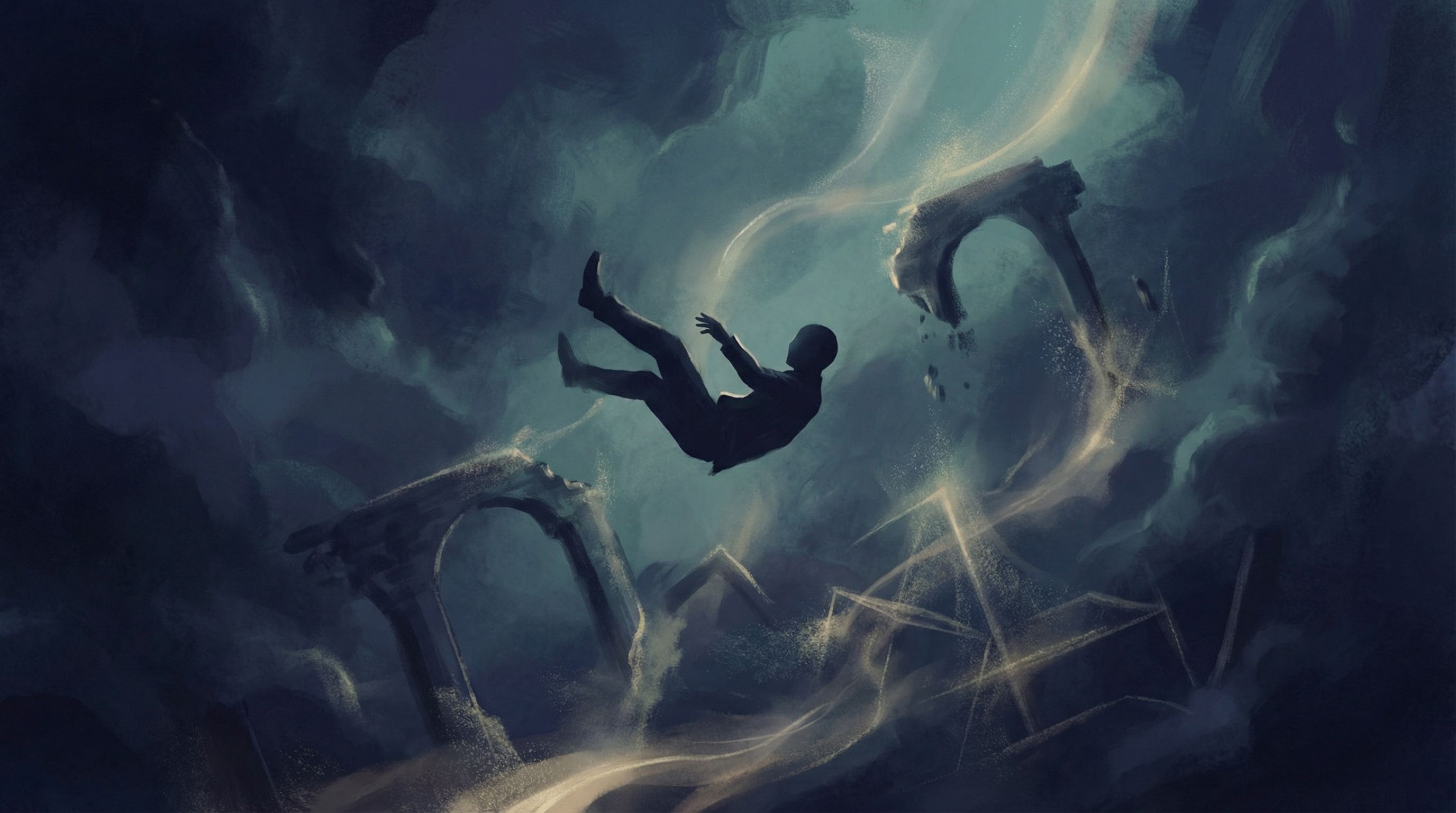
The Breath of the Blades: Why the Helicopter Hovers in Your Mind
I find it fascinating that your mind chooses such a specific machine to communicate with you. In the vast theater of your sleep, a helicopter isn't just a vehicle; it is a marvel of physics that defies the traditional "forward-only" movement of an airplane. It can hover. It can descend into tight canyons. It can turn on a dime.
When you see or hear this machine in your dreams, your subconscious is likely playing with the concept of spatial metaphors. In psychology, we often find that "up" equates to "better understanding" or "control," while "down" relates to being "stuck" or "overwhelmed."
By placing you in a helicopter, your mind is giving you a tool for surgical precision. You aren't just flying away; you are hovering over the details of your life. This often happens when you are facing a decision that feels too "close" to you. You are in the thick of the forest, and your brain is desperately trying to show you the shape of the entire woods.
Some researchers suggest that dreams of flight are linked to our vestibular system—the part of your inner ear that manages balance. When this system activates during REM sleep, your brain interprets the sensation as floating or flying. But the type of flight is chosen by your emotions. The helicopter, with its loud thrum and heavy wind, suggests that this isn't a passive drift; it is an active, perhaps even urgent, search for clarity.
---
The Pilot’s Seat: Taking Control of the Flight
If you find yourself with your hands on the controls, pay close attention to how the craft responds to you. Are you flying smoothly, or is the helicopter wobbling, threatening to clip the trees below?
Being the pilot is a direct reflection of your perceived agency. In your waking life, you might be juggling a high-pressure project or a complex family dynamic. You are the one responsible for the "landing." If the flight feels stressful, it isn't a sign that you will fail. Rather, it is an invitation to look at how tightly you are gripping the stick.
Are you trying to control every single gust of wind? Sometimes, the dream is a gentle nudge to trust your own mechanics. You have the skills to stay airborne, but you might be exhausting yourself by over-correcting every minor tilt.
Interestingly, what you wear or carry in these dreams can add layers of meaning. Perhaps you were wearing a suit while piloting, suggesting that this need for control is tied to your professional identity or your public image. Or maybe you felt the weight of a hat on your head, symbolizing a specific role or "rank" you feel forced to maintain while navigating this transition.
🌙 Yume's Echo: The helicopter doesn't need a paved runway to land; it creates its own space. Perhaps you, too, are allowed to land exactly where you are, even if the ground looks uneven.
---
The Extraction: When You Need to be Rescued
There is a very specific type of helicopter dream that many of my dreamers share with me: the Rescue Mission. In these visions, you aren't the pilot. You are on the ground, perhaps in a dark forest or on a sinking ship, and you see the searchlight cutting through the gloom. You hear the blades before you see the craft.
This is a powerful "extraction" metaphor. It often surfaces when you feel emotionally or mentally depleted. You might be in a relationship that has become a "dead end," or a job that feels like a labyrinth with no exit. The helicopter represents the "deus ex machina"—the sudden, swift solution that lifts you out of the mud.
However, I want you to remember something important: the helicopter is a product of your mind. Even if you are being rescued by a stranger in the dream, that stranger is a part of you. You are the one dreaming of the rescue. This means that the "extraction team" is already within you. You possess the internal resources to lift yourself out of the situation that feels so heavy.
The feeling of wind on your face as the craft lifts off is often a physical manifestation of relief. It is the brain's way of practicing the feeling of being free. It is a rehearsal for the moment you finally decide to leave what no longer serves you.
---
A Concrete Example: The Observer in the Sky
Consider the case of a dreamer who recently shared a recurring vision. In her dream, she was hovering in a glass-bottomed helicopter over her childhood home. She wasn't landing; she was just watching her family move about like tiny dolls.
She felt a strange mix of guilt and peace. Through our reflection, she realized that the helicopter was her mind's way of creating cognitive distance. She was going through a difficult boundary-setting process with her parents.
The helicopter allowed her to see them without being "touched" by them. It gave her the safety of height. By observing the "dolls" from above, she could see the patterns of their behavior—the way they moved in circles—without getting caught in the cycle herself. The dream wasn't about travel; it was about the safety of the vantage point.
---
The Vertigo of Truth: Facing the Aerial View
While the helicopter offers freedom, it also offers something much more intimidating: the truth. When you are on the ground, you can hide behind walls. You can pretend the path ahead is straight when it is actually a dead end.
But from the air, there is nowhere to hide. You see the layout of your life with startling honesty. You see where you have been pacing in circles. You see the shortcuts you were too afraid to take.
This can sometimes cause a feeling of vertigo in the dream. If you feel dizzy or afraid of falling, it is rarely a fear of heights. It is often a fear of what the height reveals. It is the "Aha!" moment that you aren't quite ready to have yet.
If the helicopter in your dream feels like it is in a state of emergency—lights flashing, sirens wailing—don't panic. In the language of the soul, an emergency is simply a call for focused attention. Something in your life is "beeping" for a reason. It is a signal light, not a catastrophe. It is your inner guide saying, "Look here, right now. This is where we need to land."
---
Navigating the Descent
As you return to the waking world, try to carry that sense of "hovering" with you. You don't always have to be running through the maze. Sometimes, the best thing you can do is stop, rise above the noise, and simply observe.
The helicopter is a noisy, powerful, and faithful ally. It reminds you that you are not a prisoner of the terrain. You have the ability to rise, to stabilize your thoughts, and to descend with precision exactly where you need to be.
The next time you hear that rhythmic thrum in your sleep, don't run from the wind. Step toward it. Climb aboard. The view from up there is exactly what you need to see.
If you want to explore your dreams more deeply, your Baku is waiting for you.
— Yume
I once met a dreamer who was deeply unsettled because her dream helicopter was entirely silent. She could see the blades violently chopping the thick air, bending the pine trees below, but there was no sound—only a heavy, suffocating quiet. It made me think about how we interpret these modern metallic beasts. Some dream interpreters will tell you a helicopter always means a desire for social status or rapid escape, but honestly? I find those rigid, one-size-fits-all definitions incredibly lazy. To me, a silent rotor is a profound whisper from your deeper self. It functions much like the silent flight of an eagle, stripping away the terrifying noise of your waking life so you can focus purely on the shift in perspective. When the machine in your night-sky loses its roar, your mind is simply silencing the outer chaos so you can finally hear your own internal compass.