The hat as a mask and social interface
In the vast theater of the subconscious, the hat is undoubtedly one of the most meaningful costumes. Why? Because it rests upon the head—the seat of your thoughts, your intellect, and for some, your connection to the divine. When you dream of a hat, your spirit is having a conversation about your identity.
Sincerely, this symbol has fascinated me for years because it acts as the interface between your inner world and the gaze of others. Wearing a grand top hat doesn’t carry the same weight as hiding under a humble cap. In the first case, your subconscious might be whispering about a need for recognition, a desire to dominate your environment, or perhaps the opposite: a fear of not being "big enough" for the responsibilities resting on your shoulders.
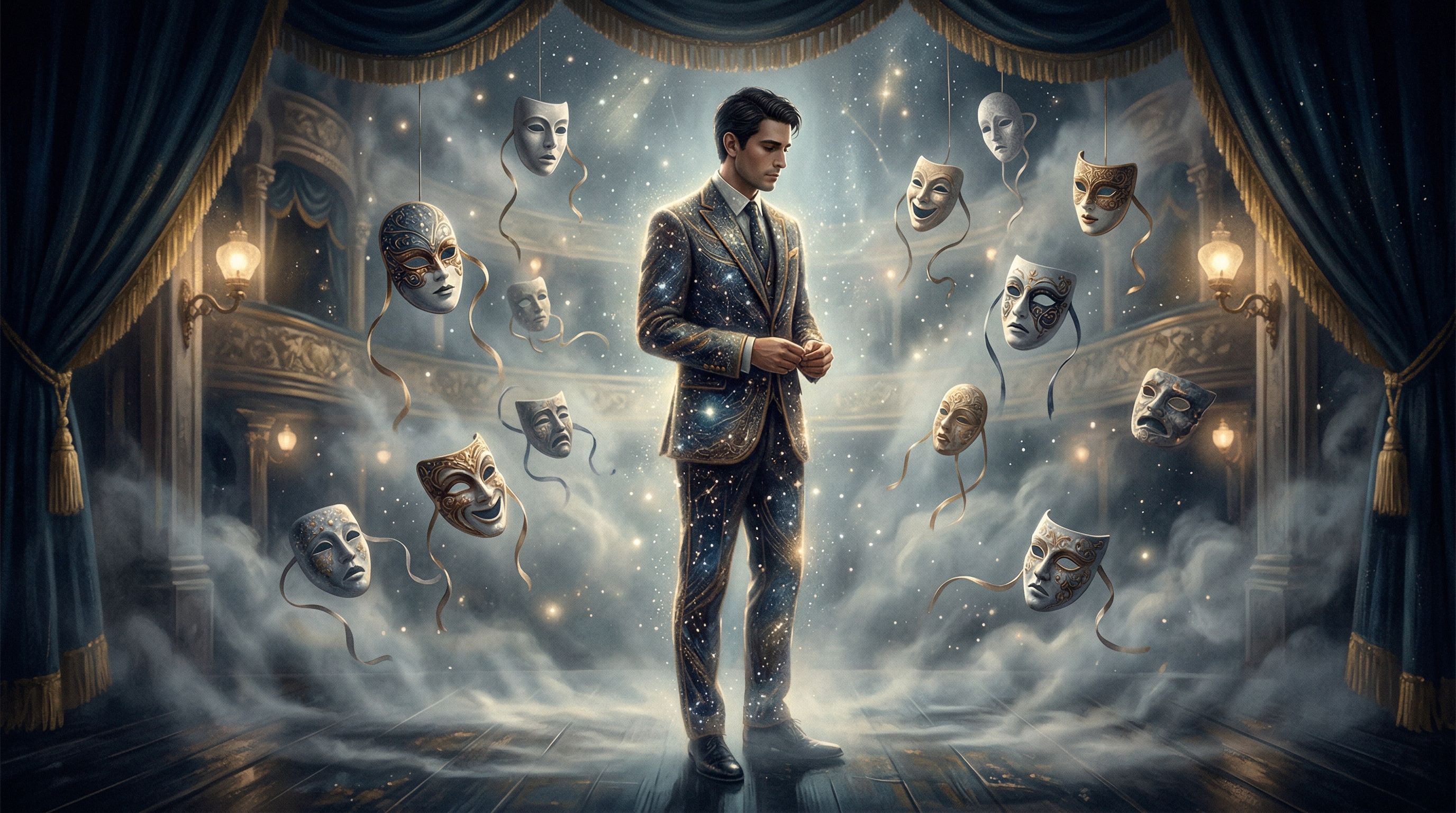
There is a certain melancholy in dreams where we wear a hat that doesn't belong to us. It reminds me of a dreamer I visited once: he was wearing his father’s heavy uniform cap, and he was stifling under its weight. It wasn’t a nightmare, just a gentle but firm message: "You are carrying a role that isn't yours." It’s a bit like losing your wallet; we are touching upon the loss of our identity markers and how we present ourselves to the world. If you feel naked without your hat in the dream, ask yourself what mask you are afraid to drop in your waking life.
The texture of our roles: From the helmet to the feather
I am truly not a fan of dream dictionaries that claim a hat simply means "glory" or "success" in a one-size-fits-all way. It is much more subtle than that. The shape of the hat is the language your subconscious uses to shade its message.
Imagine a safety helmet. If you are wearing one, your mind is likely signaling that you are in "survival" or "defense" mode. Are you expecting to take a hit? Conversely, if your hat is adorned with a delicate feather, the message becomes one of elevation, a newfound lightness, or spiritual distinction. The feather brings an airy dimension to the rigid structure of a social role.
Here are a few variations I often see drifting through the mists of sleep:
The oversized hat: You might feel like an impostor in a new position. The role is there, but you haven't quite filled it yet.
The brand-new hat: A new stage of life. You are adopting a new mindset, a new way of thinking.
The damaged or old hat: Outdated ideas. Your way of interacting with others needs a refresh. You are clinging to an old image of yourself that no longer does you justice.
Honestly? The symbol remains a mystery until you pair it with the emotion you felt. If you are proud of your hat, it is an affirmation of your personal power. If you feel ashamed, then the role you are playing has become a burden.
The wind and loss: When identity flies away
One of the most frequent—and unsettling—scenarios is when the wind carries your hat away. You run after it, feeling ridiculous and exposed. For me, the Baku who devours anxieties, this dream is a delicate feast. It isn't a threat, but rather an invitation to let go of control.
The wind represents life—the unpredictable. When it uncovers your head, it forces you to show your "summit," your bare scalp, your vulnerability. Is it really so terrible to be seen as you are, without the regalia of your function or title? Sometimes, losing your hat in a dream is the most beautiful gift your subconscious can give you: it releases you from a label that was beginning to feel too tight against your temples.
I don't know if you’ve noticed, but in those moments, the dreamer often eventually stops running. That is where wisdom steps in. Accepting being "hatless" is accepting your raw humanity, without the artifice of appearance. It is a form of intellectual nakedness that can be frightening, certainly, but it is also deeply liberating.
Dreams are not enemies trying to humiliate you. They are messengers using everyday objects—like an old felt hat or a sports cap—to say: "Look at how you hide," or "Look at how proud you are."
Have you ever woken up in the middle of the night feeling a phantom pressure around your temples, as if a tight iron band were still squeezing your head? In the dreamlands, a hat is rarely just a visual prop; its weight and texture speak in whispers. A wet, heavy wool cap that smells of old rain suggests a mind waterlogged by outdated worries, while a straw hat that constantly pricks your skin might be your unconscious gently mocking your attempts to play the carefree traveler. It is a sensory burden, not unlike the physical restriction of wearing a stiff suit—both garments demand a posture that your soul might be too tired to maintain. When the fabric bites into your skin, it is your body reminding you that your chosen persona has become a cage.
I once met a dreamer who dreamt she was trying to take off an elegant velvet beret, only to find the fabric had fused with her hair, her scalp, her very thoughts. She tugged until she bled. It was terrifying for her, but to me, it was a profound illustration of what happens when we play a role for too long. We forget where the performance ends and where our wild, untamed self begins. This fusion often happens during major life transitions—becoming a parent, taking on a heavy corporate title, or even pretending to be "the strong one" during a grief. If your hat is stuck to your head, it’s a warning. Your mask is hungry; it is eating your face. You might need to step away from the mirror, stop seeking the validation of holding a new diploma, and ask yourself who you are when the stage lights finally go dark.
There is an ancient, quiet wisdom in the way some traditions view the head as a gateway to the heavens, an open chimney for the spirit. In this light, a hat acts as a lid. Sometimes, we dream of wearing elaborate, towering headpieces not to show off, but to desperately keep our thoughts from spilling out into the ether. We are terrified of our own chaotic, brilliant, unorganized mind. I often wonder why we feel such a desperate need to cover our crown chakra, as if the universe might see something messy up there. To dream of a hatless sky, or of throwing your headgear into a bonfire, is a sacred rebellion. It is the moment you decide that your thoughts do not need to be packaged, labeled, and sold to the world, but can simply float freely, like incense drifting through an empty temple.
If the hat haunting your nights still feels a bit blurry, or if you feel it hides a deeper secret beneath its lining, don't let it fly away without questioning it. You might note the details of its shape or even try to visualize its original owner in your dream journal. On the Midnight Mind app, we have created a space to collect these symbols and even transform them into visual stories to better understand them.
That hat you saw last night... did you place it back on your head, or did you leave it to the wind? The answer belongs to you, and it is likely more beautiful than you imagine.