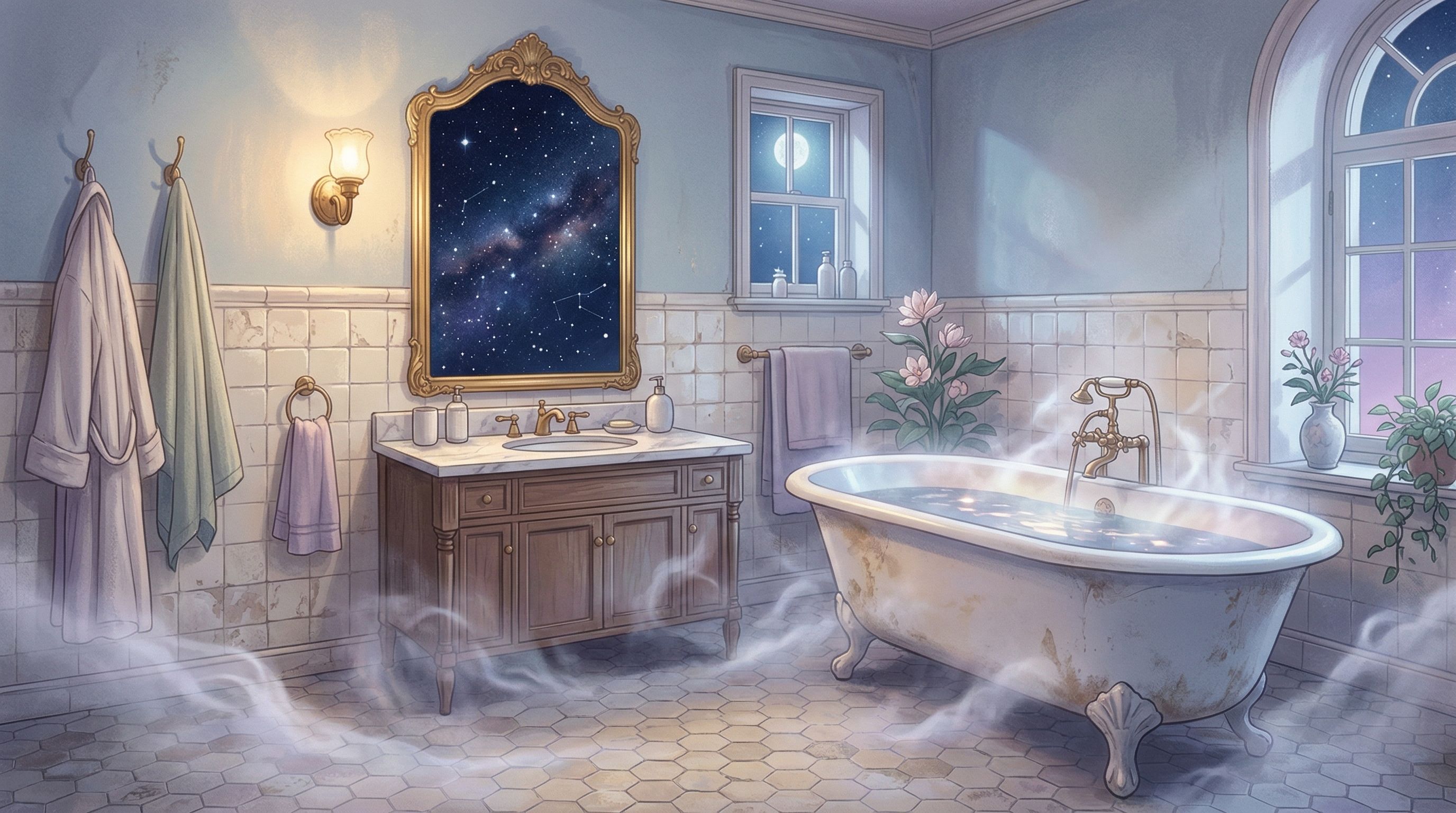
The Great Release: When Your Soul Needs to Make Space
I am often asked why the mind chooses such a functional, almost crude setting for its messages. The answer is disarmingly simple: your subconscious loves organic metaphors.
Just as your body must expel what it has processed to remain healthy, your psyche requires a regular release. To dream of a toilet is to witness an internal cleaning operation in real-time.
Psychologists often suggest that these images appear when you are carrying an emotional weight that has reached its "expiration date." It is an act of purification, a sacred sorting process where you decide what to keep and what to cast away.
🌙 The Echo of Yume : The soul has its own plumbing; sometimes, it just needs to breathe to find its clarity again.
---
Concrete Example: The Palace of Heavy Secrets
I once encountered a dreamer who visited a vast, golden palace every night. Despite the luxury, she was exhausted because she spent her entire dream searching for a bathroom. Every door she opened revealed a toilet that was either occupied, broken, or missing a wall.
In our dialogue through the veils of sleep, it became clear that she was the "confidante" for her entire family. She was carrying everyone else's burdens but had no place to set down her own. Her mind wasn't obsessed with the bathroom; it was screaming for a private space to process her own exhaustion.
Once she began setting boundaries in her waking life, the palace dreams stopped, replaced by the expansive peace of stars.
---
Intimacy Laid Bare: The Case of the Missing Doors
This is perhaps the scenario that touches me most because of its inherent fragility. You find yourself in a bathroom in a public place, or perhaps you realize the walls are made of glass while a crowd passes by.
This isn't just about release; it is about your intimacy. Some specialists suggest this dream arises when you feel the outside world is encroaching on your secret garden.
Are you forcing yourself to be transparent with people who haven't earned that right? Do you fear that someone will discover a part of you that you judge as "unacceptable"?
There is a form of brutal poetry in this forced exposure. Your subconscious is asking you: "Where are your boundaries?" If you cannot close the door in your dream, it might be time to learn to say "no" in your waking life to rebuild the walls of your private sanctuary.
---
When the Flow Stops: The Symbolism of Clogged Toilets
I sometimes observe dreams where the water overflows or the space is repulsively dirty. While unpleasant, these images are vital messengers.
What is a blocked pipe, if not a refusal to let life circulate? This symbol often points toward a fear of losing control or an accumulation of small daily slights that you have "swallowed" without a word.
A dream of a dirty toilet isn't a condemnation; it is a mental health check-up. Your reservoir is full, and it is time to process what has been stagnating.
If you feel like your nights have become a confusing maze of obstacles, you might also find resonance in labyrinths.
---
Navigating Your Inner Ecology
Dreams of toilets are whispers of your "inner ecology." They never seek to humiliate you, but rather to free you from the superfluous.
If these nocturnal visions return to haunt you, do not see them as a threat. See them as an invitation to a grand spring cleaning of the soul.
By acknowledging the buildup of emotions in your waking hours, you allow the dream to change, letting the water become clear once again.
If you want to explore these symbols more deeply and turn these strange scenes into a path for self-discovery, your Baku is waiting for you.
Have you ever noticed the sensory reality of these dreams? The cold touch of tiles under bare feet, the sterile light, the panic of physical urgency. Sometimes, this dream is a playful trickster. Your body has a simple, physical need, but your mind, wanting to protect your deep slumber, constructs an elaborate obstacle course to keep you asleep. It is a fascinating biological compromise. But if we look closer, that physical tension often mirrors a waking contraction. You are holding your breath in your daily life, bracing yourself against change, and your muscles remember what your conscious mind tries to forget. It reminds me of the profound vulnerability of finding a safe, warm place to rest when your body is carrying too much unspoken tension.
It honestly saddens me when modern interpretations treat these dreams with nothing but disgust. In older, wiser traditions, nothing is wasted; what is discarded by the body is seen as the vital gold of the earth. Taoist philosophy often reminds us that decay is the very cradle of life. When you dream of these functional spaces, you are not merely looking at waste; you are looking at potential fertilizer. The heavy betrayals, the silent griefs, the exhaustion you are finally ready to let go of—they are not meant to be erased as if they never existed. They are meant to decompose, to turn into the rich, dark soil of your psyche. It is a slow, sacred alchemy. Your painful memories are not stains; they are the compost from which your future resilience grows.
I often see this dream occur during intense creative transitions. A writer or a painter will come to me, frustrated by a sudden blockage in their work, only to reveal they spent their nights unclogging old pipes. There is a profound parallel here. When you cannot create, it is rarely a lack of inspiration; more often, it is a congestion of old ideas and unexpressed grief blocking the channel. You cannot invite new, vibrant energy into your inner secret garden if the old, stagnant waters have nowhere to go. The block in your dream is simply a visual representation of your creative flow waiting for a release. Once you allow yourself to discard the expectations of others, the channels clear, and the creative current rushes back, wild and clean.
I must admit, I get quite tired of those rigid, old dream dictionaries that insist dreaming of toilets or waste simply means "financial wealth is coming." It is such a lazy shortcut, a way to bypass the actual emotional work your soul is asking of you. I once met a dreamer who clung to this belief, hoping his recurring nightmares of overflowing water meant a promotion was near. In truth, he was drowning in a toxic partnership, refusing to see how much of his own dignity he was swallowing daily. The dream was not a lottery ticket; it was a mirror of his self-betrayal. We must have the courage to look past these easy definitions and listen to the specific, sometimes uncomfortable, poetry of our own nights.