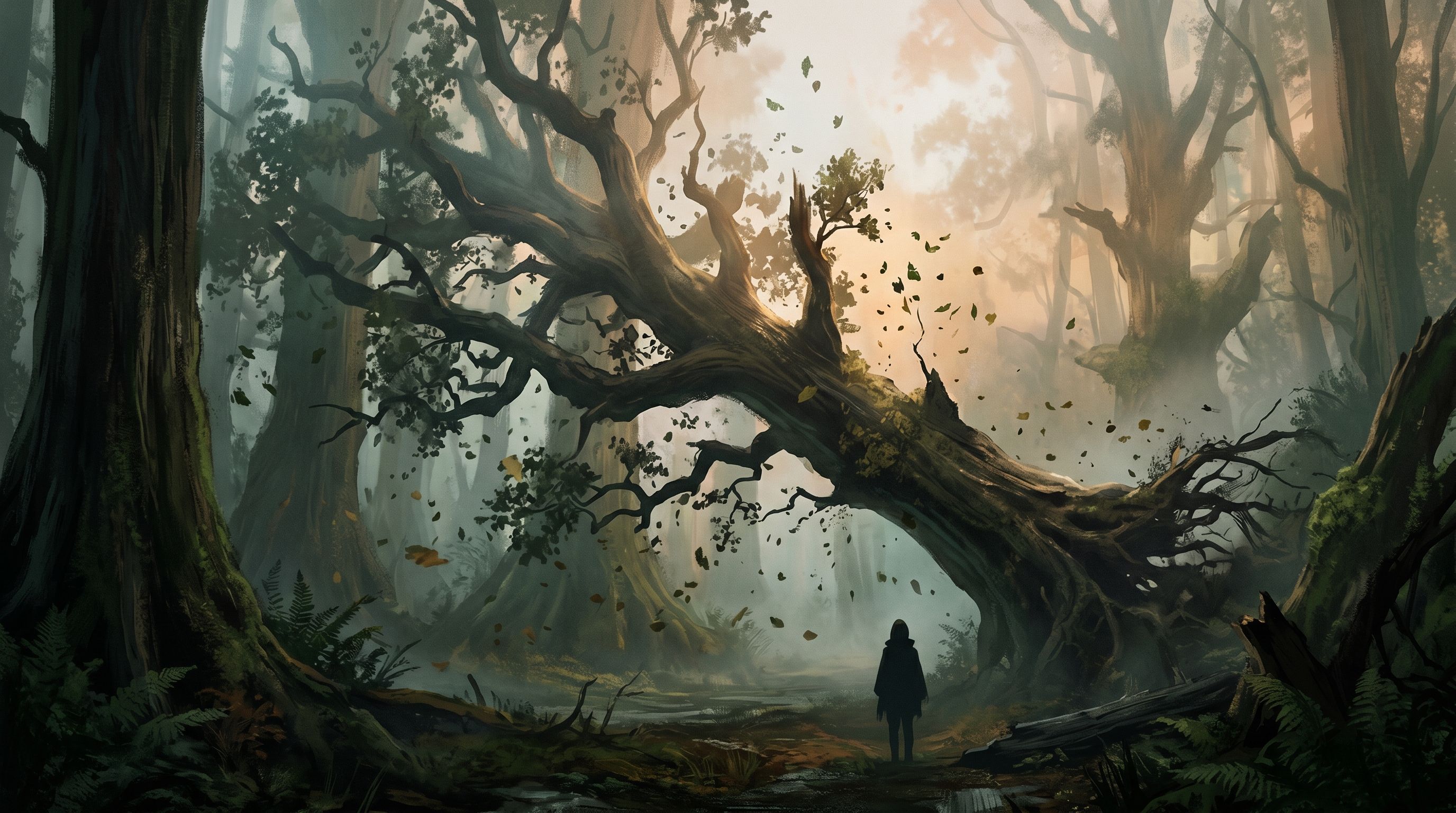
There’s a strange sensation that comes with a gentle descent or simply walking down a flight of stairs in a dream—that suspended moment where the ground seems to drop away, pulling you downward. Honestly, it exhausts me to see cheap dream dictionaries immediately scream "bad omen" or "impending failure" the moment movement toward the floor is mentioned. Let's set the record straight: going down is far from a catastrophe. As a Baku, I've tasted thousands of these nocturnal descents, and I can assure you they often hide the richest journeys of all. In this article, we’ll explore why your mind chooses to take the elevator in reverse, what this famous regression really means, and how to turn this dive into your subconscious into an ally for your waking life.
---
When the Surface Wears You Out and You Go Looking for the Cellar
We spend our entire lives trying to climb. We scale career ladders, step onto stages, and chase the peaks. So when your mind suddenly decides to head downward—whether via an endless staircase, an old well, or a steep mountain trail—it’s often a gentle warning signal. The surface has simply become too loud.
I remember a dreamer who crossed my path just last week: he spent his nights descending stone steps, terrified of reaching a pitch-black room. But the dark isn't empty; it's simply quiet. Going down means agreeing to take off the social mask you wear all day to rediscover the foundations of your inner house. It’s a homecoming, much like investigating that strange scratching noise behind your walls to finally figure out where the echo is coming from.
---
Regression Isn't Failure; It’s an Archaeological Dig
The word "regression" sounds scary. We instantly think of sliding backward, returning to a vulnerable childhood, or losing control. Yet, I tend to see things quite differently. If your psyche is making you go down, it’s because you need to sort through the basement of your history.
Think of it like a nocturnal archaeological dig. The deepest layers of our psyche hold our old memories, unresolved grief, and also our most wild and authentic resources. Don't run away from this descent. If you catch yourself slipping down slopes or sinking underground, ask yourself which part of you is quietly asking for a little attention in the peace of the depths.
Have you ever noticed how the air changes when you descend in a dream? It’s rarely a neutral transition. Often, the temperature drops, the light turns a bruised, twilight blue, and your limbs begin to feel heavy, as if you’re moving through honey. I’ve always been fascinated by this shift in gravity. Your waking body is lying perfectly still on a soft mattress, yet your spirit experiences the immense, crushing pressure of the deep. This sensory weight isn't a punishment; it’s your mind’s way of forcing you to slow down. When the dream-world thickens around you, it demands your full presence. You cannot rush through the deep layers of your mind. Sometimes, this descent requires a vessel, a protective shell that allows you to breathe where the pressure should overwhelm you—almost like boarding a quiet submarine to explore trenches you normally avoid during the sunlit hours. Listen to that pressure; it’s telling you to stop running.
I must admit, it irritates me when modern psychologists treat the descent as a purely negative state of depression or regression. They miss the poetry of the dark. In my long journeys through human nights, I’ve learned that going down is the only way to meet the parts of ourselves we’ve exiled. Jung called it the descent into the unconscious, the necessary journey to look at your own shadow in the eye. You cannot integrate what you refuse to visit. If you dream of walking down into a dark, dusty cellar, you aren't being threatened; you are being invited to dinner by your forgotten traits. Your anger, your wild creativity, your abandoned desires—they are all waiting down there, sitting on old crates, wondering when you’ll finally come down to play. To go down is to become whole again.
I once met a dreamer, a brilliant woman who had just walked away from a highly successful but soul-crushing career. Every night for a month, she dreamed she was slowly descending a rusty spiral staircase that seemed to have no end. She woke up exhausted, convinced she was ruinously sliding backward in life. "Yume," she whispered in her sleep, "why am I falling?" But she wasn't falling. She was incubating. When we go through massive life transitions—a divorce, a career change, or the quiet grief of losing a former version of ourselves—we need a fallow period. You cannot plant new seeds on a mountain peak where the wind sweeps everything away. You need the rich, damp, dark soil of the valley. Her descent was simply her soul demanding a sacred pause before the next climb.
Ancient cultures understood this journey infinitely better than we do today. They spoke of katabasis—the ritual descent into the underworld to retrieve a truth, a lost love, or a divine spark. Think of Ishtar shedding her jewels at each of the seven gates of the underworld, or Orpheus searching the shadows. They didn't view going down as a defeat; they saw it as the ultimate initiation. When your dream pulls you downward, you are participating in this timeless myth. You are the hero traveling to the roots of the world to find what has been lost. It takes immense courage to walk down when everyone else is scrambling to climb. The next time you find yourself stepping downward into the dark, don't look back up. Take a deep breath, trust the ground beneath your spectral feet, and see what treasure is waiting at the bottom.
Does this symbol spark your curiosity, and would you like to map out your own nocturnal descents? Come add it to your personal collection and explore the geography of your nights over on the Midnight Mind app.
---