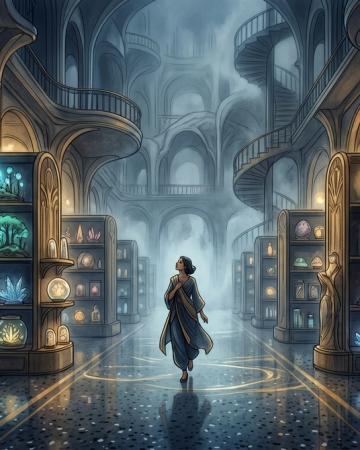

A place where nobody advises you, where everything is shelved, labeled and lit the same way at any hour: the supermarket is a recent invention. The first of its kind, King Kullen, opened in August 1930 in a former garage in Queens, New York. France had to wait until 1948 for its first self-service store, and 1963 for its first Carrefour hypermarket. Neither Artemidorus nor Ibn Sirin ever set foot in one, so the old readings will only take you halfway. Here, what you do in the aisles and what you feel there speak louder than any dream dictionary.
What makes a supermarket so particular in a dream?
It's a place where you choose alone, from a lot, in front of strangers. A supermarket dream is almost always about choice, need and price.
Honestly, I find real supermarkets pretty tiring: the plastic, the background noise, the constant nudge to want more than you need. The dream keeps that setting and puts it to work on a simple question: what do I take, what do I leave? The supermarket's ancestors, though, are very old: the Greek agora, the souk. They help you think about a supermarket without describing one. On the agora, people talked, haggled and ran into neighbors; in a supermarket, you choose in silence in front of price tags. If your dream leans on that silence, you'll find below what it may be saying. And if your scene is set in an open-air market instead, with voices and smells, that's a different entry: dreaming of a market.
Why do you get lost in the aisles, or can't find what you're looking for?
The dream stages an overload of options. Wandering between the shelves often reads as the fatigue of a decision you can't make.
Psychologists have a name for it, the "paradox of choice," popularized by Barry Schwartz in a 2004 book. The best-known example is the jam experiment by Iyengar and Lepper (2000): in front of 24 jars, about 3% of passersby bought one; in front of 6 jars, about 30% did. Stay cautious, though, because a 2010 analysis pooling 50 experiments found an average effect close to zero. Too much choice freezes some people, in some situations, and not everyone. So I keep the idea as a lead: if you recognize yourself in that analysis paralysis, the dream makes it visible.
The detail of the search matters. Looking for one specific product and not finding it points to a need you know about but can't reach. Not knowing what you're looking for points more to a want that has no name yet. Ask yourself in which area of your life you keep circling the options without picking one. And if the aisles start looping back on themselves, the entry on dreaming of labyrinths goes further on that theme.
What do the contents of the cart say?
It shows what you're carrying right now. A full cart speaks of abundance or overload, an empty one of lack, and one too heavy to push of a load you didn't choose.
When it's overflowing, look at what's in it. Items piled in out of reflex, things you don't need, can speak of a void filled with whatever is easy to grab. An almost empty cart, on the other hand, often feels like arriving with no resources, or not wanting much of anything. The cart that weighs a ton and keeps pulling to one side says something else: you're moving forward, but an obligation drags you off course every yard. Ask yourself what's in there that you didn't choose.
The exact contents matter too. Ordinary food speaks of basic needs; objects that have no business being there (a toy, an old photo) speak of memories you're trying to take back, and they are covered in the FAQ below.
What does it mean to reach the checkout and not be able to pay?
The checkout is the moment the dream talks about what your choices cost you. Not being able to pay often points to a fear of not deserving what you want, or of not having the means to follow through.
A declined card, an empty wallet, money that isn't accepted: these are variations on one scene, and the dream rarely says anything about your bank account. If shame rises under the eyes of the other customers, the question is "who is judging?" more than "how much does it cost?" For the card scene, the entry on dreaming of a bank card goes into detail.
The line that won't move speaks of impatience. If you get irritated by how slowly other customers go, ask yourself whether they are holding back a project of yours, or whether you want everything, right now. On the other hand, getting through the checkout easily, setting down your items and walking out, usually reads as a calm dream: you own what you chose.
A huge, unfamiliar or foreign supermarket: what does the place change?
The more familiar the store, the more the dream speaks of routine; the bigger and stranger it is, the more it speaks of new ground where you don't have your bearings yet.
Imagine you push open the door of your neighborhood supermarket, the one where you know every aisle, and you get lost anyway. The dream is taking a safe setting to show that something in a habit you thought was solid no longer holds. On the other hand, an endless warehouse where nobody speaks your language and the labels are unreadable often points to a recent change: a move, a new job, a relationship just starting. You don't know where things are yet, and the dream says so in its own way.
I'm a little wary of readings that sound too sure of themselves here: a big store can also be just the echo of a week of forgotten errands. What points the way is what you feel: curiosity in front of the unknown leans toward a wish for something new, anxiety toward a change that was imposed rather than chosen.
What do the white light, the freezer hum and the crowd say?
The setting can be the message. Harsh light that erases shadows, the hum of freezers and identical shelves often say you're running on autopilot.
In a dream, this setting without shadow or season can feel like floating above the tile, with nothing touching you. If you feel numb, you may be getting through the week by putting your emotions on pause so you don't go under. There's nothing shameful in that, but frozen food doesn't warm anyone for long. A calm, bright supermarket can be restful instead: everything is in its place, nothing asks anything of you. Same setting, two feelings, and the feeling is what settles it.
If it's packed, the logic is close to that of a crowd in a dream: other people's eyes weigh on what you put in your cart. If it's part of a larger complex, the entry on dreaming of a shopping mall widens the setting. And if the scene ends in the parking lot, looking for your car, go to dreaming of a parking lot.
What should you do with a supermarket dream when you wake up?
Make the dream's shopping list, then cross off whatever you didn't need.
Note what was in the cart and what you were looking for. For each item, one question: do I really need this, or am I taking it because everyone does? Often a single item stands out from the list, and that's the one the dream is showing you. If a real choice is waiting in your waking life, make it small: two options, one day to decide. An imperfect choice that gets made costs less than ten possibilities left open.
If dreams like this leave you heavy for days, or come with a tiredness that lingers, tell someone you trust, or a health professional if it lasts. And if the same store keeps coming back, note in Midnight Mind what you were looking for each time: Yume gives you a free reading of each dream, and you'll see whether it's always the same aisle waiting for you.