

Picture a line growing behind you, a terminal that beeps, and the word "declined" popping up even though you had more than enough to cover the bill. Nobody says a word. Everybody looks. You wake up with your hand still held out. Bank card dreams sting in a very particular way: an ordinary gesture, an everyday object, a flat verdict. Let's see what the card stands for, and what each snag (a refusal, a loss, a forgotten PIN) can hint at.
What does it mean to dream of a bank card?
Dreaming of a bank card is less about your money than about your access: to what you want, to your share, to the right to help yourself.
A card holds nothing you can see: no bills, no weight, no shine. It works because a system somewhere accepts your name. That makes it a good picture of trust, in both directions: the trust others place in you, and the trust you place in yourself. When the card goes through without a sound, the dream often leaves a feeling of permission, as if you could take what's within reach. When it catches, it shows where you doubt you're entitled.
Two readings come up. In the first, the card is a resource: what you know how to do, what you've been trusted with, the credibility you've built. In the second, it's a dependence: everything hangs on a little plastic rectangle that can be taken away, and the dream acts out the fear of being left with nothing without it. To choose between them, notice what you felt as you held the card out, before you knew whether it would work: ease, or a flicker of dread. In my view, that first moment tells you more than how the scene ends.
Why does a declined payment feel so humiliating in a dream?
Because the refusal is public and comes with no explanation: the terminal turns down your name in front of people, and no one says why.
That missing reason leaves room for the worst one: "I'm not up to this." To read the scene, look at three details. First, who is watching: strangers point to a general fear of being judged, while a coworker, a relative, or an ex points to one particular relationship. Second, what you were trying to buy: a book, a train ticket, or a meal for other people each name a very different area of life (learning, leaving, giving). Third, how you reacted: apologizing, insisting, pulling out another card, or walking away without a word make for different dreams.
Ask yourself one question: what request lately have you felt you couldn't live up to? A job, someone's expectation, a promise you made to yourself. The dream is aimed at that request. If you've just had a real payment turned down, or a tight month, it may simply have replayed it; in that case it's telling you you're tired, and nothing more.
Why does losing a bank card, or having it stolen, feel so unsettling?
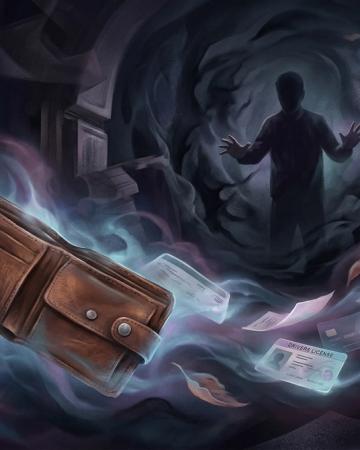
Losing a card points to feeling cut off from your means; having it stolen adds that someone else is benefiting.
A loss dream is often a search dream: a bottomless bag, pockets emptying out, hands moving faster and faster. Notice where the search takes place. At home, the question is personal: what part of myself can't I find anymore? In a place people pass through (a station, an airport, a hallway), it's more about a transition. If you do find the card in the end, note where it was: the answer often shows what you thought you'd lost and had only put away. For the whole wallet, see dreaming of losing your wallet.
Theft changes the scene. Someone takes your card and walks off, or uses it in your place. Ask yourself what that person's face looks like. When it's someone you know, the dream sometimes points to a relationship that costs you more than it returns, or where someone takes credit for your work. I'd stay cautious: the thief in the dream can also be a part of you that spends your energy without asking. The thief wears many faces in dreams, and this is one of them.
What does a forgotten PIN reveal?
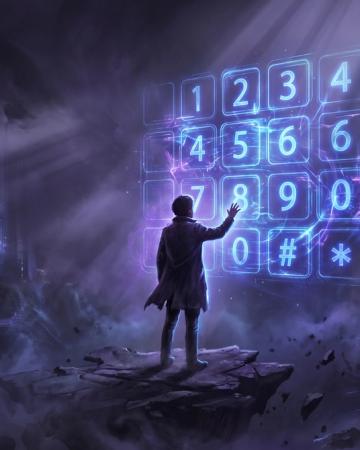
A forgotten PIN means holding the card and not being able to use it: the resource is there, the access isn't.
The detail is modern. The first cash machine opened in London in June 1967, and its code was meant to have six digits. Its inventor, John Shepherd-Barron, cut it to four when his wife told him she couldn't remember more than that. That's the story Barclays tells in its own archives. So blanking in front of the keypad is as old as the machine.
In the dream, the numbers blur, the keys fade or shift around, and every wrong try tightens your throat a little more. I read the scene as a question: what do you know, what do you have in hand, that you can't seem to use? A talent, an answer you already have, a conversation you keep putting off. It can happen when everything is in place on paper and something is still holding you back. A forgotten password explores the same idea of access; and if, after three tries, the machine keeps your card, you'll find that scene in the variations below.
What should you do with a declined-payment dream that keeps coming back?
Let it tell you what's still unresolved, without treating it as a bad omen.
A recurring dream keeps its setting but can change in the details: the line is longer, the person behind you is different, the total has gone up, this time you thought of a second card. Those shifts show where the situation feeding it stands. A dream that returns before a specific deadline (an interview, an exam, a request you need to make) is most often replaying the nerves of that deadline. A dream that returns for no obvious reason invites you to look at what you've been putting off: an answer to give, time or words you owe someone.
Write it down every morning for a week, without interpreting it. After a few days, what repeats jumps out. If it's wearing you out or waking you every night, bring it to a friend or a health professional: damaged sleep deserves attention in its own right.
What did people say about money in dreams before cards?
Nothing about the card itself, obviously; but the ancients already had opinions about dreamed money, and they're less flattering than you'd think.
In the second century, Artemidorus devotes a chapter to money. In his book, small bronze coins bring annoyances and quarrels, silver coins haggling over contracts, and gold the same haggling with higher stakes. And it's better to dream of a little than a lot: a big sum weighs you down, and it points to worries. There's no promise of fortune in any of it: for him, dreamed money is first of all a nuisance. He talks about coins, never a balance, and he always judges by the dreamer's own life.
I don't know of any entry on the bank card in the sources I can cite, not in Artemidorus, not in the dream books that bear Ibn Sirin's name, not in the Chinese collections. I'd rather tell you that than invent an ancient pedigree. That leaves Jung: his idea of the persona, the social mask that gets you recognized, offers a way to read an object that carries your name and gets you accepted in exchanges (see the traditions below).
Does a bank card dream say anything about your actual account?
Rarely in any direct way: nothing in a dream lets you predict a gain, a loss, or the state of your finances.
I don't read a dream like a bank statement, and I wouldn't hand it any money decision. What the card shows is your relationship with money: feeling at ease with it, dreading running short, being ashamed to ask, feeling in debt without knowing to whom. Those feelings exist even when the budget holds. And if you're going through a tight stretch, your sleep may simply pick up the day's worry without announcing anything. For the inner side of money, dreaming of money and dreaming of a bank go further.
If that worry is real and weighs on you, take it to a friend, a relative, or your banker; the dream has no answer to give it.
Here's the gesture I'd suggest: before you get up, write down three things: what the terminal showed, who was there, and what you felt in your chest or your hands. Then ask yourself one question: where are you waiting, right now, for someone to accept you before you let yourself take what's yours? If you'd like to look at the dream again with its details (the line, what you were trying to buy, how the cashier reacted), describe it to me in Midnight Mind and I'll answer from your own account.