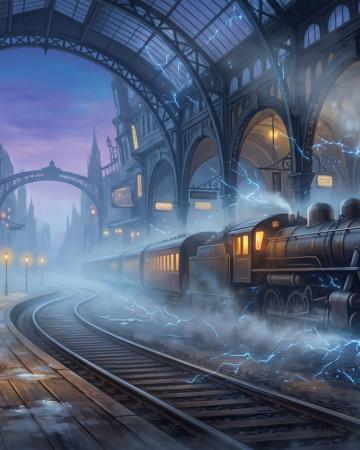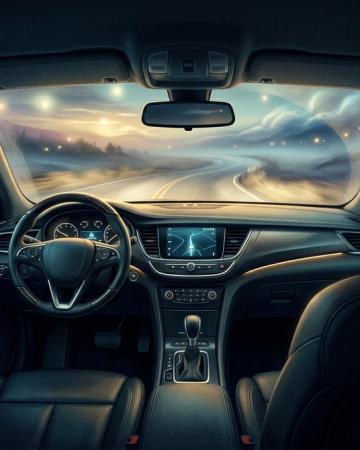


Picture level B2 of a parking garage: one fluorescent tube buzzing, numbered pillars you stopped reading a while ago, the engine off. Somewhere a car door slams. You can't quite tell whether you just arrived or are about to leave. Dreams about parking lots and garages tend to leave that suspended feeling, a little cold and sometimes surprisingly restful. Here is what the setting usually says, and the details that separate a pause from a dead end.
Why dream about a parking lot, a place where nobody stays?
Because a parking lot is built to be passed through: you pull in, leave the car, and go on your way. The dream turns it into an image of a stage in between, somewhere between what you've left and what you haven't reached yet.
It's a recent setting, and I'd rather say so plainly: no ancient dream text mentions parking, because the place didn't exist. I won't invent an Artemidorus or an Ibn Sirin passage for you. Two serious ideas about places of transit do help read the scene, though.
The first comes from the ethnographer Arnold van Gennep. In The Rites of Passage (1909), he describes every change of status in three steps: you separate from your old situation, you spend a while in the margin, and then you're taken back in. The word "liminal," which you'll often see in writing about dreams, names that middle step and comes from the Latin limen, a threshold. A parking lot is almost a caricature of it: you don't live there, you wait there for what comes next.
The second idea belongs to the anthropologist Marc Augé, who coined the term "non-places" (1992) for transit spaces where you stay anonymous, such as airports, highways, and shopping malls. I'd put the parking lot in the same family, though that's my own grouping, not a quote from Augé. In a dream, that anonymity can feel like relief (nobody asks anything of you) or like worry (nobody knows you). The next question is where the difference shows.
Is the concrete silence a refuge or a dead end?
It depends on what you feel, and on one simple question: did you want to leave? If not, the parking lot is shelter. If you did and nothing let you, it's a dead end.
When the dream is calm, with soft light, cool air, and your car neatly parked, it reads as a pause you needed, whether you gave it to yourself or life handed it over. Few days leave a spot where you have nothing to produce and nothing to decide, and the gray concrete in your dream supplies one. If you wake up rested, I wouldn't look any further: keep that pause.
When it's heavy, with aisles that repeat, one level too many, and an exit that keeps slipping away, the waiting is something you're enduring. The parking lot then describes a stretch of time that drags on without your knowing why you're in it, like being stuck in neutral. I'm wary of readings that always see failure here: a parking lot can also be time you took on purpose, and your feeling decides, not the scenery.
One last clue: do you know what you're waiting for? If someone is due to arrive in the dream, or something is about to happen, the pause has a purpose. If you can't say why you're there, ask yourself instead what you're avoiding deciding right now.
Why can't you find your car in a parking lot?
Most often, a wobble about your place or your role, one that arrives during a change. The car is what moves you forward and presents you to others, so losing it among a hundred look-alikes means no longer knowing which one is yours.
A Jungian reading goes through the persona, Jung's name for the face we show the world, "a kind of mask" that shapes how others see you. You choose your car, you show yourself in it, it carries you around: it makes a good image for that face. The idea of the persona is Jung's; linking it to the car is a modern comparison that I'm offering as a lead. For the vehicle itself, the page on dreaming of cars goes into what it stands for.
This scene tends to come back when your bearings shift: a new job, a divorce, a new city, a child leaving home. The old role doesn't quite fit anymore, and the new one hasn't been parked anywhere yet. Instead of looking for the old car, it can help to ask which one you'd like to drive.
Watch your own moves in the dream. You press the key fob to flash the lights, you ask for directions, you remember the level: you have resources, and the dream is showing them. You end up leaving on foot, or giving up: part of you may be ready to leave the old role without getting it back. And if the car you find isn't quite yours, note what's different, since that often hints at what is changing.
Why is it so hard to find a space, or to park, in a dream?
Because the dream stages a question of place: where yours is, who leaves it for you, who takes it from you.
Circling a full lot while frustration builds with every aisle often reads as a feeling that there's no room left for you in a crowded setting: a team, an industry, a circle of friends. The dream sometimes suggests looking elsewhere instead of waiting for the last open space, as if the right spot existed in another setting.
Botching the parallel parking, starting over, feeling other drivers watching: it often reflects a fear of getting it wrong in public. Parking crooked points to a place you occupy without being sure you're entitled to it. Being boxed in by a badly parked car means a decision that depends on someone else. And circling for a long time while the clock runs feels a lot like being late for your own life.
Ask yourself which space you're looking for: the closest to the entrance, the easiest, or the one where you'd feel good? In the dream, your answer changes how you circle.
Does it matter if it's an airport, a hospital, or a supermarket lot?
Yes, because the place says what you're waiting for: you don't park in the same spot to leave on a trip, to get treated, or to buy groceries.
The lot of an airport prepares a departure. You leave your car, which is to say your everyday life, for a while. If you feel at ease there, you may already have organized your transition; if you worry about not finding the car when you return, you're wondering what will be left of your life by then.
A hospital lot speaks of waiting tied to the body, to health, to someone close. If the dream keeps coming while a loved one is sick or you're waiting on results, it is first about that wait and the worry that comes with it. Worry like that can be shared: talk to someone, without waiting for the dream to stop.
A supermarket lot brings you back to daily life: what you need, what you carry home. It's a low-stakes lot that questions your pace more than your future. A lot at work or at your building speaks of the place you leave from each day: notice whether you park there gladly or hesitate to get out of the car.
What should you do with a parking lot dream when you wake up?
Name the stage you're in, then ask whether you chose to be there. Those two questions are usually enough to tell whether the dream was about a rest or a dead end.
Write one line: "I'm between _ and _." You often already know the two missing words. If the dream was peaceful, give yourself a real stop this week, with no goal and no screen. If it left you stuck, pick one pending thing, a call, a form, an answer, and settle it: a gate lifts more easily once you've paid. If you've felt stuck in your waking life for a long time, talk to a loved one or a therapist: a dream can show the dead end, but it can't replace support.
If you want a reading built from your own dream's details, describe it in the Midnight Mind app: I'll look at the level, the light, the car, and your mood on waking, and you'll see whether the parking lot returns night after night.