

The word "hospital" comes from the Latin hospes, which means host, and it shares that root with "hospitality." At bottom, a hospital is a place where you are received when you can no longer manage alone. Keep that in mind when you wake up: in a dream, the hospital puts you where someone is looking after you, or should be. What's left to work out is who, how, and what you made of it.
Does a hospital dream predict an illness?
No. A dream can't make a diagnosis, and it doesn't predict an illness or a hospital stay. It draws on what you're living through and what worries you, including worries you haven't put into words.
The hospital is one of the few places everyone knows by heart without having chosen it: the waiting, the corridors, the harsh light, the sense that nothing is up to you anymore. When you feel fragile, from exhaustion, grief, or fear for someone, your mind reaches for the matching set. It's also common to dream of one right after visiting a relative who's in the hospital, simply because the images are fresh.
If a pain or a symptom is bothering you during the day, only a doctor can answer that; the dream has no opinion about your body. If the anxiety is still with you when you wake up, remember that the feeling is real even when the dream predicts nothing. Breathe, drink a glass of water, and leave the dream for later. And if illness itself is what fills your dream, that has its own entry: dreaming of illness.
Why does your mind send you to the hospital when everything is fine?
Because it's the one place where you're allowed to stop and be looked after, and part of you would like that permission.
In waking life, you don't lie down to say you're worn out: you need a reason, a fever, a doctor's note. A dream has no such scruples. It dresses you as a patient to talk about a tiredness you won't admit to, a weight you've carried too long, or a wish to be seen as you are, without pretending to be fine.
Which way the meaning leans depends on how you walk in. If you arrive exhausted, the dream probably points to a slowdown you keep putting off. If you arrive for someone else, a worry is looking for a way out. If you let yourself be treated without a fight, a part of you is finally accepting help. To test it, ask yourself one thing: when did you last really ease off, without guilt? If the answer takes a while, you may have found the subject of the dream.
The link between sleeping, dreaming, and being healed is also very old. In the sanctuaries of Asclepius, the Greek god of medicine, the sick slept on site and told their dreams to a priest, who prescribed a remedy, often baths. At Epidaurus, the best known, there was even lodging for pilgrims. I won't claim your dream hospital descends from those temples, but the idea that you can visit a place of healing in your sleep is not new.
Patient, visitor, or caregiver: what does your role change?
A lot, because it shows which side of the bed you're on in your life right now.
- Patient. Notice how you take the care. If you go along with it, part of you accepts the help being offered. Imagine you pull out the IV or demand to be discharged: the dream is then showing what it costs you to depend on anyone, even for a while.
- Admitted, in bed. The stop is forced on you, and what you feel in that bed gives the direction. Anger means the part of you that wants to run everything is protesting; a relief you're almost ashamed of means you were probably waiting for permission to stop.
- Visitor. You're worried about someone, or dreading a separation. If the person really is sick, the dream is first replaying that worry.
- Caregiver. Doctor, nurse, or just someone in scrubs: you may be carrying other people's well-being, sometimes with a wish to keep everything under control. The doctor has an entry of their own: dreaming of a doctor.
If your role changes partway through the dream, note when. That is often where the thing you're struggling to tell yourself sits.
What does it mean to wander hospital corridors without finding the exit?
Usually that you sense something needs care or understanding and you don't know where to start.
Picture hallways that all look alike, doors without numbers, a reception desk you can't find. That setting captures the disorientation of someone who suspects there's a matter to deal with but hasn't named it yet. Think back to what you were after in the dream: a department, a person, an answer. That is often the key word. If you sit in a room for a long time and nobody comes, you're closer to the waiting room, and if the passages themselves hold you, dreaming of a hallway goes further.
As for the exit, you don't always want it. Imagine you sign your discharge papers and anxiety rises: the dream may simply be saying that you don't feel ready to go back to the pace you had before. I find that more useful than any "happy ending" someone might hand you.
Operating room, ER, ambulance: is the dream more serious?
It's more intense, but it doesn't get any more medical: these scenes are mostly about the fear of losing control or of not measuring up.
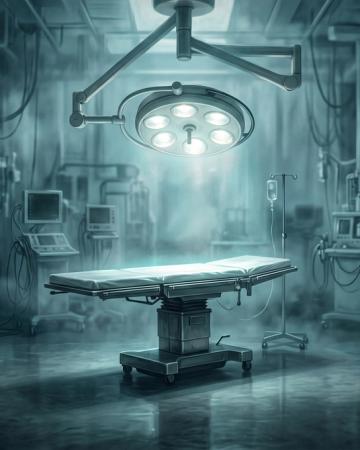
An emergency room triages, because not everything gets treated at once. If your dream is all sirens and gurneys, ask what you're treating right now as a matter of life and death that could wait until tomorrow. On an operating table, the image is forced trust: placing your fragility in someone else's hands. Both scenes have an entry of their own, dreaming of an ambulance and dreaming of an operating room. Here I'll only note that the hospital is the frame around them.
What do the white light, the smell, and the silence of an empty hospital say?
They set the tone of the dream, and the tone matters more than the props.
The smell of disinfectant, a buzzing fluorescent tube, the cool of a too-white sheet: some people wake up with these sensations still on their skin. A smell brings back a memory faster than an image does, like Proust's madeleine. Work out which visit, birth, or loss that smell belongs to. The dream may be less about hospitals than about that moment.
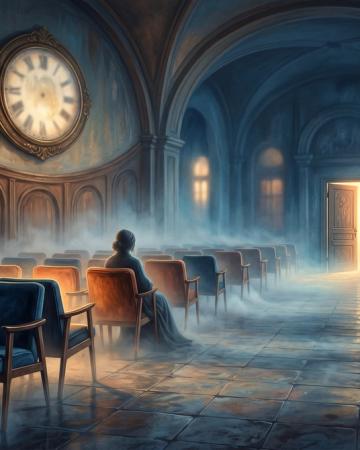
An empty hospital can soothe or unsettle, and how you feel makes the difference. If it's calm, it often says that a stretch of care is behind you. If it's uneasy, with nobody there to receive you, it points to support that's missing right now. The silence deserves a moment of its own: no noise of everyday life, no demands. That calm may be the whole remedy of the dream, a moment when nobody expects anything from you.
What if the dream keeps coming back after a hospital stay or a loss?
Then it is probably replaying something you lived through, and it needs gentleness before interpretation.
After a stay in the hospital, or after sitting with someone who died there, dreams often return to the rooms, the sounds, the words left unsaid. There's no need to hunt for a symbol at all costs: sometimes a dream is just memory doing its work. What will teach you most is the gap between two nights. Is the room a little less cramped? Does someone come in? Do you finally find the door? Those small differences show whether the grief is moving.
If you keep waking up in a sweat, if the dreams have been coming back for weeks, or come with a sadness that hangs over your days, reach out to someone you trust, your doctor, or a therapist. A dream can put a name on a pain; easing it often takes a listener other than yourself.
This morning, write three lines: your role, what you were hunting for, and how you felt walking in and walking out. Read them again in a week, alongside whatever else was happening that week. Whenever you like, add the dream to Midnight Mind with its setting, your role, and your feelings, and I'll go through it with you, detail by detail.