The labyrinth of shelves: between choice and vertigo
As I sit by your bedside, watching the flickers of your REM sleep, I often see you wandering through these vast, indoor cathedrals of commerce. In the waking world, a store is a place of transaction, but in your mind, it is a map of your potential. Each aisle represents a direction your life could take, a talent you might choose to cultivate, or a facet of your personality you are considering "wearing" for a while.
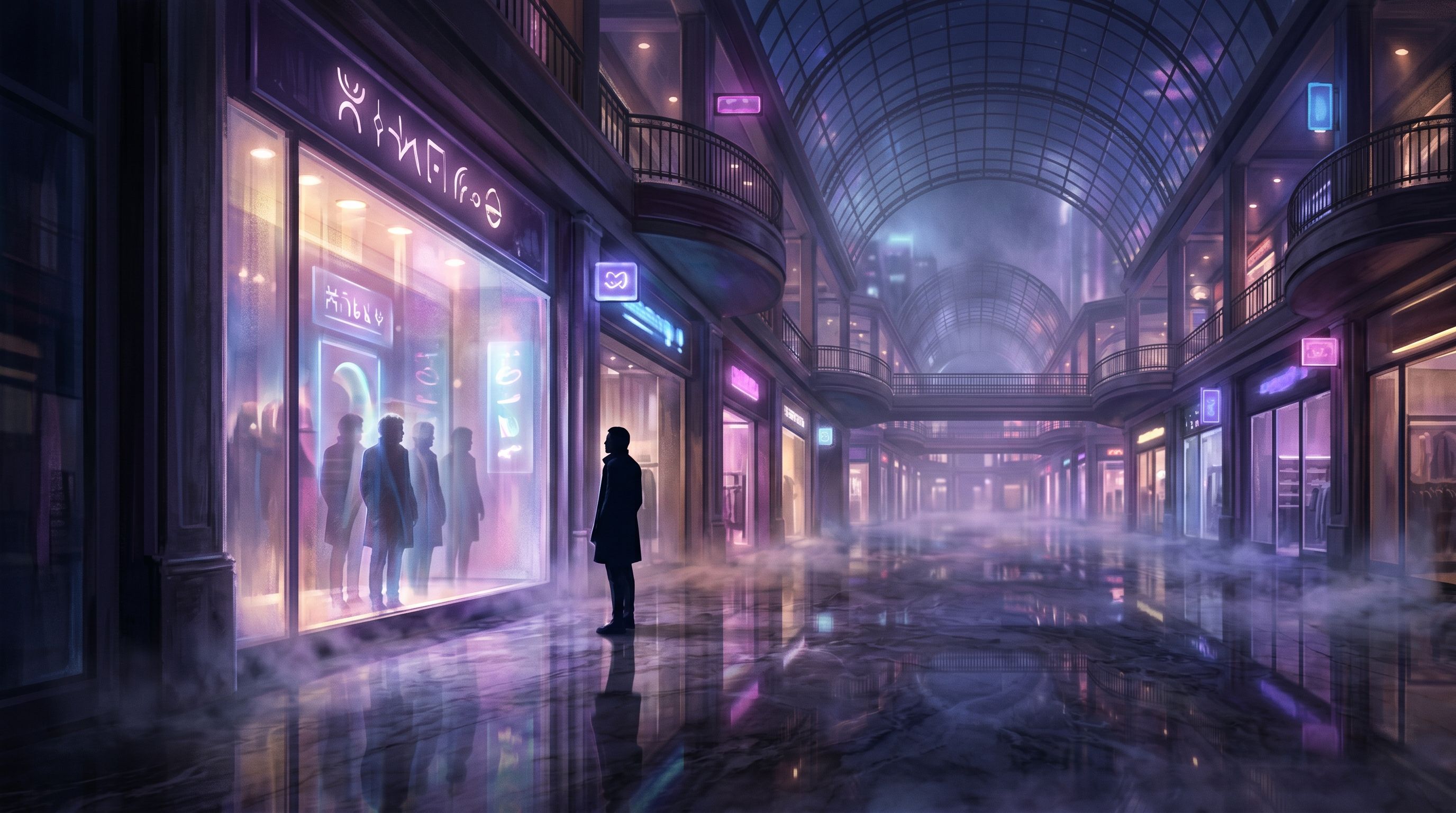
Some specialists in dream psychology suggest that these settings appear when you are at a crossroads. Pausing before a window display or getting lost between well-stocked aisles is a visual metaphor for the "Paradox of Choice." When you have too many options, the fear of making the wrong one can paralyze you. If the store in your dream feels infinite and overwhelming, it might be your subconscious telling you that you are overstimulated by the demands of the outside world.
Honestly, I find it a bit poignant how the modern mind tends to transform our deepest aspirations into merchandise. But please, do not be too hard on yourself: your subconscious is simply using the images it knows—the language of the consumer—to speak to you about your growth. It is like observing the branches of a tree reaching for the light; in your dream, those branches have simply become shelving units.
---
The moment of truth at the checkout line
The aspect that moves me most in these dreams is the moment of the transaction. It is a moment of pure vulnerability. Do you have enough money? Is it the right currency? I have seen dreamers try to pay with old buttons, dried leaves, or even memories. This is a poignantly accurate metaphor for your sense of worthiness.
If you find yourself unable to pay, it rarely relates to your actual bank account. Instead, it often whispers of a feeling of being an impostor. It is as if you haven't yet "earned" the right to access a new version of yourself or the happiness that seems just out of reach. You might be questioning if you have the "currency"—the skills, the time, or the emotional maturity—to sustain the life you want.
Conversely, a totally empty store with dusty shelves breaks my heart when I witness it. It is often a sign of emotional exhaustion, a period where you feel the world has nothing nourishing left to offer you. But remember, in the realm of the mind, emptiness is also a space for creation. An empty store is a place waiting to be reinvented, a blank canvas for your next chapter.
🌙 The Echo of Yume : "A store is just a forest where the trees have been turned into shelves. You are still the wanderer looking for the fruit that will sustain you."
---
What are you trying to take home?
The specific items you seek in your dream store carry immense weight. If you are wandering through a clothing store, you are likely experimenting with a refined identity or testing a new social posture. You are asking yourself: "Who do I want to be seen as?"
If the store is more intimate, perhaps selling items that represent hidden desires, it suggests a search for intimacy or a part of your shadow self that you are finally ready to "own."
- The Grocery Store: Relates to basic sustenance, emotional "food," and how you provide for your fundamental needs.
- The Antique Shop: Represents a search for wisdom in your past or a desire to reclaim a lost part of your history.
- The Toy Store: Often points toward a need to reconnect with playfulness or to heal a specific childhood longing.
I am not a fan of rigid interpretations that say "dreaming of a store means vanity." That is far too reductive. If you are searching for something, you are in a state of quest. You are looking for the missing piece of your internal puzzle.
---
Concrete Example: The Bookstore of Blank Pages
Consider the experience of a dreamer who recently shared a recurring vision with me. She found herself in a magnificent, multi-story bookstore. Every book she pulled from the shelves, however, had completely blank pages. She felt a rising panic, thinking she had lost the ability to read or that knowledge had vanished from the world.
In reality, this dreamer was facing a major career change. The blank books weren't a sign of ignorance, but a representation of her "unwritten" future. Her subconscious was showing her a store full of possibilities (the books) but reminding her that she was the one who had to write the content. The "price" she had to pay was the courage to start from page one. Once she recognized this, the anxiety of the dream transformed into a sense of quiet invitation.
---
Navigating your inner inventory
When you wake up from these nocturnal shopping trips, I invite you to sit with the feeling for a moment before the day rushes in. Do not see these places as temples of materialism, but as museums of your future self.
Ask yourself: "What was the one thing I didn't dare to put in my basket?" The answer is often the key to your next small step toward self-actualization. Your dreams are not there to judge you for your needs, but to show you the incredible richness of your personal inventory.
If you find that your dreams are becoming crowded with these symbols and you wish to understand the patterns they form over time, your Baku is always here to help you sift through the shelves. Exploring these symbols more deeply can turn a confusing night into a clear path forward. If you want to explore your dreams more in depth, your Baku is waiting for you.
Sometimes, dreamers confess to me with a heavy heart that they stole something from the shelves. They wake up feeling guilty, as if their moral compass has shattered in the dark. Frankly, I find these dreams of shoplifting quite beautiful. They rarely point to a hidden criminal instinct. Instead, stealing is often the only way your subconscious knows how to claim what you feel denied of in your waking life. If you have spent years playing the role of the helper, always putting others first, slipping a small shiny object into your dream-pocket is a quiet rebellion. It is your soul saying: I need this, and I cannot wait for permission to have it. It is like crossing a fragile boundary in the dead of night, not to destroy, but to survive.
I once met a dreamer who spent night after night searching the aisles of a dimly lit supermarket for her grandmother’s laugh. She described the hum of the fluorescent lights, the cold draft rising from the freezer section, and the absolute frustration of finding only empty jars labeled with forgotten dates. This is the tragic trap of the dreaming mind: we look for living warmth in places built for cold transactions. When you search a store for something that cannot be packaged—like forgiveness, closure, or a lost love—your mind is wrestling with the finality of change. It is a quiet grief, a realization that some things cannot be acquired, only remembered. If you find yourself in such aisles, look up from the shelves. The treasure you seek is never barcoded; it is already dissolved within the fabric of who you have become.
It honestly tires me to see how modern psychology encourages us to view our inner selves as projects to be continuously upgraded, like a house under perpetual renovation. This constant pressure to "add value" to who you are follows you right into your sleep. Why must we always be consumers of our own souls? Sometimes, walking into a store in your dream is an invitation to practice the art of leaving empty-handed. In ancient philosophies, true abundance is not about filling the basket, but realizing you require nothing on display to be complete. Next time you wander those endless corridors, try to simply look at the items without the urge to possess them. You are not a collection of parts waiting to be purchased or improved; you are the sky holding the entire marketplace, vast and beautifully free.