The Salt of the Road and the Weight of the Anchor
I have a confession to make: I have always held a special affection for dreamers who cross paths with nomads in the vast territories of the night. There is a kind of wild nobility in these images that the modern world often tries to suppress. Sometimes, people come to me and ask: "Yume, does this mean I am going to lose my job, or that my home is in danger?" I must tell you, those literal interpretations are quite wearying to a Baku. Your mind is a poet, not a real estate agent; it speaks in symbols, not in eviction notices.
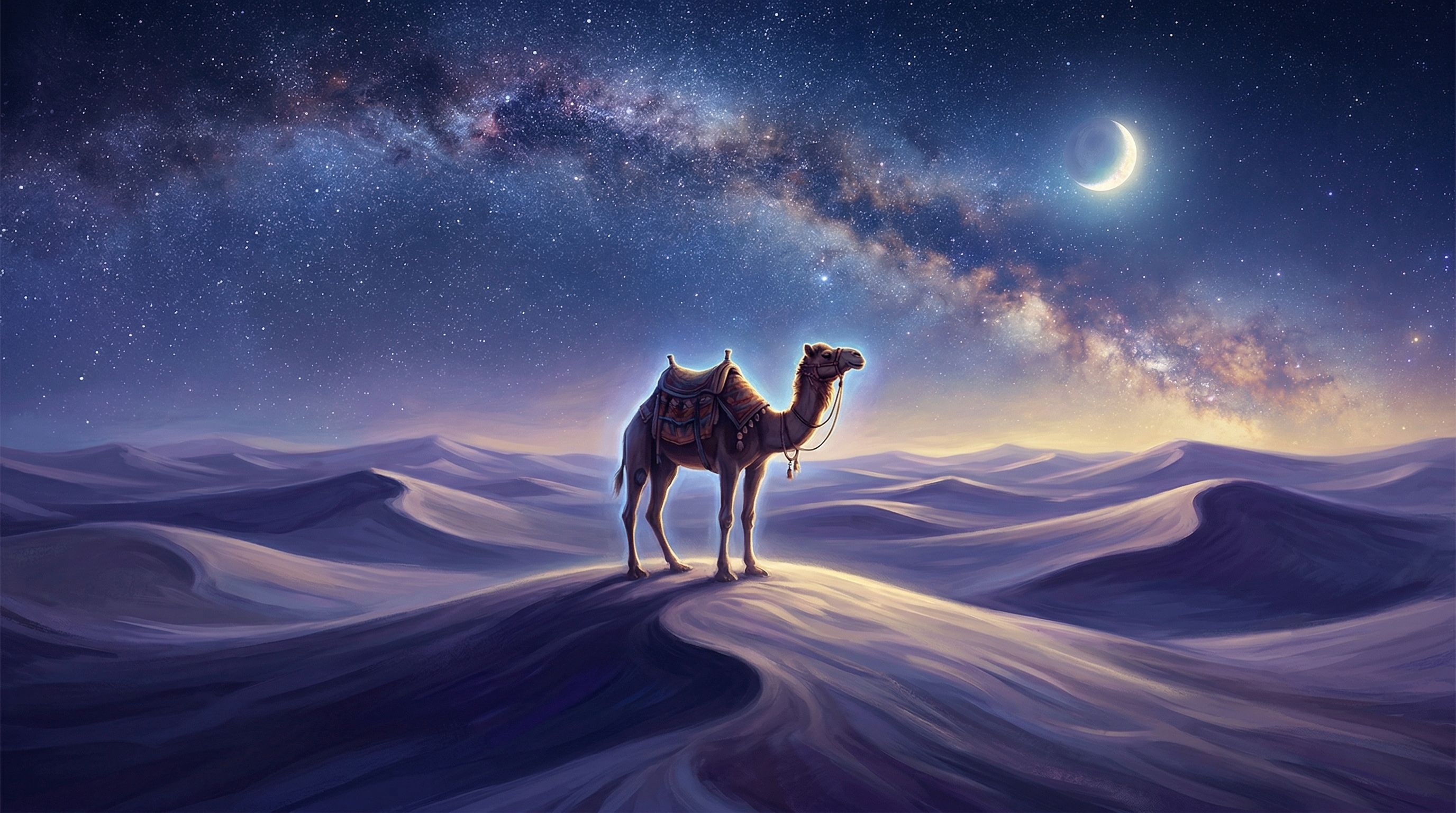
In the theater of your unconscious, the nomad is the one who possesses everything precisely because they hold onto nothing. If you see yourself walking an endless road with only your intuition as luggage, you must ask yourself: what burden have you finally managed to shed? Often, freedom begins exactly where the fear of loss ends. When you strip away the titles, the addresses, and the expectations of others, who is the "you" that remains standing under the desert stars?
I often think the nomad is the spiritual cousin of those who dream of skateboarding through empty city streets—it is that same search for a "flow state," a mix of precarious balance and pure, unadulterated speed. But where the skater seeks the thrill of the moment, the nomad seeks the truth of the journey. If the atmosphere of your dream felt light, it is your soul stretching its limbs after a long period of confinement. If, on the contrary, you felt lost or anxious, it suggests that the idea of wandering still frightens you. But remember: we never truly get lost in dreams; we simply explore areas of our inner map that do not yet have a name.
---
Why Wandering is Not a Mistake
From a very young age, you are taught that you must "know where you are going." It is a strange concept for a Baku to grasp. In the world of sleep, not knowing where you are going is often the necessary condition for arriving exactly where you need to be. Some specialists in dream psychology suggest that the nomad appears when the "ego" is too rigid, acting as a compensatory figure to remind you of your inherent plasticity.
The nomad's wandering is a form of moving meditation. I once encountered a dreamer who was deeply distressed because he saw his tent camp blow away in a fierce sandstorm. He woke up convinced it was a sign of impending ruin. In reality, his spirit was showing him that his current belief system was too fragile to protect him from his own growth. He didn't need a stronger tent; he needed to learn how to move with the wind.
🌙 Yume's Echo: The house is not a place where we stop, it is the skin we wear on our back as we move forward.
We are beings of flux, not statues of stone. While some might label a lack of direction as "emotional instability," I prefer to see it as an invitation to observe your attachments. Do you possess your objects, your relationships, and your ideas... or do they possess you? The nomad in your dream is the part of you that knows how to survive on the "salt of the road," finding nourishment in change rather than in the safety of the known.
---
Listening to the Whisper of the Sands
If you had the chance to speak with this nomad, I encourage you to try and remember the depth of their eyes rather than the specific words they spoke. Often, the wisdom of a dream is not found in language, but in a sense of presence. The nomad is that "Self" that needs no diploma, no social media profile, and no permanent address to feel valid.
If the dream leaves you with a lingering feeling of melancholy, perhaps you are currently feeling "emotionally homeless." This is a profound state where the old versions of yourself no longer feel like home, but the new version hasn't been built yet. Do not forget: the sky is the nomad's roof. What you perceive as a lack of security might be, when viewed from another angle, a vast opening toward the possible.
A Concrete Example: The Crossroads of the Desert
Imagine you are standing at a crossroads in a vast, golden desert. A nomad approaches you, offers you a drink of water, and points toward the horizon without saying a word. You feel a sudden urge to follow, but you look back at a heavy suitcase you’ve been carrying.
In this scenario, the suitcase represents the "emotional baggage" or the outdated identities you are clinging to. The nomad isn't telling you to abandon your life, but rather to evaluate what is essential for the next phase of your journey. The water offered is a symbol of life-giving intuition—the only thing you truly need to cross the dry spells of your existence. This dream is a nudge to simplify, to breathe, and to trust that the path will reveal itself as you walk it.
---
How to Carry the Nomad With You
My advice, should this traveler return to visit you in the night: do not immediately try to carve the meaning of the dream in stone. Let the feeling of the open road travel within you for a few days. Observe where, in your daily life, you could inject a little of that fluidity. Perhaps it is time to change your routine, take a different path home, or simply accept the beauty of not having an immediate answer to your problems.
The nomad’s truth is deceptively simple: the path is the home. You are not a finished product; you are a work in progress, a traveler moving through different landscapes of the soul. Some researchers in the field of sleep science suggest that dreams of travel and navigation help the brain process complex transitions, allowing us to "rehearse" change before it happens in reality.
If you need a quiet space to record these nightly encounters and see how they evolve throughout your inner travels, your Baku is waiting to help you map your dreamscapes.
What did you feel as you looked at the horizon with them? That is where your true compass is hidden. Trust the wind, trust the dust, and most importantly, trust the part of you that knows how to walk without a map.
Why is it that we so often ignore the temperature of our sleep? I am always fascinated when a dreamer remembers the physical texture of their journey. They tell me of the rough wool of the nomad’s cloak, or the dry, scratchy heat in their throat. This dry throat is not just a physiological call for a glass of water on your nightstand; it is a thirst of the soul. You are parched from drinking too much of other people's expectations. When the nomad offers you water from a dusty goatskin, or when you find yourself walking across an endless, sun-baked landscape, your mind is stripping away the damp, suffocating comfort of your routine. It is a harsh, clean dryness. It reminds me of the vast openness of dreaming of a prairie—there is nowhere to hide, no walls to absorb your fears, only the raw touch of the earth beneath your soles.
I once met a dreamer—a woman who had just walked away from a twenty-year career—who dreamt she sat by a small fire in a wind-swept canyon with an old traveler who did not speak her language. She woke up weeping, feeling completely untethered. Honestly, this is where mainstream dream books fail you, labeling such experiences as mere anxiety or a "loss of identity." What a flat way to view the soul's labor. In ancient traditions, the traveler is not a figure of pity, but of profound initiation. When you are between two lives, when the old self has faded but the new one is not yet born, you enter a liminal space. It is a quiet, necessary exile, very much like the profound emptiness of dreaming of being alone in the world. The nomad simply teaches you how to sit comfortably in the drafty corridor between your life's chapters.