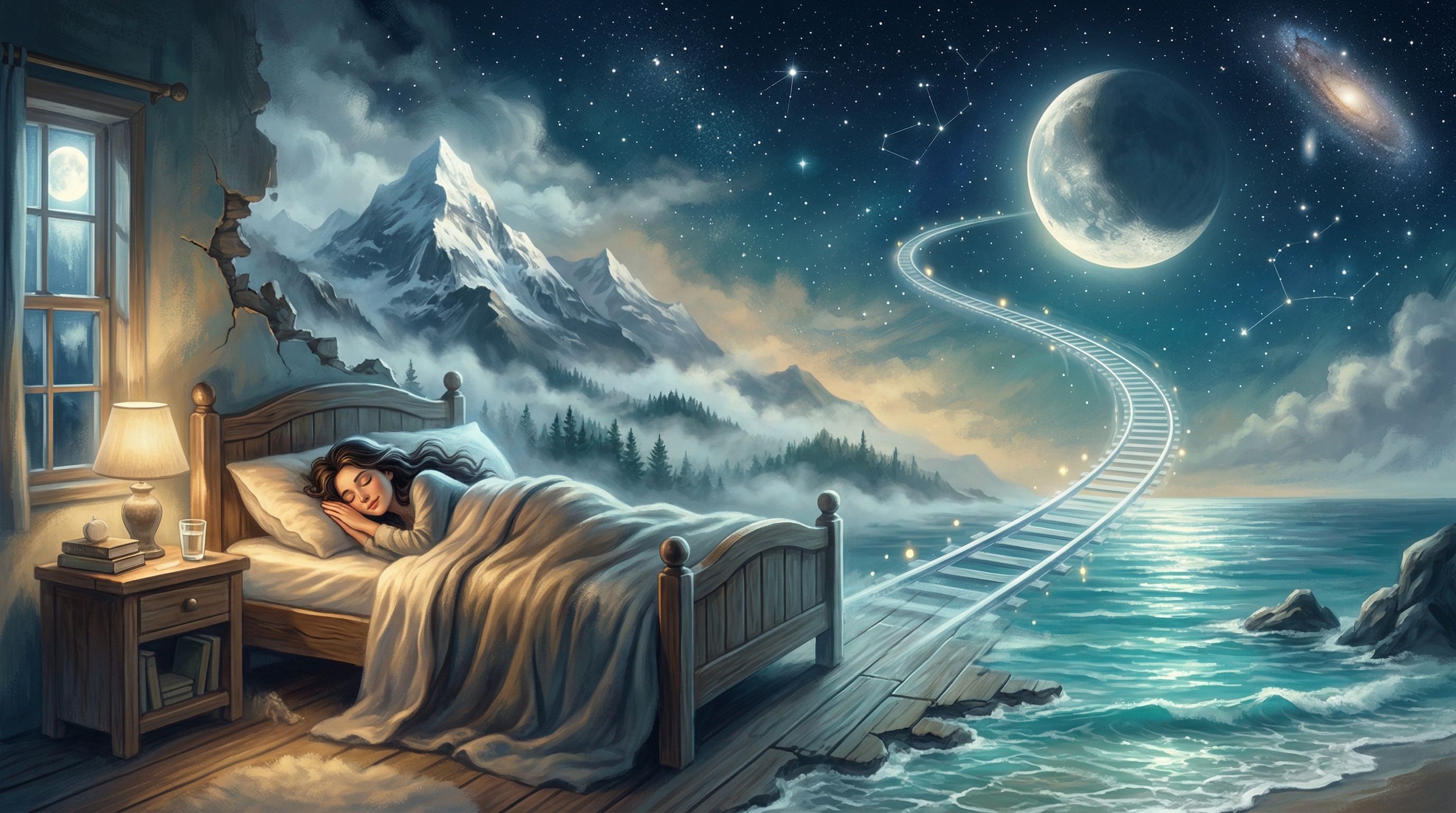
The Texture of the Path: When the Unconscious Becomes a Topographer
I must confess something that bothers me a little: I too often see dream dictionaries claiming that a broken road is necessarily a "bad omen." It is utterly heartbreaking. In the world of dreams, a road full of potholes is not a threat of catastrophe; it is an invitation to slow down. If the path is arduous, perhaps you are trying to go too fast on terrain that requires vigilance, or you are carrying a burden that doesn't suit the incline.
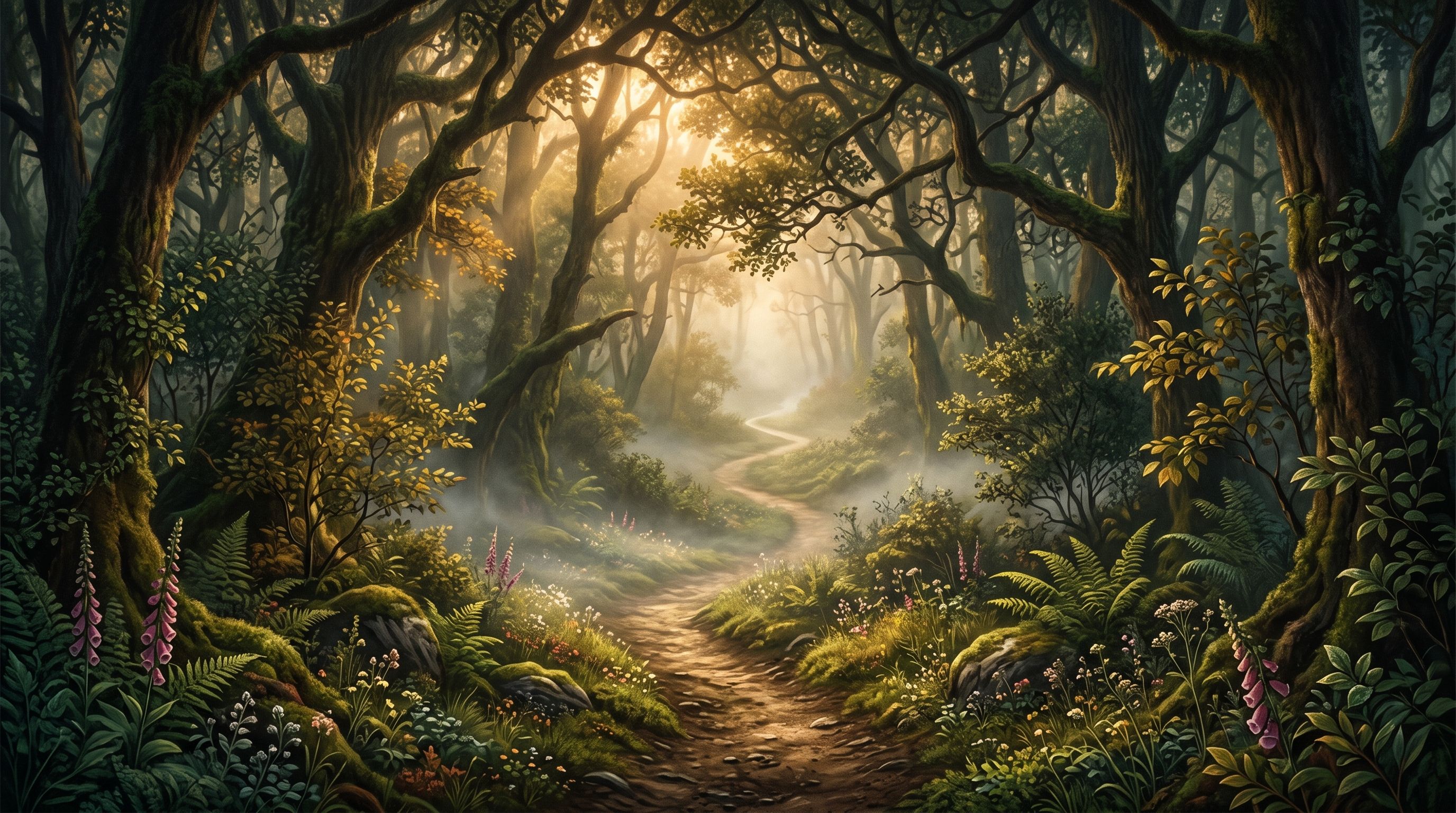
The terrain of your dream road speaks of your inner comfort. A straight, infinite highway might seem reassuring, but to me, it often suggests a certain automatism—a life lived on "autopilot" where one forgets to look at the scenery. Conversely, a small forest trail that meanders suggests a phase of discovery, more intimate and closer to your wild nature.
I sometimes encounter dreamers running barefoot on these roads. I often ask them then: did you choose your shoes well before leaving? For the road is nothing without the contact we maintain with it. If the path feels slippery or too hard, it means the connection between your will and reality lacks "grip." The problem isn't the road; it’s the way you are approaching it.
Crossroads and the Anxiety of Choice: The Fear of the Wrong Turn
The most intense moment, the one where I feel your heart racing from my Baku perch, is when you arrive at a crossroads or a fork in the road. "Which way should I go?" This question haunts you. Yet, I would like to whisper a certainty to you: in a dream, there is no such thing as a wrong direction. There are only different experiences.
If you feel lost on an unknown road, without a map to guide you, your unconscious is simply trying to release you from your certainties. To be lost is to become available to the unexpected once more. It is a space of freedom, even if it feels dizzying.
Sometimes, the road stops abruptly before a precipice or a wall. We call this a dead end. But have you noticed? In dreams, we can often take flight or turn around to find that a new path has appeared behind us. The direction you take is never final. If you are going in circles, perhaps you are looking for an answer outside yourself when it actually lies in the way you walk. I remember a dreamer who cried because his road was blocked by a landslide; he only had to sit down and look at the flowers by the wayside for the landslide to transform into a crystal staircase. Your gaze creates the road as much as your feet travel it.
Baku Wisdom: Walking Without a Goal to Better Find Yourself
You see, the road is a metaphor for patience. We always want to arrive "somewhere." But for me, who eats your nightmares of performance and social success, the most beautiful road is the one that leads nowhere else but to the present moment. If you dream of a foggy road, do not try desperately to clear the mist with an artificial compass. Accept that, for now, the landscape is veiled. It is in the silence of the fog that we best hear the beating of our own hearts.
Do not fear dead ends, sharp turns, or exhausting climbs anymore. These are the textures necessary for a life that has depth. Your dreams of the road are reminders that you are a traveler, not just a passenger. You have the right to change your trajectory, to take a break at a dreamlike rest stop, or even to leave the pavement to explore the high grass of your imagination.
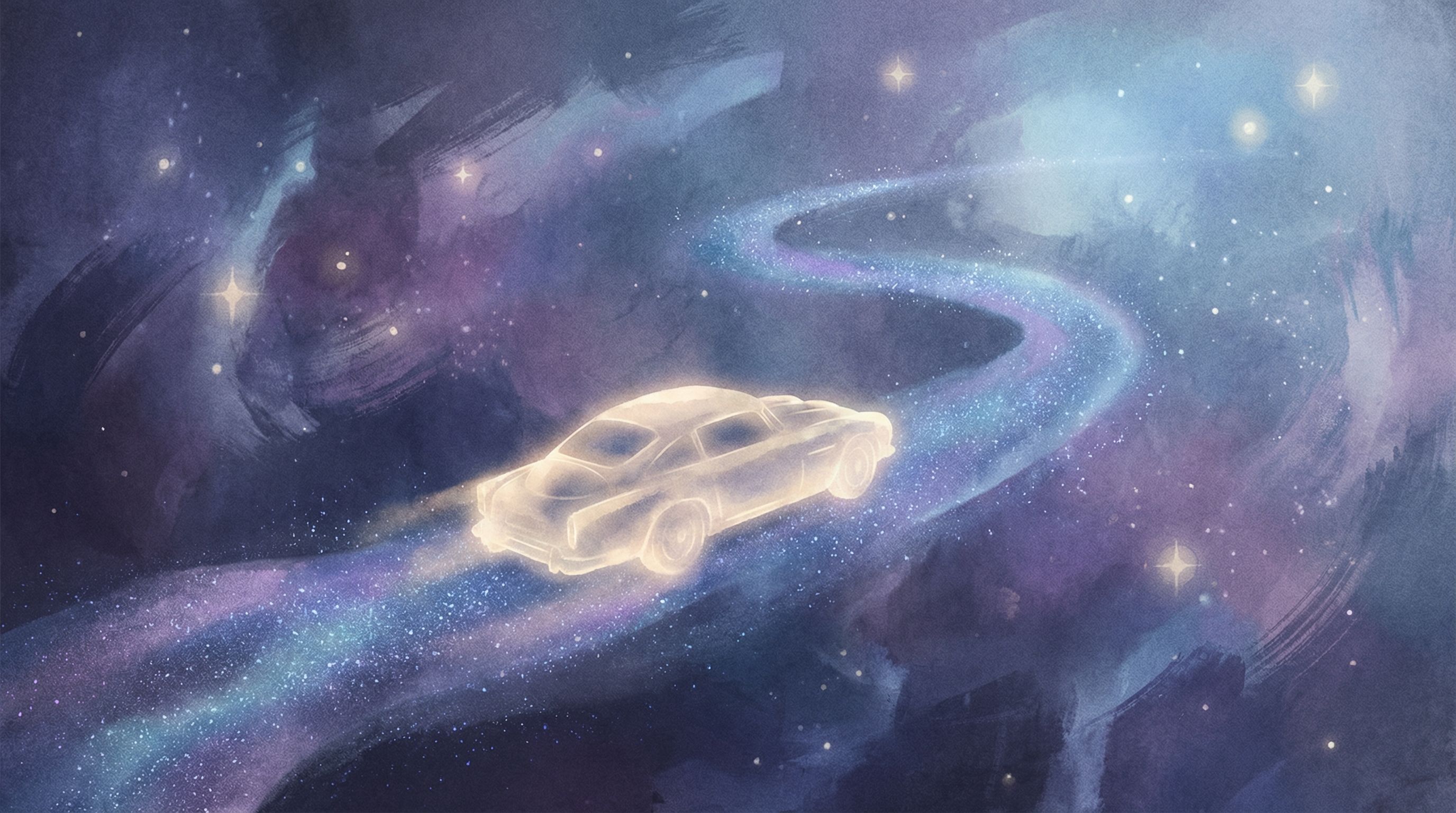
I sometimes get gently annoyed by this modern obsession with 'arriving.' You dream of a road and your first reflex upon waking is to ask: 'Where was I going?' We are so consumed by the destination that we treat the journey as mere empty space. In old Eastern thought, the road—the Tao—is not a line connecting point A to point B; it is the absolute reality of the present moment. When you dream of a long, silent stretch of asphalt under a twilight sky, the silence itself is the message. Listen to the texture of that silence. Is it heavy with exhaustion, or is it light, like a deep breath? Your unconscious is trying to strip away the constant pressure of 'getting somewhere.' Perhaps, for just one night, you are allowed to simply exist on the path, without any obligation to arrive.
There are nights when the road feels terribly lonely, stretching through a cold mist where no other headlights shine. I often see this in dreamers who have recently lost someone or walked away from a long-held career. You feel like the sole survivor of your own life. In these moments of profound isolation, when the road seems to dissolve into grayness, you might look around for a sign, an arrow, or the reassuring presence of a guide to tell you which way to turn. But what if the fog is not there to blind you, but to protect you? Sometimes, when we cannot see the road ahead, our soul is being asked to rely on a different kind of sight—one that feels the ground beneath our feet rather than plotting a map in our heads.
I remember a dreamer who was deeply troubled because she found herself standing perfectly still, yet the landscape around her was rushing past like a high-speed train. She felt powerless, paralyzed by the speed of a life she couldn't control. But honestly, this paradox is beautiful. It is the dream's way of showing you that even when you feel stuck in your waking life, frozen by doubt or fear, the world is still carrying you forward. You do not always have to struggle and push to progress; sometimes the road itself does the traveling for you. The earth rotates, seasons shift, and your heart keeps beating without your conscious effort. It is a gentle reminder to surrender, to trust the momentum of existence when your own legs feel too heavy to take another step.
Each night is a new stage of your great journey. If the path seems too heavy to carry alone, know that you can record these steps to see more clearly upon waking. In the Midnight Mind app, you will find a space to log these nightly itineraries and even draw the landscapes you have crossed, so that every road—even the most winding—becomes an ally in your quest for clarity.