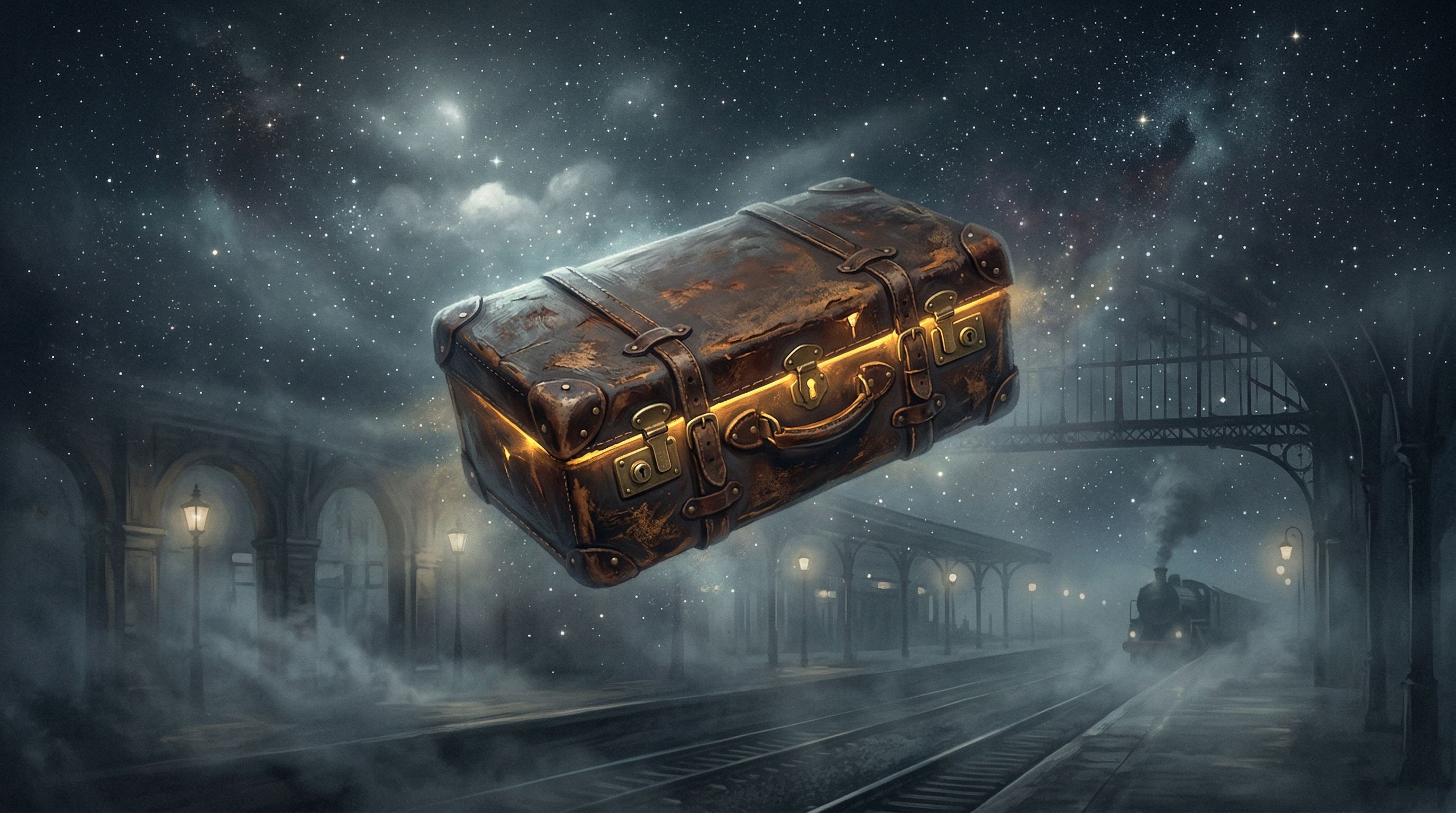
The Platform of the Soul: Why Leave Now?
To be honest, those dream dictionaries that tell you "dreaming of a trip means an imminent house move" make me smile softly. It’s so reductive. If the mind used such literal symbols, my work as a Baku would be quite dull! When I slip into the dreams of my dreamers, I often see this departure as a signal of saturation. Your current "Self" has become like a garment that is much too small. You are bursting at the seams, and your subconscious, in its great wisdom, is showing you the door.
Departure is the moment we accept that we are no longer quite who we were yesterday. It is fascinating to see how each dreamer prepares their luggage. Some pack their entire house, a sign of difficulty in leaving the past behind. Others leave empty-handed, which requires a courage that is almost frightening. It’s a bit like pitching a tent in the middle of a forest: you are trying to find out what you truly need to survive and flourish once you are stripped of your social disguises.
I remember a dreamer who spent his nights chasing a train he could never catch. He was exhausted. While chatting with him (through the veils of sleep, of course), we realized it wasn’t the train he was looking for, but the permission to miss the departure. Sometimes, a dream of leaving simply highlights that you are putting too much pressure on yourself to "move forward" at all costs, according to the standards of others, when your soul actually needs to just sit on the waiting room bench for a while.
Facing the Unknown: The Adventure Where You Are the Hero
The most striking aspect of these dreams is often the mist surrounding the destination. You know you are leaving, but you don't necessarily know where to. This is where the adventure truly begins. The unknown in a dream is never an empty void; it is a space full of possibilities. It is a blank page waiting for the ink of your decisions.
If you feel panic at the thought of this departure, ask yourself: what is holding me back? Often, it is the fear of losing control. In our waking life, we plan everything. In a dream, the journey imposes its own rhythm. You might find yourself having to speak a language you don't know or realizing you’ve forgotten the essentials. This is an excellent exercise for the ego. Your mind is testing you: "Will you know how to manage if the structures collapse?"
I sometimes see strange links between the ability to leave and the ability to express oneself. If you are struggling to board the plane, perhaps something is stuck on your tongue—an unspoken word or a truth you don't dare to utter. Travel is a liberation of the inner voice. We leave so that we can say "I am" without needing to add "the son of," "the employee of," or "the partner of."
I am not one of those who believe everything must always be interpreted positively. A departure can also be tinged with sadness, a necessary mourning. One never leaves without leaving a feather of themselves behind. But do not forget that I am here to devour the anxiety of this departure. The monsters lurking in the airport of your nights are merely guardians checking if your ticket is valid—and your ticket is your desire to grow.
My advice for the future? The next time you see yourself packing your bag in a dream, don’t look for your passport. Instead, look at the landscape around you and ask: "What am I not taking with me this time?" It is in what you leave behind that the true key to your evolution lies.
I often notice these dream journeys manifest right after a sudden collapse in the waking world, like the silent aftermath of a painful relationship ending. You aren't traveling for leisure here; your soul is conducting a forced evacuation. It is a migration of the heart. When a major structure in your life dissolves, the dreaming mind immediately builds a train station, a highway, or a dusty path to give your grief a direction. It is a beautiful, almost desperate mechanism of psychological survival. Instead of drowning in the stagnation of loss, you are moving, even if only in your sleep, through landscapes that don't exist yet. It teaches you that while your physical self is still sitting in the ruins of what was, your deeper consciousness has already packed its bags, quietly refusing to let you die alongside your past.
Why do we always assume a journey requires vast open roads and heavy trains? There is an ancient Taoist wisdom that speaks of the "immobile traveler"—the one who wanders the entire cosmos while sitting quietly in their room. Sometimes, your dream doesn't offer you a grand highway, but rather invites you to slip through a hidden secret passage within your own house. I find this paradox utterly beautiful. Your conscious mind wants the flashy passport stamps, the dramatic geographical cure, but your subconscious knows that the most profound departures are internal. You don't need to cross oceans to escape a dead-end routine. The real threshold is a shift in perspective, a quiet cracking open of your daily perception. When you dream of traveling through tight, unexpected spaces rather than vast skies, your spirit is reminding you that the exit you seek is already inside the walls of your current life.
I once met a dreamer who dreamt, night after night, of wandering through a massive, drafty airport terminal carrying nothing but a decaying wooden chest. She was exhausted, her shoulders aching even after she woke up. When we peered inside that heavy chest together, we didn't find clothes or gold, but old letters, childhood fears, and grievances she had nursed for decades. This is the exhaustion of carrying too much history. If your dream of travel feels heavy, sluggish, or physically painful, it is rarely about the destination. It is a direct confrontation with your hoarding of emotional clutter. Your dreaming mind is begging you to leave the chest behind on the carousel. After all, how can you expect to cross the misty, light-filled borders of your next life phase when you are still hauling the anchors of your oldest regrets?
If the landscapes of your nights sometimes seem too vast to explore alone, you might like to keep a record of your expeditions in your own logbook with Midnight Mind, transforming every departure into a compass leading toward yourself.