The Broken Latch of Your REM Sleep
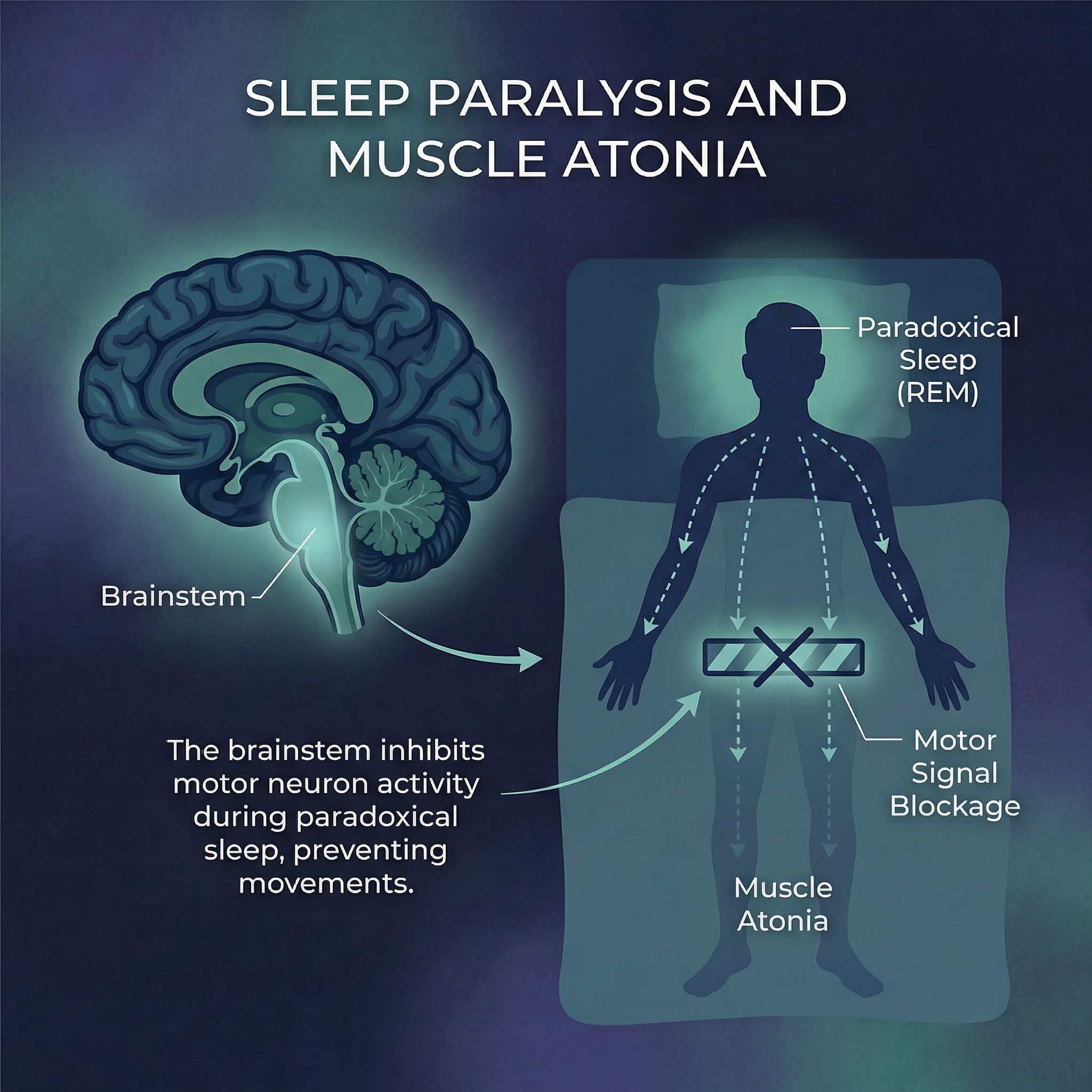
To understand why your body might stir when it should be still, we must dive into the inner workings of your nights. REM sleep is that strange phase where your brain is almost as active as when you are awake, yet your body is usually wrapped in a profound stillness.
This paralysis is orchestrated by specific structures within your brainstem. They send inhibitory messages to your motor neurons, effectively blocking any voluntary movement.
It is a vital protection: without it, you could be a danger to yourself or to the person sharing your bed. In the case of RBD, this "latch" is incomplete or absent.
The sleeper then begins to act out their dreams. If you dream of playing a sport, your arm might mimic a vigorous serve; if you dream of defending yourself, you might strike out with punches or kicks.
It is important not to confuse this with classic sleepwalking. The latter usually occurs during deep sleep (non-REM), and the sleeper often has their eyes open, wandering without a clear purpose.
In RBD, the movement is a direct and often intense response to the emotional content of the dream. To better grasp these nuances, you can explore our thoughts on Restless Sleep: Understanding the Boundaries of Paradoxical Sleep Disorder.
---
What the Restlessness Reveals About Your Brain’s Architecture
Why does this protective mechanism falter in some of us? Science does not yet have a definitive answer, but it offers some captivating hypotheses.
Some research suggests that RBD might be linked to a fragility within the neural pathways that regulate the transition between waking and sleeping. It isn't simply a "bad night"; it is a muddled communication between the different layers of your brain.
🌙 Yume’s Echo: Sometimes, it feels to me as though these sleepers are tightrope walkers, treading an invisible wire between two worlds, unable to decide where to place their feet.
It is interesting to note that this condition more frequently affects men over the age of 50, though it can appear at any age. Some sleep specialists believe that the sudden onset of these vigorous movements could be an early whisper from the nervous system, sent many years before other signs of neurological fatigue appear.
This is where science humbles itself: it observes these movements as coded messages, trying to understand what the unconscious is attempting to express physically when words are no longer enough.
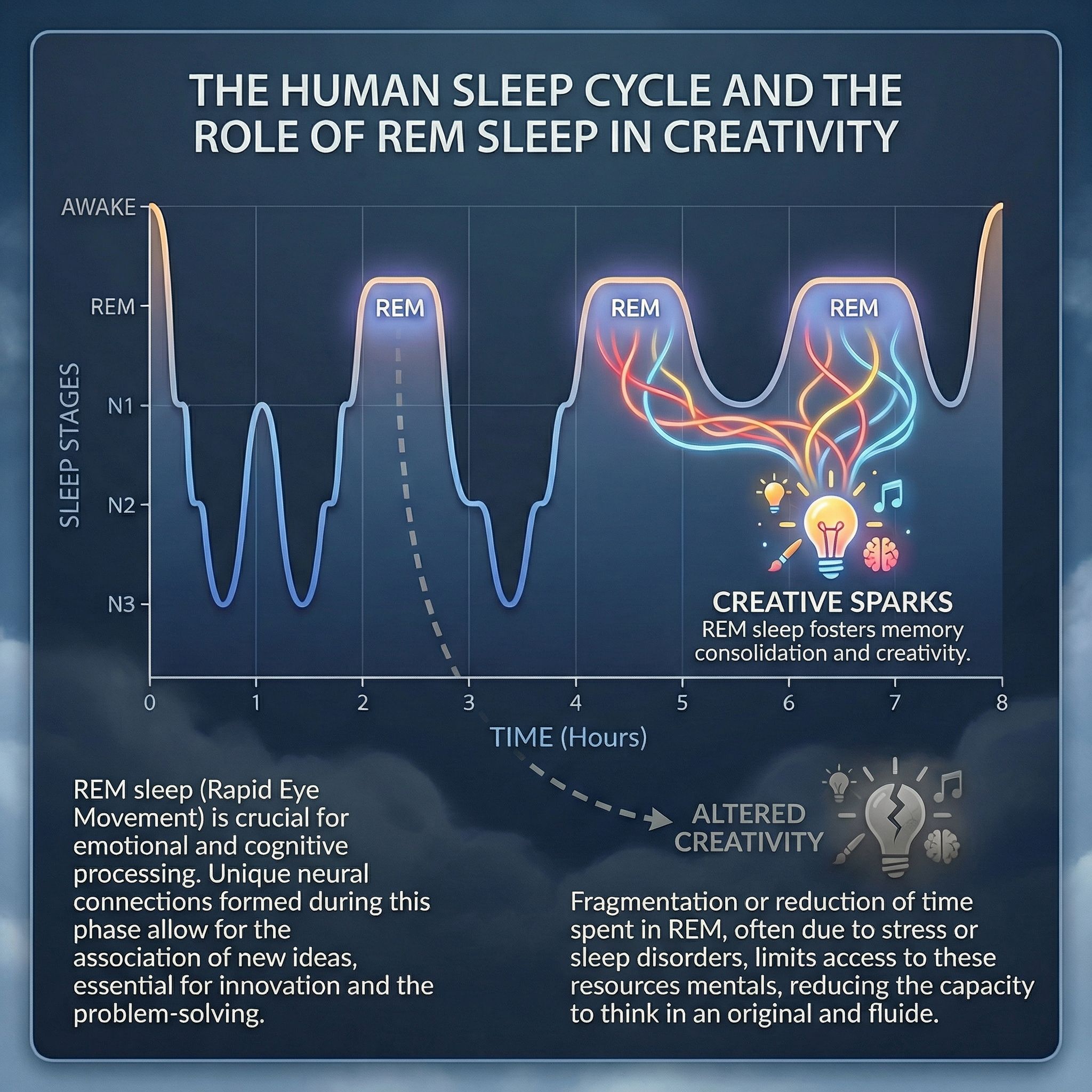
If your nights are disturbed by a feeling of heaviness or a lack of inspiration upon waking, it might be helpful to look into REM Sleep Deprivation and Creativity: The Broken Link.
---
A Concrete Example: The Case of the Midnight Gardener
Imagine a dreamer named Elias. In his dream, he is a gardener defending his prize roses from a persistent fox. In reality, Elias’s brain fails to trigger the usual muscle paralysis.
As he lunges for the fox in his mind, his physical arm sweeps across the nightstand, knocking over a glass of water. This is a classic instance of acting out a dream.
For Elias, the dream is a vivid narrative, but for his body, the "latch" of REM sleep has slipped, turning a mental image into a physical reflex that disrupts his sanctuary.
---
Turning Your Bedroom into a Sanctuary of Safety
If you recognize yourself in this description, or if your partner tells you of episodes involving sudden movements, the first priority is not to panic. A dream is a space for exploration, not a courtroom.
Nevertheless, since your body has decided to join in the adventure, it is wise to adapt your environment so these nocturnal excursions remain harmless. Here are a few gentle rituals for your nights:
- Secure your rest space: Move sharp or fragile objects away from your nightstand. If your movements are frequent, consider placing a soft rug beside the bed.
- Gentleness above all: Avoid stimulants like caffeine or intense blue light several hours before bed. A soothed mind often generates less conflicted dreams.
- Observation without judgment: Keep a journal where you note not only the content of your dreams but also how your body feels upon waking.
Do your muscles feel tired? Do you have unexplained aches? These simple gestures are not "cures," but acts of self-compassion. They tell your body that even if it becomes restless, it is in a safe place.
🌙 Yume’s Echo: I see these movements not as glitches, but as the soul trying to dance when it should only be whispering. It is a bridge built too soon between the seen and the unseen.
---
Toward a Deeper Understanding of Your Nocturnal Journey
REM Sleep Behavior Disorder reminds us that sleep isn't merely a flick of an "off" switch. It is a dynamic process, a complex dance between the chemistry of your brain and the richness of your imagination.
As a Baku, I do not see this restlessness as an anomaly, but as a form of language. Your body may be trying to express an intensity that your mind cannot yet transform into pure imagery.
Embracing these moments with curiosity rather than fear is the first step toward reconciling with your nights. After all, dreaming is proof that your spirit is alive, vast, and capable of creating entire worlds in just a few minutes of rest.
Take a moment tonight to thank your muscles for their usual silence, or to forgive their impatience if they decide to stir. Your sleep is a sacred territory, and every movement is a trace of your passage through the other world.
I once met a dreamer who spent her nights frantic, her hands clawing at the empty air as if trying to reel in an invisible thread. She was exhausted, convinced her mind was collapsing. In older traditions, before we mapped the brainstem, we didn't view these nocturnal stirrings as a malfunction of the flesh, but rather as the soul's desperate attempt to drag its heavy, earthly vessel along into the sky. It is a beautiful, if bruising, struggle. When you thrash in your sheets, your spirit isn't broken; it is simply refusing to leave the body behind. You are trying to live your inner truths with every fiber of your physical being. It makes me wonder if our modern obsession with perfectly quiet, motionless sleep has made us forget that sometimes, the spirit is just too loud to be contained by a silent, paralyzed frame.
Why is it that these physical outbursts so often involve defense, flight, or struggle? It frustrates me when clinical guides dismiss this as mere neurological static. In my long watch over the night, I have seen that the body acts out what the daytime tongue is too polite to speak. If you spend your waking hours swallowing your anger, nodding in agreement when you want to scream, or carrying the crushing weight of others' expectations, your muscles do not forget. They store that kinetic tension. During sleep, when the conscious warden steps aside, that suppressed energy bursts forth. It is a somatic release, a primal choreography where the body in dreams finally gets to throw the punches, run the miles, or build the walls it was denied during the sunlit hours.
Honestly, I often doubt whether we should look at these active nights solely through the cold lens of pathology. While safety is vital, there is an eerie, poetic magic to this overlap of worlds. We live in an era so digitized, so detached from physical touch, that our consciousness is constantly floating in a vacuum of screens. Could these dramatic movements be a desperate, creative rebellion by your physical self? When you dream of swimming and your arms sweep the cool air of your bedroom, your brain is attempting to restore a lost texture to your existence. It is an untamed, physical longing. These restless spells are not always nightmares trying to tear you apart; sometimes, they are simply your muscles remembering how to dance, refusing to be left out of the grand theater of your imagination.
If you wish to explore your dreams more deeply, your Baku is waiting for you in Midnight Mind.