The Alchemy of Void: When Biology Commands Amnesia
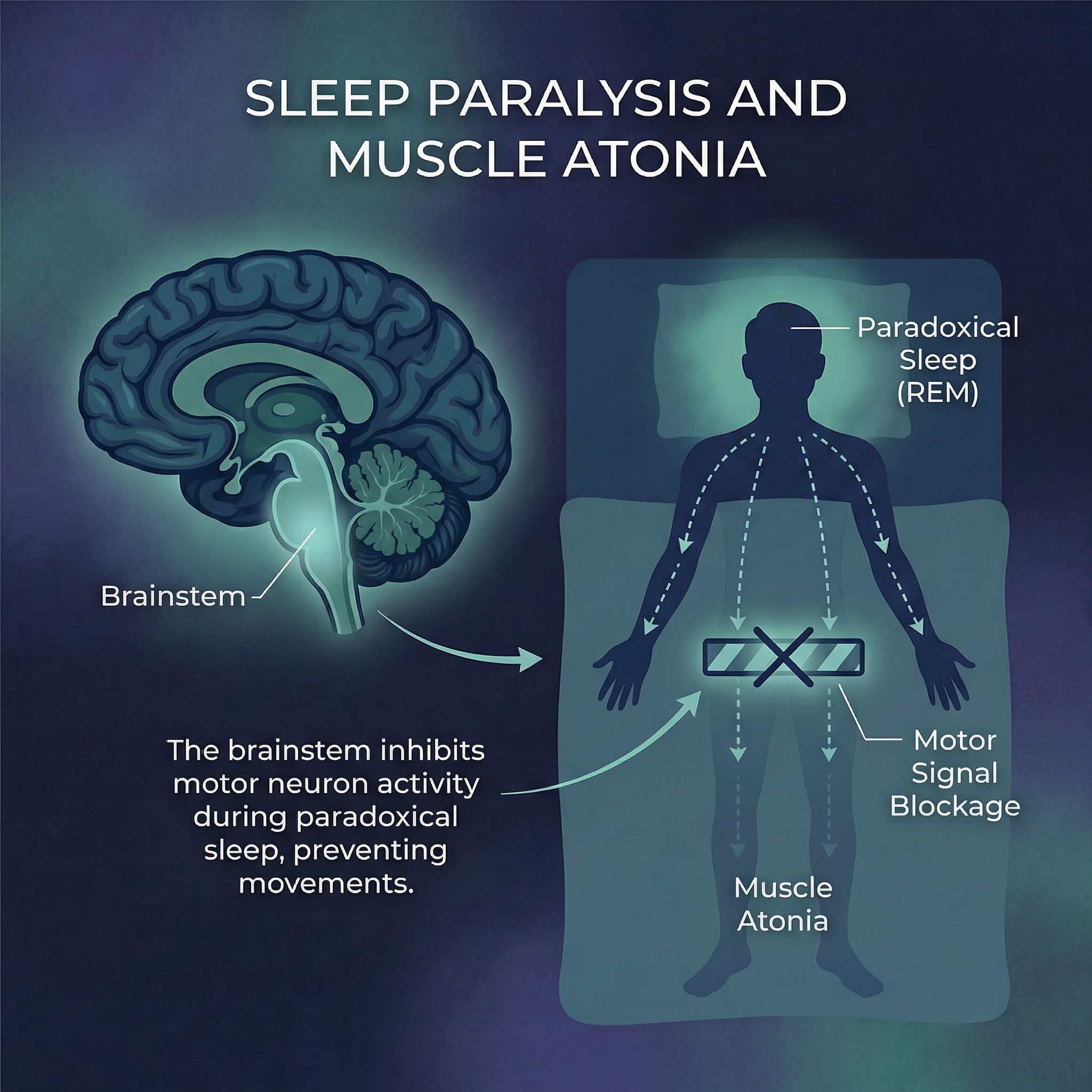
The phenomenon of forgetting your dreams is not a flaw in your system, but an intrinsic characteristic of your biological architecture. While you dream, your brain goes through phases of high activity, especially during REM (Rapid Eye Movement) sleep. Yet, in this effervescence, a crucial function is put on pause: the ability to encode information into long-term memory.
Some neuroscientists suggest that certain brain areas, such as the prefrontal cortex, are largely deactivated while you are dreaming. Now, it is precisely this area that manages logic, coherence, and the voluntary archiving of data. Without this vigilant "librarian," the images scroll by without ever being placed on the shelves of your consciousness.
Your dream is an experience lived in a perpetual present. It is a sequence of pure sensations that do not naturally seek to become archives. It is, in a sense, a movie you watch without ever pressing the "record" button.
---
The Guardian at the Gate: The Chemistry of Awakening
At the moment you wake up, a brutal chemical shift occurs in your cranium. During REM sleep, your brain is bathed in acetylcholine, a neurotransmitter that promotes intense mental imagery. However, it is almost completely devoid of norepinephrine, a substance essential for fixing a memory in a durable way.
Imagine trying to write a poem with invisible ink on the surface of a river. The emotion is there, the gesture is precise, but the medium refuses to retain the trace. As soon as you open your eyes, norepinephrine returns in force to help you face the demands of reality.
This change of electrical and chemical regime acts like a sweep on the residues of the night. Your brain then prioritizes immediate sensory information: the light in the room, the sound of the alarm, or the sensation of hunger. External reality, brutal and pragmatic, often crushes your internal reality, which is subtle and fluid.
🌙 Tsuki's Echo: Forgetting is not a loss; it is a sacred space that your mind creates to welcome the new day without being cluttered by the ghosts of the night.
---
A Concrete Example: The Two Mornings
Imagine two versions of your morning. In the first, your alarm blares, you jump out of bed to check your notifications, and the dream is gone instantly. Your brain has switched to "survival and logic" mode, erasing the nocturnal data to make room for your to-do list.
In the second version, you keep your eyes closed and stay perfectly still for two minutes. You don't look for a story; you look for the "color" of the dream. Suddenly, a flash of a red door appears. By focusing on that single image without moving, the rest of the scene—a childhood house, a conversation with a stranger—slowly reconstructs itself. This simple pause acts as a bridge between two worlds, allowing the chemistry of wakefulness to "photograph" the dream before it evaporates.
---
The Soul's Perspective: The Filter of the Unconscious
If we turn to a more symbolic dimension, forgetting takes on a protective meaning. In the tradition of analytical psychology, the dream is seen as a direct communication from the Unconscious, a language made of archetypes and symbols. Sometimes, your conscious mind is simply not ready to receive the message.
Your "Ego" acts as a filter, a protective barrier against truths that might be too harsh or emotions that feel too vast to process. Forgetting a dream would then be a form of psychological defense mechanism. It is as if the guardian of your consciousness decided that certain images are too disturbing to be integrated immediately.
Yet, even if the memory fades, the emotional imprint remains. You may no longer remember the scenario, but you retain a strange melancholy or an unexplained joy throughout the day. The memory of the heart is often more resilient than that of the neurons.
---
Small Rituals to Capture the Invisible
If you want to reduce the amount of forgetting and bring back some nuggets from your nocturnal journeys, you can train your mind with gentleness. It is a form of cognitive muscle that requires patience rather than force.
- Total Immobility: Upon waking, do not move an inch. Physical movement activates motor areas and instantly erases fragile dream images.
- Emotional Capture: Don't look for the plot right away. Ask yourself: "How do I feel?" The emotion is the thread that often leads back to the labyrinth.
- The Keyword: Write down a single word in a journal, even if it seems absurd. "Blue," "Flight," or "Key." This word serves as an anchor to bring back the rest later.
- Set an Intention: Before falling asleep, tell yourself clearly: "Tonight, I want to remember."
Your mind is like a wild cat: it doesn't come when you force it, but it approaches if you remain silent, still, and welcoming.
---
Honestly, it always baffles me when people assume a forgotten dream is a dead dream. Your body is far smarter than your conscious memory. Have you ever woken up with your heart racing, your throat dry, or perhaps carrying a strange, heavy warmth in your chest, without having any idea why? I once sat with a dreamer who woke up weeping, convinced she had lost something precious in her sleep, though her mind was a total blank. The images had dissolved, yes, but the emotional frequency remained anchored in her muscles. The unconscious doesn't just speak in pictures; it writes directly onto your nervous system. When you forget, the narrative is erased, but the somatic imprint remains. You don't need the storyline to digest the healing that happened in the dark.
It gently tires me to see this modern obsession with writing down every single nocturnal scrap, as if your mind were a data sheet to be optimized. Some dream therapists insist that if you don't journal the moment you wake up, you are failing your inner self. What nonsense. There is a quiet, necessary beauty in letting things dissolve. Some nights are meant to be digested in complete darkness, integrated by the soul without the ego's interference. Trying to drag every image into the waking light is like pulling a deep-sea creature to the surface; the pressure change destroys its fragile shape. Let it go. The dreams that truly need to reach you will find a way, sometimes returning disguised as a sudden deja-vu while you are washing the dishes or crossing a busy street.
And then there is that exquisite, frustrating trick of the mind where you believe you have successfully saved the memory, only to realize you were trapped in a loop, experiencing a false awakening where you dream of writing it down. You wake up for real, and the paper is blank. I find this specific loop fascinating because it shows how desperately we want to build a bridge between these worlds. But perhaps the fog is the point. In Shinto traditions, we often view the borderlands of sleep not as a puzzle to solve, but as a sacred mist. You do not demand that the forest reveal all its paths at dawn; you simply trust that the trees know where they stand. Trust the fog of your mornings. It is keeping you safe.