A Nightly Therapy for Your Emotions
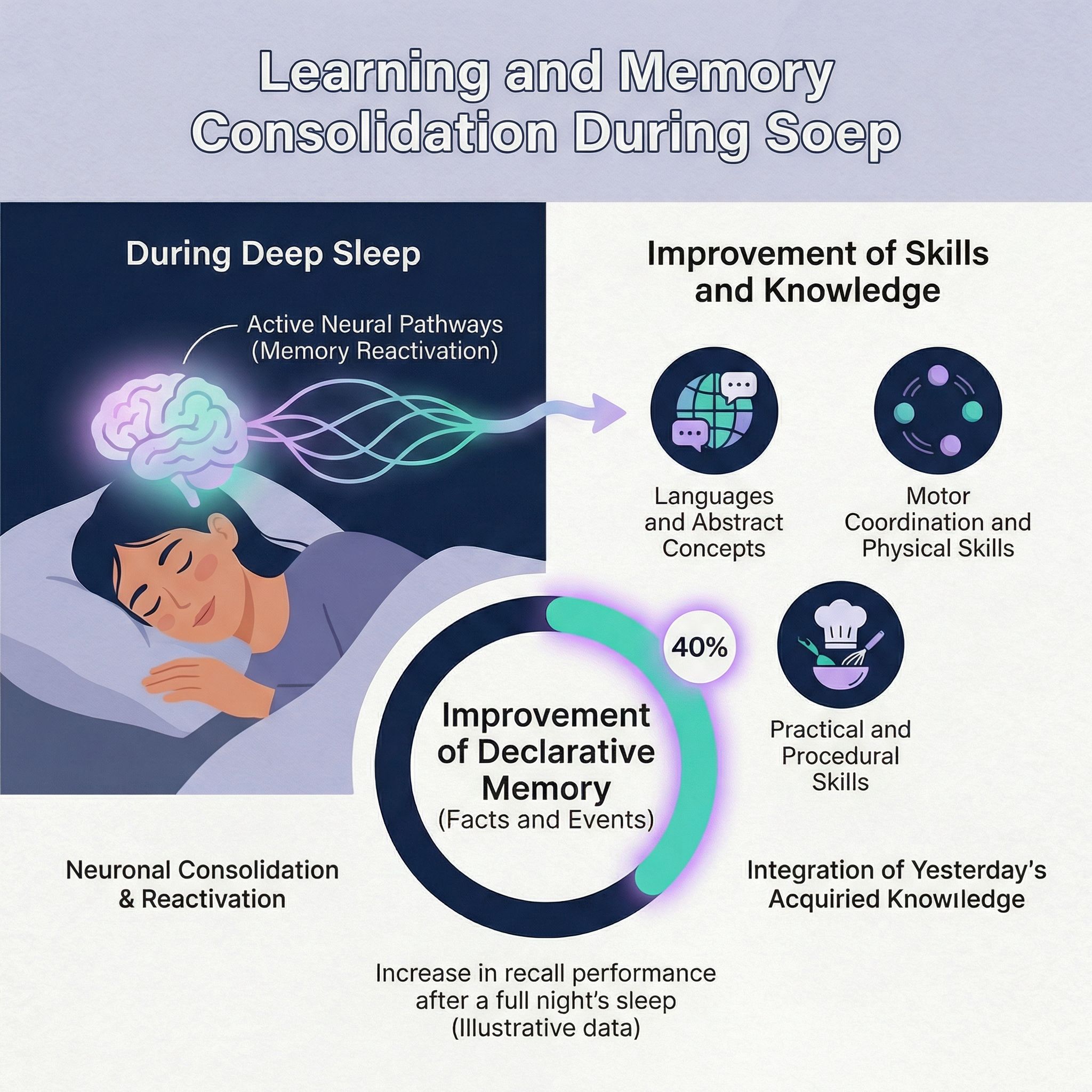
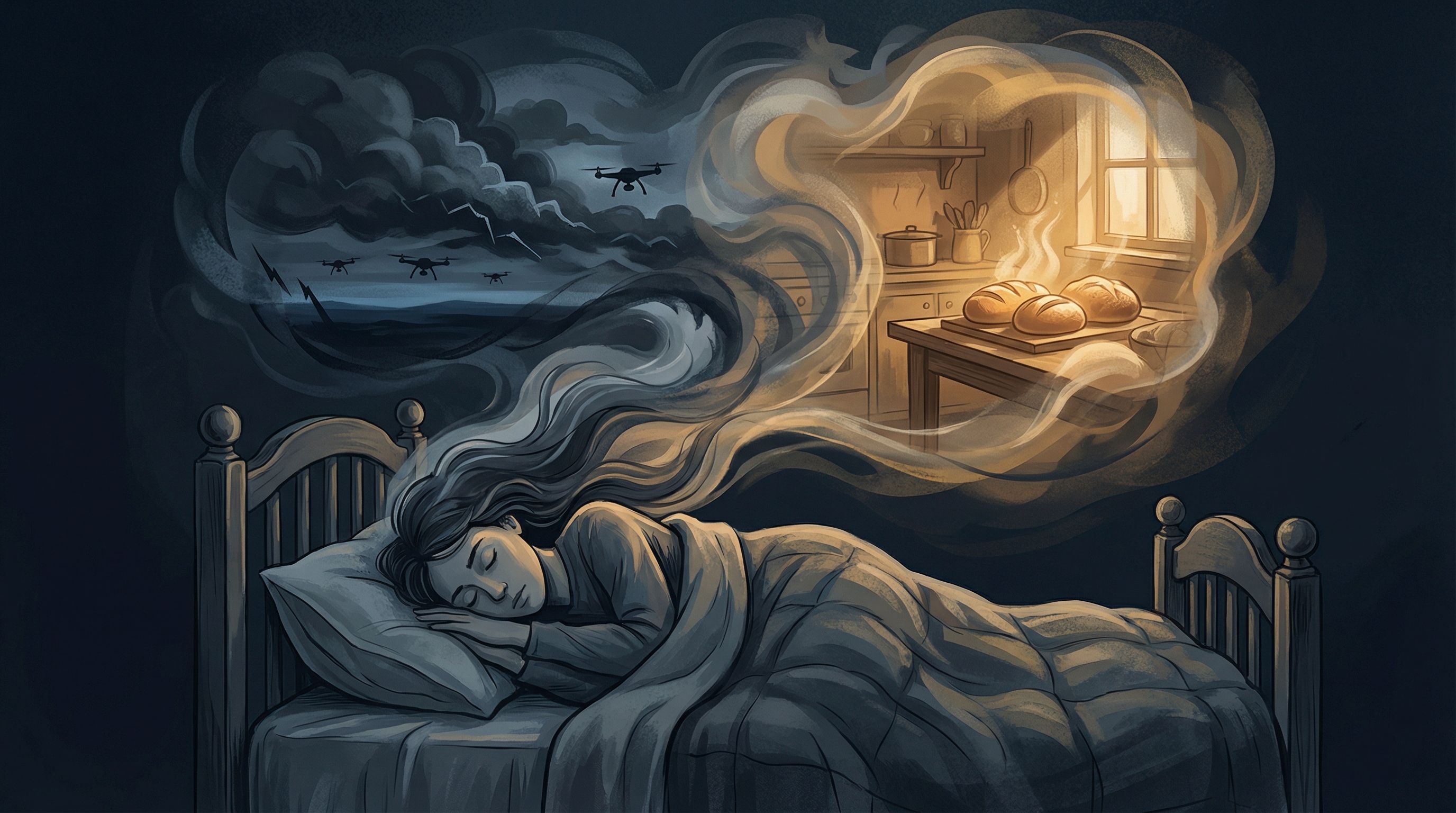
One of the most precious functions of your dreams is what researchers call emotional regulation. While you sleep, your brain revisits the events of your day, but it does so in a unique neurochemical environment.
During REM (Rapid Eye Movement) sleep, the phase where your dreams are most vivid, your brain is almost completely devoid of noradrenaline. This is a key stress-related chemical.
This means you can process traumatic or upsetting memories without the physical "sting" of the stress response. It is a bit like your mind applying a soothing balm to your wounds or frustrations.
Some specialists in the field of sleep science suggest that this process helps digest complex emotions. By the time you wake up, the emotional edge of a difficult experience has often been softened, allowing you to approach it with more perspective.
If you didn’t dream, every little stressor would accumulate without ever being processed. Your dreams are the artisans who untangle the knotted threads of your psyche, allowing you to find a sense of inner balance each morning.
🌙 Yume’s Echo: View your dreams as a gentle sea that comes to smooth over the jagged sandcastles you built during the day.
The Great Sorting of Memory and Forgetting
Your mind is a library with shelves that are constantly filling up. Every second of your conscious life generates thousands of fragments of information—faces you passed, words you heard, the specific hue of the sunset.
Some sleep specialists believe that dreaming is the moment your brain decides what it must keep and what it can let go. It is a process of memory consolidation essential to your learning and your mental health.
Here lies a fascinating mystery: to remember well, one must know how to forget. You can explore this phenomenon further in the article The Paradox of Forgetting: Why does the mind erase its own journeys?.
By sorting through these memories, your brain creates unexpected connections. It doesn’t just store data; it allows different pieces of information to talk to one another.
This "cross-talk" between distant memories is the raw material for your intuition. It is why you sometimes wake up with a "gut feeling" about a decision that seemed impossible the night before.
A Life and Survival Simulator
Why do you sometimes dream that you are being chased or that you find yourself naked in public? These scenarios, though uncomfortable, may have a deep biological purpose according to the threat simulation hypothesis.
This theory suggests that your dreams are practice sessions. Your mind simulates perilous or stressful situations to allow you to test your reactions without any real risk to your physical safety.
It is a form of dress rehearsal for life. By facing your fears in the astral realm, you strengthen your ability to cope with the unpredictable once you open your eyes.
This explains why certain themes are universal. We all share a kind of library of common symbols, as you can discover by reading The Collective Unconscious: Why we all dream of falling.
When you dream of a conflict, your brain is actually mapping out potential escape routes or social strategies. You are becoming more resilient while lying perfectly still in your bed.
Concrete Example: The Public Speaking Dream
Imagine you have a big presentation coming up. That night, you dream you are standing on a stage and you have forgotten your notes.
Your heart races in the dream, but your body remains safe. By "living through" the embarrassment and the panic in your sleep, your brain is desensitizing you to the fear.
When you actually step onto the stage the next day, your subconscious feels as though it has already survived the worst-case scenario. You are calmer, not because the fear is gone, but because it has been rehearsed.
The Laboratory of Infinite Creativity
Dreaming is the only time the rigid logic of your "left brain" steps aside to make room for associative thinking. Freed from the laws of physics and social conventions, your mind can explore solutions you would never dare consider while awake.
Great scientific discoveries and major works of art were born in this state of semi-consciousness. Your nightly brain is a master of analogy: it connects concepts that seem to have nothing in common to create new meaning.
To dream is to allow your imagination to play unsupervised. It is a form of pure freedom where every symbol, every character is a facet of your own complexity seeking expression.
There are no "bad" dreams in this laboratory. Even the strangest image has a reason for being—a truth waiting for you to lend it a listening ear.
🌙 Yume’s Echo: Your unconscious doesn’t speak just for the sake of talking; it simply uses a language made of poetry and shadows rather than words.
How to Invite Dreams Into Your Life Starting Tonight
Now that you understand a little better why your mind stirs at night, you may want to remember these journeys more clearly. The good news is that dream memory is a skill that can be cultivated with gentleness.
You can start tonight with a simple ritual: place a notebook and a pen on your nightstand. Before falling asleep, whisper to yourself that you are ready to listen to what your mind has to say.
Upon waking, do not jump out of bed immediately. Stay still for a few moments with your eyes closed. Let the last images of your dreams float to the surface of your consciousness.
- Write down a word, an emotion, or a color, even if the story seems blurry.
- Do not try to analyze right away; simply collect the raw material.
- Thank your mind for this nightly gift, whatever form it takes.
By doing this, you build a bridge between your conscious world and your secret garden. You learn to become a benevolent witness to your own inner richness.
Dreaming is an act of resistance against the noise of the world. It is a space that belongs only to you—an inexhaustible resource of wisdom and comfort that you carry with you everywhere.
Take care of your nights, for they are the soil of your days. If you feel the need to walk further into this dreamscape, your Baku will always be here, ready to listen and accompany you.
Sometimes I watch dreamers toss and turn, and it strikes me how deeply the physical shell is woven into these astral journeys. Your sleeping brain is not a detached spirit; it is deeply tethered to your flesh. A sudden drop in room temperature becomes an arctic blizzard in your slumber; a heavy blanket transforms into a locked, stone room. This is where the body in dreams becomes its own cartographer, redrawing your physical boundaries to speak a language of pure sensation. I once met a dreamer who kept seeing heavy, sinking stones in her chest, only to realize her waking body was begging her to breathe through a long-ignored exhaustion. Your unconscious never separates the physical from the spiritual; it uses the weight of your limbs to tell you what your waking mind is too stubborn to admit.
It frankly exhausts me when I see people waking up in terror, convinced that a dark dream is a curse or a premonition of failure. Why must we always pathologize the shadows? These intense, midnight disruptions—what many call nightmares—are rarely threats. In my eyes, they are simply unfinished stories, raw emotional material that was too heavy to digest during the rush of the day. When you dream of a monster chasing you through a dense fog, your mind is merely throwing its arms up, asking you to look at a vulnerability you have swept under the rug. I often taste these dreams myself, and believe me, they do not taste of malice; they taste of neglected truths waiting for a little of your warmth. Do not fear the dark theater; it is only trying to make room for the light.
What messages does your mind whisper to you when everything grows silent? If you want to explore your dreams more deeply, your Baku is waiting for you on Midnight Mind.