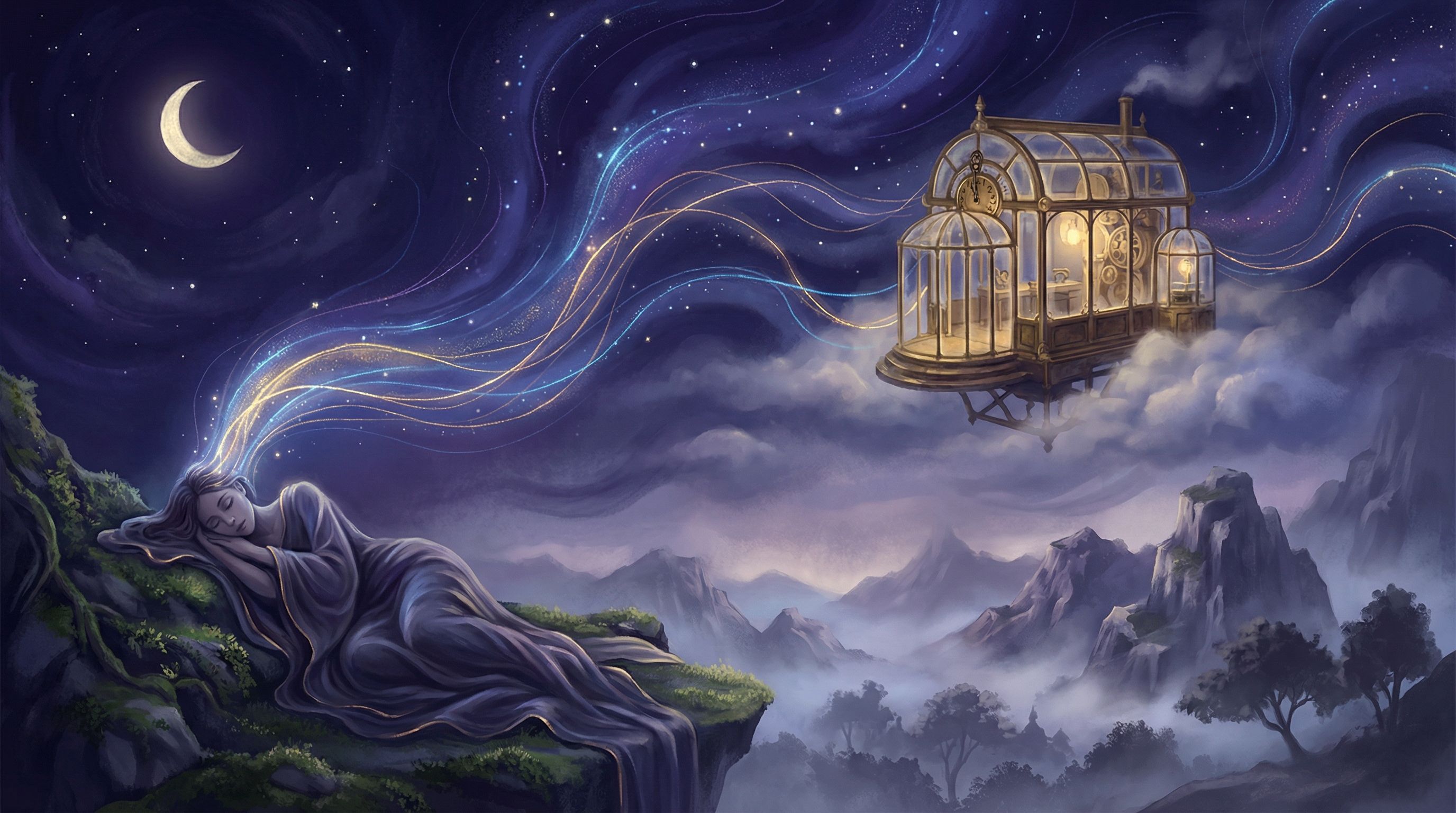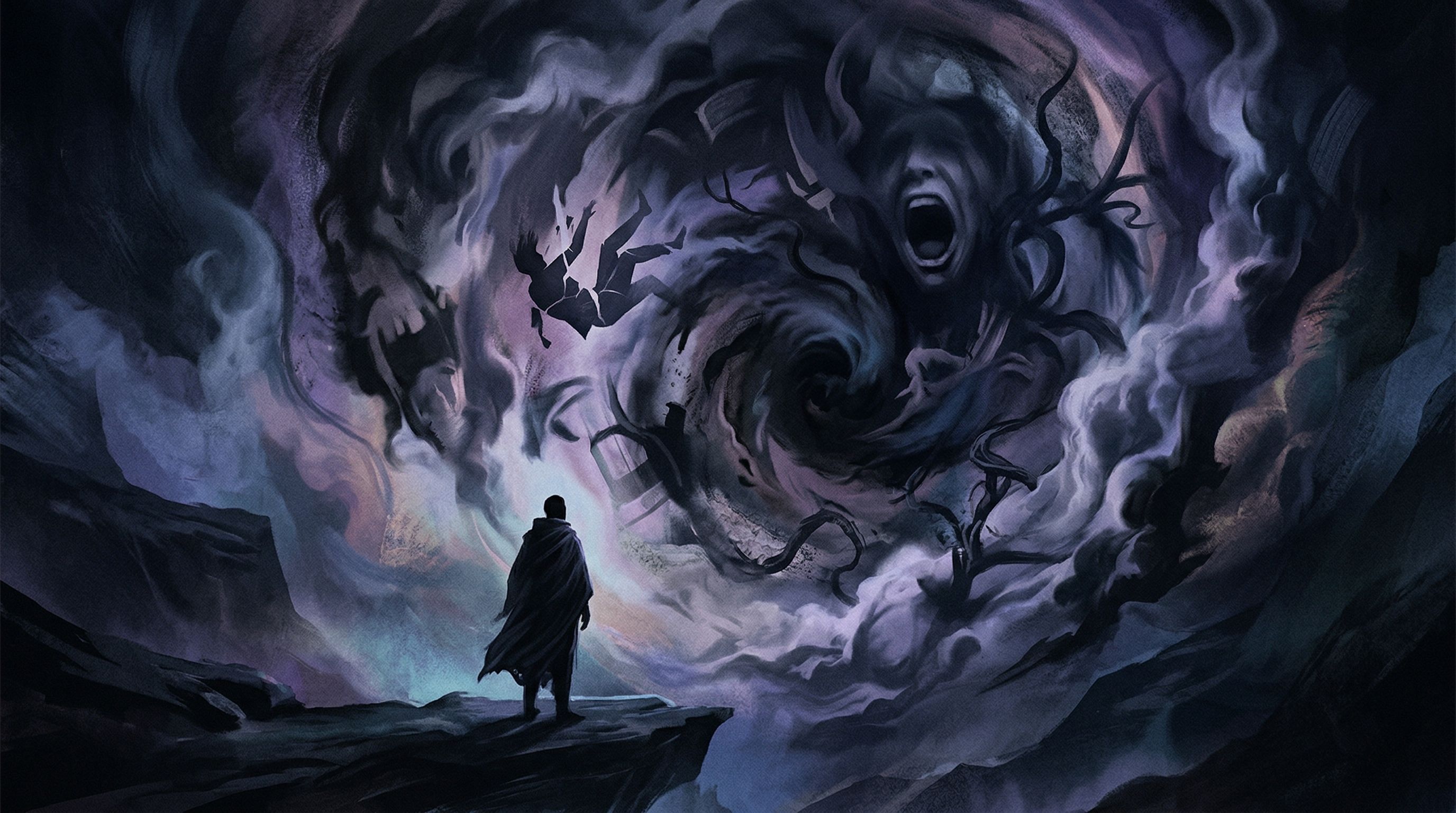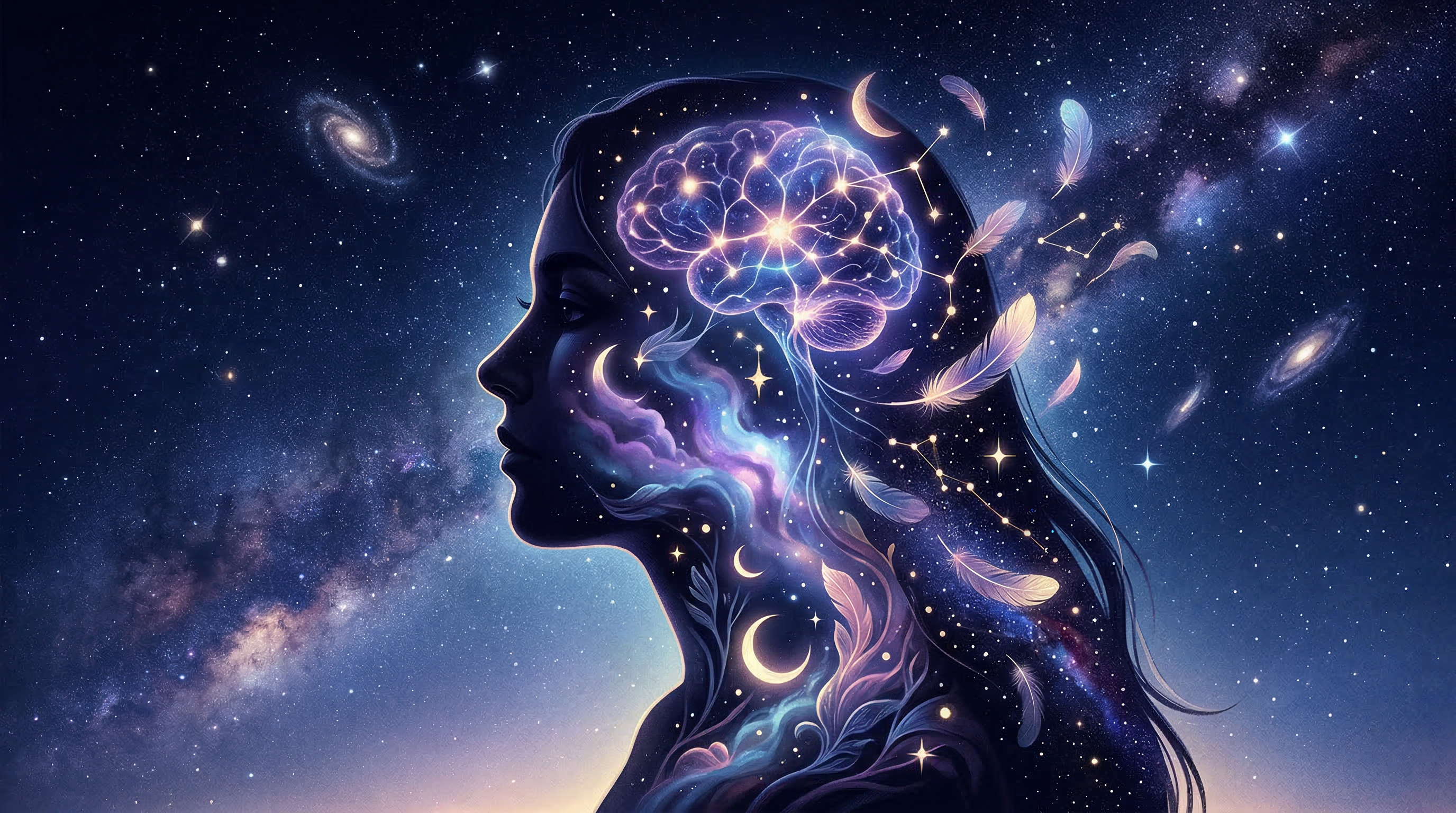
The Gallery of Dread: When the Dark Becomes Sublime
You have likely become accustomed to perceiving the nightmare as an intruder, a parasite that comes to spoil the purity of your rest. It feels like a theft of peace, a violent interruption of the silence you crave. Yet, if you observe these visions with the eye of a collector, you discover a raw force that the sterile comfort of the day simply cannot match.
Your mind, in its infinite creativity, uses the night to stage dramas that no Hollywood director could ever replicate. The aesthetic of your fears possesses a unique textural depth. Think about the specific grain of a cast shadow on a dream-wall, the surreal distortion of a familiar face, or the impossible, shifting architecture of your childhood home.
In the history of art, the greatest creators have understood that unease is a powerful engine of fascination. Philosophers like Edmund Burke and Immanuel Kant spoke of the Sublime—that feeling of being overwhelmed by something vast, dangerous, and beautiful all at once. When you stand before a storm, you feel small, yet exhilarated.
Your nightmares are your internal storms. They are the "Black Paintings" of Goya or the melting landscapes of Dalí manifesting in your own mind. These artists knew that the boundary between dream and reality must sometimes dissolve to make way for a higher, more visceral truth.
Every time your mind generates an image that makes you jump, it is not trying to harm you. It is simply using the most saturated pigments of your emotional palette to draw your attention to a point of internal tension. It is a form of mental painting, where your unconscious projects symbols onto the screen of your eyelids—symbols that you might not dare to formulate when you are awake and guarded by logic.
---
From Terror to Canvas: The Alchemy of Subconscious Creation
Creation often arises from friction—from a discomfort seeking a resolution. When you wake up with your pulse thrumming in your ears, you are actually in a state of maximum neurobiological receptivity. Your brain is firing in patterns that link disparate ideas together in ways the waking mind finds impossible. This is where your adventure begins.
Instead of turning on the light to chase away the shadows, why not invite them to sit at your table? Considering your dark dreams as a personal museum allows you to transform the passivity of the victim into the active observation of the curator. This perspective changes your internal chemistry because it introduces distance.
- Symbolic richness: A monster is rarely just a monster; it is the physical embodiment of a boundary you are afraid to cross or a challenge you have been avoiding.
- Chromatic intensity: Nocturnal emotions are purer, stripped of the social filters and "politeness" of your everyday life.
- Narrative structure: Your restless nights often possess a dramatic rhythm and a sense of "pacing" that professional screenwriters spend years trying to master.
By accepting that unease can be beautiful, you allow yourself to explore corners of your psyche that would otherwise remain in total oblivion. Art is not about representing only "pretty" things; it is about representing the things that move us in a profound way. It takes a specific kind of aesthetic courage to look at your own chaos and find the hidden harmony within the discord.
🌙 Hoshi's Echo: A nightmare isn't a monster under your bed; it's a poem screaming to be read aloud in the language of shadows.
---
Use Case: The Architect of the Endless Staircase
Imagine you have a recurring nightmare where you are climbing a spiral staircase that never ends. The stone is cold, the air is damp, and something unseen is following you from the darkness below. Usually, you wake up in a sweat, feeling exhausted and defeated by the futility of the climb.
As a curator, you change the narrative. Instead of running, you pause—either in the dream if you are lucid, or during your morning reflection—to notice the texture of the stone. You realize the "monster" behind you provides the energy you need to keep climbing. You decide to "frame" this dream as a piece titled The Infinite Ascent of Ambition.
Suddenly, the dream isn't a failure of sleep; it’s a vivid representation of your current career stress, rendered in a Gothic aesthetic. By naming it and observing its "brushstrokes," the fear loses its grip, and the insight remains. You are no longer the person running; you are the architect of the experience.
---
Curator of the Obscure: Practices for Taming Your Shadows
How do you move from fear to inspiration without being overwhelmed? It is not about becoming an expert in psychoanalysis, but about adopting the stance of a benevolent explorer. I offer you here some rituals to transform your nights into raw materials for creation:
The Mental Sketchbook As soon as you wake up, do not look for the "meaning" immediately. Look for the texture. Was the light cold and blue? Was there a sensation of a velvety fall? Note the adjectives before the facts. "Heavy, crimson, silent" tells you more about your state of mind than "I was in a car."
The Spotlight Challenge Take a recurring image from your nights and try to give it a title, as if it were a painting in a prestigious gallery. Titles like "Uncertainty in C Major" or "The Weight of Silences" help you categorize the emotion. Naming a fear is the first step toward mastering it.
The Aesthetic Distance The next time you feel unease rising in a dream, try to visualize yourself with a notebook in hand. Say to yourself, "Well, this is an interesting staging." This slight distancing is the key to the metamorphosis. You are no longer the prey; you are the critic.
The aesthetic of darkness is not a celebration of suffering, but a recognition of the full spectrum of human complexity. We are beings of chiaroscuro—a technique using strong contrasts between light and dark. Denying your shadows is like amputating half of your creative potential. Each nightmare is a back door to a room within yourself that you had locked long ago.
---
The Science of the Shadow: Why We Dream Darkly
While the mystical side of dreams is captivating, modern science offers a grounding perspective on why these "exhibitions" occur. Some specialists in the field of sleep science suggest that nightmares serve as a "threat simulation."
According to certain hypotheses, your brain uses the safety of sleep to practice responding to dangerous or stressful situations. Research suggests that dreaming plays a crucial role in "emotional regulation." By processing intense emotions in a dream state, your brain may be attempting to reduce their impact in your waking life.
While we must be careful not to claim that dreams "cure" anxiety, they certainly act as a vital processing center for the data of our lives. During REM sleep, the amygdala (the brain's emotional center) is highly active, while the prefrontal cortex (the rational center) is dampened.
This creates the perfect laboratory for high-intensity emotional experimentation. Your brain isn't malfunctioning; it is working overtime to ensure you are emotionally resilient for the day ahead.
🌙 Hoshi's Echo: I don't eat your dreams to make them disappear; I digest them so that their raw energy can become your own strength.
---
Towards a New Dream Routine
Learning to love your nightmares does not happen overnight. It is a practice, a discipline of the mind that requires gentleness and perseverance. By changing your perspective on your nocturnal productions, you are not only changing your nights; you are changing your relationship with the unexpected and the unknown in your waking life.
The true art of living perhaps consists of knowing how to appreciate the spectacle, even when the curtain rises on a scene that shakes us up. You are not a helpless spectator of your nights; you are the director, the lead actor, and the most privileged audience member.
So, the next time the shadow stretches across your dreamscape, do not close your eyes too quickly. Look at what your mind has prepared for you. It may be the beginning of your greatest work.
Your Challenge for Tonight: Before you drift off, tell your mind: "Show me something intense tonight. I am ready to see the colors of my shadows." Keep a pen by your bed. The gallery is about to open, and you have a front-row seat.
---