
Every year on the Ides of September, a Roman magistrate drove a nail into the wall of the temple of Jupiter on the Capitoline Hill. According to Livy (Book 7, chapter 3), the custom came from a very old law, and the nails counted the years, back when writing was scarce. One more nail, one more year: the metal kept the memory of time passing. In a dream, a nail keeps something too: a commitment, a decision, an idea you can't seem to dislodge. What it does in the scene (who swings, what it goes into, what becomes of it) says more than the object itself. Let's walk through the scenes people search for most.
What does it mean to drive a nail into a board, a door, or a coffin?
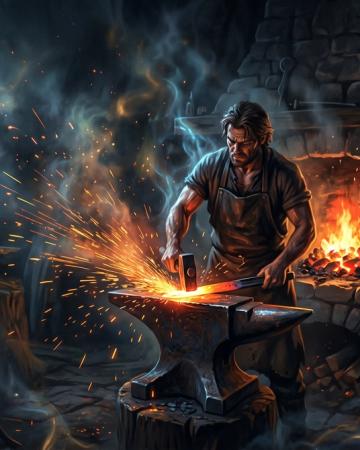
Driving a nail almost always has to do with fastening something: a decision made, an agreement sealed, a place where you're settling in. The dream stages the object of your fixation.
Watch how the nail goes in. If it sinks in one stroke, the decision is ripe and the scene carries the same confidence. If it bends or won't go in, the dream points at the surface instead: wood that's too hard, bad timing, a method that forces. Imagine you hit harder and harder and nothing moves. I'd read that as an invitation to look at the wood before blaming the hammer. A nail that bends also keeps you from fastening something crooked, which looks a lot like help.
In the Ibn Sirin tradition, driving a nail into wood announces a marriage, meaning two things that won't come apart again. Think about the hand on the tool, too. Is it yours, or is someone nailing for you? In that case the question becomes who decides what holds in your life.
First thing to rule out: if you're renovating, in the middle of a move, or tinkered with something yesterday, the dream may simply have replayed the sounds and motions of your day. Then it is looking no farther than your living room.
The coffin is a case apart, because its nails close for good. Seeing a coffin nailed shut, or hearing the hammer blows, speaks of something ending: a period, a role, a relationship you're burying. It doesn't announce anyone's death, and dreams of a coffin far more often mark the end of a chapter than the end of a life. Notice who holds the hammer and how you feel: relief says you've already turned the page, dread says you're turning it too fast. English even has the phrase "the last nail in the coffin" for the final blow to a doomed plan, and the dream may be using the same picture.
What does it mean to find or pick up a nail?
A nail you find is a tool without a project: you have something to fasten with, but not yet the place. The dream is about resources before it is about decisions.
"Finding a nail" is a search that comes up often, and the circumstances matter. A nail at the bottom of your pocket is yours and waits its turn. A nail at the roadside looks like an opportunity from outside. The collections credited to Ibn Sirin tie a large number of nails to strength, allies, soldiers and helpers, with one caveat: one entry also sees the company of questionable people. From all of this I keep a single question: who do you plan to build with? A nail you come across unlooked-for also has something of a builder's leftover about it: it comes from someone who built before you, and asks what you'll do with their inheritance. If the nails are scattered on the floor, ask which projects are still in loose parts and which one deserves assembling first.
What does it mean to pull a nail out?
Pulling a nail undoes a fixation: you give up what held together, or you free what was held. How you feel on waking, relief or regret, tells you which side you're on.
"Pulling nails" is a common search, and I found no old entry on it in the dictionaries I read, so I'm sticking to the meaning of the gesture. Pulling a nail takes leverage, patience, and some effort. In your life that might look like leaving a belief, a job, a commitment that grew too heavy. The hole stays in the board, a small scar in the wood that keeps the trace of what held there. If the dream ends on that hole, look at what you'll put in its place, or whether you'd rather let the board breathe.
What about a rusty nail, or a nail in your foot?
A rusty nail points to an old commitment nobody tends anymore; a nail in the foot, to a detail that stops you cold. Neither predicts misfortune.
Rust fuses with the wood: pulling an old nail tears out material, and some compromises end up becoming part of us. Ask whether you want to clean up that past or leave it where it has found its use. A nail in the foot halts your walking on the spot. It differs from a thorn, which is small and comes from the path with no one behind it: a nail was driven in, or left lying, by someone. Who left this one: you, someone close, a workplace? Finally, a lone nail driven where nothing hangs matches the phrase "fixed idea": a thought sunk too deep to budge. If an injury like this really happened to you, check the date of your last tetanus shot: that advice comes from common sense, not from the dream.
Why would you spit out or swallow nails in a dream?
In the collections credited to Ibn Sirin, swallowing nails means swallowing your anger. That old reading fits the image well: a taste of iron, a mouth full of points, and nothing you can say.
Spitting the nails out changes the scene. Your dream body rejects what can't be digested, and I take that as a good sign. Have you swallowed sharp remarks to avoid a scene? Truths you keep trying to digest out of politeness? A mouth full of metal speaks of a stifled voice, and a tight throat on waking tells you how much. If these dreams repeat and leave you uneasy, confide in someone you trust, and in a doctor or therapist if the unease settles in: words held back for a long time end up weighing on you.
Nail, screw, or fingernail: which one did you dream of?
A nail is struck and never taken apart; a screw tightens and loosens; a fingernail belongs to your body. English uses one word, "nails," for the metal and the nail on your finger, so searches cross over.
A screw can be reconsidered: you adjust it, back it out without tearing the board. A nail commits more, which is why a nailed-down decision weighs so much. Fingernails tell another story: in the same books attributed to Ibn Sirin, the nail on a finger stands for a person's ability and standing, long and handsome ones for money or business, broken ones for a loss. Those readings are old landmarks, not a forecast. This page is about the metal kind; a dream of fingernails, or of nails falling off, is a different symbol.
What do you do with the nail once you're awake?
Note the gesture (driving, finding, pulling, swallowing) and the state of the nail (new, bent, rusty). The first points to the action waiting for you; the second, to how old the question is.
Then try this. Find a nail in a wall at home that no longer holds anything. Remember what hung there and why it came down. The memory is often enough to name what the dream touched. Decide whether to pull the nail or hang something else on it. And if the dream still nags at you, you can tell it to Yume in Midnight Mind, who will go back over it with you, object by object.