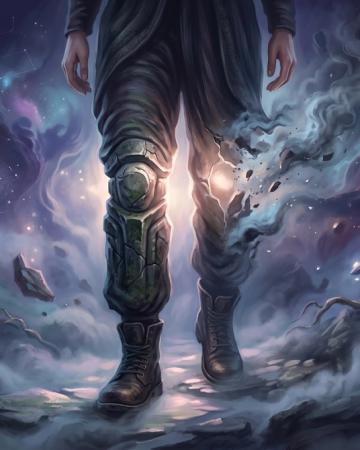


In his book on dreams, Artemidorus tells of a man who dreamed his feet were walking on their own while his body stayed still: they moved without ever getting anywhere. Soon afterward, the man was sentenced to the pump, a kind of forced labor where you walk without leaving your spot. Dreams about feet often feel like that: real effort, and a question about where it leads. Bare, heavy, hurt, or stuck in a pair of shoes you can't find, it's the detail that changes the reading, so let's take them one at a time.
What does it mean to dream about feet?
Dreaming about feet is about footing and forward motion: what carries you right now, and which way your steps are taking you. Everyday language says the same thing. We lose our footing, keep our feet on the ground, land on our feet.
In a dream, you usually notice feet because something is off. As long as they do their job, nobody thinks about them, and the dream only brings them up when they raise a question. For Artemidorus, they stand for those who serve and carry: slaves, but also children, who serve their parents. He even faults most dream interpreters of his day for thinking only of slaves. Today, we tend to read in them what carries you yourself: your work, your home, your health, the people you lean on.
In my view, two questions are enough to start with: what were your feet standing on, and were they getting anywhere? If it was your legs that stayed with you, the reading is close, and worth a detour.
What does it mean to walk barefoot in a dream?
Walking barefoot usually says you're exposed, with no protection or layer in between. The ground decides the rest: it makes the scene gentle or harsh.
On cool grass or warm sand, it's often a return to something simple, a moment when you have nothing to prove. On gravel, brambles, or broken glass, the same bareness becomes exposure: you move without your usual protection, like having to play a role without the costume. If you're barefoot somewhere you shouldn't be (at the office, on the street, at a party), the dream looks like those scenes of embarrassment where you find yourself unprepared.
Old readings are split. In the dictionaries published under Ibn Sirin's name, walking barefoot means hardship and fatigue. In the Bible it's the opposite: at the burning bush, Moses is told to take off his shoes because the ground is holy (Exodus 3:5), and bare feet become a sign of respect. I wouldn't choose for you. Just ask yourself whether you felt free or raw. Your own feeling settles it.
Why do your feet feel heavy or stuck to the ground?
Most often, the dream stages an effort that goes nowhere, or a road you're hesitating to take.
Imagine you're walking down an endless hallway. You can see the door at the far end, you put in a huge effort, and still the floor slides under your feet like a treadmill. In that case your strength isn't the issue; the terrain is. Then ask the question that separates the two readings: is it your effort you need to rethink, or your direction? Someone wearing themselves out on a task that no longer fits them will have this dream quite naturally.
Part of the explanation is probably very physical. During REM sleep, the muscles of the body are almost completely relaxed, which makes your legs hard to "feel" in a dream and is why running is so hard there. If this dream keeps returning and your legs also feel heavy or numb while you're awake, that's a question for a doctor, not for a dream dictionary.
What does it mean when your shoes go missing?
Most often, a feeling of not being ready: you have to leave, and something is missing.
The scene is very common: a trip, an interview, a ceremony, and shoes that stay missing or don't match. A shoe stands between your foot and the road; it gets you ready to walk. Losing one is the sense that the road begins before you have what you need. The right question is a specific one: what do you feel you're short of in order to get going? Time, money, confidence, someone's go-ahead?
I stay cautious on one point: that lack may be real, or it may only be a doubt the dream puts into pictures. If you can't tell which, list what you already have. The list is often longer than the dream made it seem.
What do hurt or dirty feet mean?
They point to a weak spot in what carries you: fatigue building up, a responsibility that weighs on you, sometimes unease about something you did.
A cut, a sprained ankle, a sore foot: the injury is a forced stop. It makes you look at where you are. The dictionary that bears his name ties harm to the feet to finances, work, or the boss you depend on, which is to say to what supports your material life. If the pain centers on the heel, it's the weak spot, the place where you're easiest to hurt, that you should look at.
Dirty feet, covered in mud or dust, speak more of having walked through something. Ask yourself where you've "stepped" lately: an embarrassing situation, a choice you're not proud of, or just an exhausting stretch. The dream hands down no verdict and predicts nothing: it shows what you carry with you.
What does it mean to have more than two feet, or to lose one?
Artemidorus gives this odd scene a whole passage, which makes it almost a specialty of this symbol. For him, having more feet than usual is good news for merchants, shipowners, and anyone who employs workers, since they will have more people at their service. A poor man gains servants. A rich man, on the other hand, falls ill: he will need more feet than his own, those of his bearers. He adds that many dreamers who had it went blind afterward and had to take guides.
These readings come from a world where people got around on foot or in litters, and they shouldn't be applied literally. Keep the core idea: extra feet are the feeling of needing more means to get ahead. A missing foot reads the other way, as the sense of losing a support. Under Ibn Sirin's name, an amputated foot means losing half your wealth. Either way, look at what around you suddenly seems like too much, or not enough.
And what if the feet are someone else's, or you are washing feet?
Someone else's feet point to what you do for them, or to what they carry.
Washing, tending, or massaging someone's feet is a scene of service and humility. In the Gospel of John (13:5 and 14), Jesus washes his disciples' feet and tells them to wash one another's feet. The gesture means the same thing there as in your dream: coming down to the other person's level, taking care of them. Having your feet washed reads the opposite way, as the difficulty or the relief of letting yourself be looked after. Following the feet of someone walking ahead of you raises the question of whom you're following. And if the scene had a sensual or intimate tone, it reads like any dream of closeness with that person.
That's the set of landmarks. When you wake up, before you get up, do one simple thing: put your feet on the floor, then write down three things from your dream. What were they walking on, what were they wearing (or nothing), what were they doing (moving ahead, staying put, slipping)? Those three clues beat any list. If you'd like, describe the scene to me in the app, with the texture of the ground and the feeling under your feet: I'll read it with you, detail by detail.