

Maybe you crossed a bridge, stopped halfway, or stood at the edge without daring to step on. A bridge has two ends, and a dream rarely shows you both. What matters is how it felt to walk on it, what lay beneath your feet, and what you could make out on the far side. Let's go through those three clues, and then look at what myths have done with bridges for a very long time.
What does it mean to dream of a bridge?
Dreaming of a bridge is almost always about a passage: from one situation to another, from one stage of your life to the next, from a state of mind you're leaving to one you don't know yet. The bridge doesn't tell you whether you're ready. It shows that you're in between.
I read it through three things. First, its condition: solid, shaky, or broken. Second, your attitude: are you moving forward, hesitating, or holding back? Third, what you can guess about the other bank. If you have no idea, that is information too: the transition is under way, but its destination is still blurry to you.
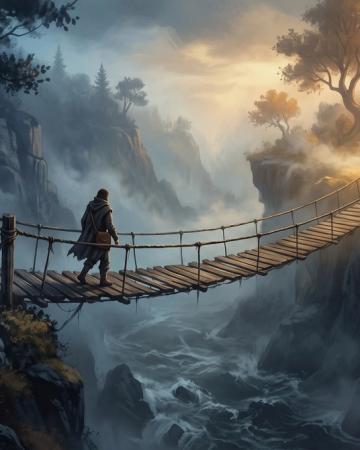
Condition and material go together. A stone bridge speaks of continuity: the change rests on something you've built. A rope or plank bridge speaks of precariousness, a crossing without guarantees where you test every step. A modern bridge of steel or concrete, straight and efficient, points to a change you've already decided on, almost like paperwork. A ruined bridge says you feel the crossing will be harder than expected, which is a good reason to prepare for it, without giving up. When the bridge is solid and you feel up to it, the dream simply confirms that you have what the crossing takes.
A common psychological reading sees the bridge as a link between two parts of yourself, say reason and emotion. I think that holds up as long as you start from the scene and not from the diagram. Ask yourself which two concrete things your bridge connects: two jobs, two cities, two people, two versions of you. If it's the road itself that stayed with you, dreaming of a road may shed light on the other half of the image.
What does it mean to cross a bridge in a dream?
Crossing a bridge goes with a change you've already started or are about to start. The crossing counts for more than the far bank, which the dream often barely shows.
Where the dream catches you changes the reading. At the foot of the bridge, the decision isn't made yet. In the middle is the most telling spot: going back is no longer easy, and you haven't arrived. Picture yourself stopping halfway and turning around, and the bank you left is already a little hazy. Plenty of real situations feel like that: a move in progress, a recent breakup, a new job you haven't taken the measure of.
If you reach the other side, the dream often ends on a quiet sense of relief. If it cuts off before you get there, don't try to finish it. The question is still open, and that's what to look at when you wake up.
What does the space under the bridge say?
What lies under the bridge shows what this change is stirring up in you: water for feelings, empty air for uncertainty, mist for what you can't see yet.
Calm water beneath the arches reads as feelings settling during the transition. A violent current says the change is shaking you more than you admit. When there's nothing but a gorge with no visible bottom, the vertigo takes over. I take it seriously, because it comes from the body: creaking planks, a racing heart, a tight stomach. Those sensations often capture what's at stake in a decision better than any word could. Ask yourself whether your dizziness comes from real danger or from not wanting to let go of the bank you're leaving.
Fog says something else: you don't have to guess what comes next, only where to put your next foot. And a bridge laid over the ocean, with no bank in sight on either side, points to a long transition that asks for patience more than momentum.
Is not crossing the bridge a failure?
No. Standing at the bridge or refusing to step onto it shows hesitation, and hesitation is information worth listening to, not a fault.
There are two ways of not crossing. One is fear: you want to get across and something holds you back, the unknown, an old wound, the memory of a change that went badly. You tend to wake up uneasy, sometimes with the sensation of falling or being frozen in place. The other is wanting to stay: you look at the far bank with no urge to go there, and the dream feels fairly calm. In that case the question is whether you're choosing to stay or letting yourself be held back. There's an old saying about crossing that bridge when you come to it, and sometimes a dream is just telling you that you aren't there yet.
Picture yourself settling under the bridge instead, against the cool stone, listening to the water pass overhead. That spot exists in dreams, and it speaks of a need for shelter, a stretch of time when you don't have to choose. I see nothing shameful in it. If the same hesitation follows you into waking life and keeps you from moving on a decision that matters, talking it over with someone close usually helps more than brooding alone.
Why do myths send the dead across a bridge?
Because a bridge is the simplest image of a threshold: once you've crossed it, you're no longer on the same side.
In Zoroastrianism, the Chinvat Bridge (in Avestan, the "bridge of judgment") is the one every soul crosses after death; it looks wide to the righteous and narrow to the wicked. In Islam, hadith describe a bridge over Hell, the Sirat, which each person crosses faster or slower depending on their deeds. In the Norse world, Snorri tells in the Prose Edda how Hermóðr, riding to the dead to find Baldr, crosses the Gjallarbrú, guarded by the giantess Móðguðr. And the Romans called their priests pontifices, a word often tied to pons and facere, "bridge-maker," though that etymology is debated.
None of these texts is about dreams. They only show that the bridge has long been the figure for passing from one world to another. If your dream returns after a loss or before a big turning point, it may carry that sense of a threshold, and you don't need to share any of these beliefs for that to be true.
What does it mean to meet someone on a bridge?
It depends on who you meet and what you do together: you find each other again, you part, or you don't know who they are.
A familiar figure on the far bank suggests a reunion or a goodbye. If the person has died, this dream often comforts and sometimes shakes you. Let whatever you feel come, and don't rush to explain it. If grief still weighs on your days, someone you trust, or a therapist, can help you carry it: a dream puts a name on the pain, but it won't heal it.
A stranger waiting in the middle often points to something you haven't named yet: a situation, a fear, a part of you. Notice what they do. Someone blocking your way speaks of an obstacle; an outstretched hand, of support you may need.
How do you name the two banks?
Grab a page and draw a line across it. On the left, write what the bridge was taking you away from; on the right, what you guessed lay on the other side. Then put an X on the line where you stood in the dream.
It looks simple, and it is often enough. It forces you to name what the dream left blurry, and that's where the transition becomes concrete: you can't decide to cross something you haven't described. If the right bank stays empty, the change is mostly a departure, and the question becomes what you're looking for. If the left bank is hard to write, that may be the one to look at first. Also note what the bridge was made of and what was beneath it. Those two details shift the reading most.
If you want to go further, describe your bridge to me in the app: the material, the mist, the person you met, the bank you reached. I'll read it with your details, and the dream will find its place in your journal.