

A construction site is one of the few places where nobody expects you to be finished: the walls are bare, cables lie across the floor, and the result is promised for later. When that scene moves into a dream, you can wake up with opposite feelings, the drive of something moving forward or the vertigo of something that will never end. What follows should help you recognize your own version of the dream: your place on the site, the state of the work, and how you feel when you wake.
What does it mean to dream about a construction site?
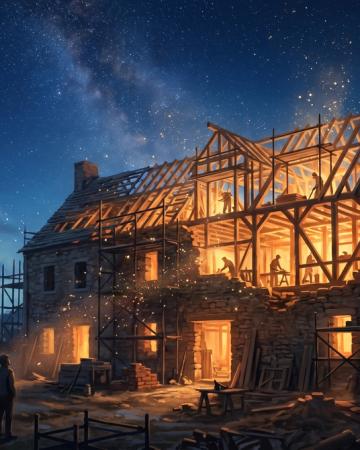
Dreaming about a construction site says that something in your life is being built or reworked and isn't finished. The scene itself doesn't announce a success or a problem.
What I like about this symbol is that it promises nothing. Dream dictionaries love to say "success ahead" or "hard work", but the image shows a halfway state: what stood there has been opened, and what comes next doesn't exist yet. The real question is what is under construction in your life. A job you're changing, a relationship you're reorganizing, a way of seeing yourself that you haven't replaced yet.
If nothing comes to mind, that tells you something too. The dream may be about a wish to change that doesn't have a name yet, like a building permit filed before you know what you want to build.
The size of the site matters, too. A small job (one wall to redo, a single room) reads as a targeted change you can name. A huge site, with cranes as far as you can see, points to an ambition that impresses you, sometimes to the point of vertigo. If that's your dream, it may be suggesting you break your goal into pieces: nobody builds fifty floors in a night, not even in a dream.
What does a house under renovation say when you still live in it?
It speaks of a change you go through without being able to stop living: daily life carries on during the work, with dust on the table.
Imagine you're cooking dinner in a kitchen with one wall missing, workers moving through the hall. If you adapt easily, you handle a change in progress well. If it drives you up the wall, maybe you lack a room to catch your breath, an hour that's yours while everything shifts. A house is a common image of the self and of privacy, so renovating it points to what you're reworking in yourself: a family inheritance, a habit, a relationship to the past.
The difference from moving is small but real. When you move in a dream, you change address and take your boxes. Here you stay, and the house changes around you. Ask yourself who ordered the work: you, or a situation that forced your hand.
The room involved sharpens the meaning. A kitchen under construction often reads as a change in how you feed yourself, in the broad sense, how you take care of yourself. A bedroom open to the wind touches intimacy, a relationship, sleep. A roof being redone speaks of protection, of what covers you when things go badly. These are leads, not rules: how you feel in that room settles it.
Who is running the work in your dream?
Your place on the site matters more than the site: the person who decides, the one who carries out orders, and the one who watches aren't living the same change.
If you're the architect, plans in hand, the dream shows a project you authored and are steering. If you're hauling bricks without knowing for whom or why, it's more about a change that landed on you, with tasks handed down and no explanation. If you're watching through the fence, the change is within sight but out of reach: out of caution, or because someone else decides.
One case comes up often: unknown workers are building without you. I read it gently, as a transformation that moves ahead without your watching every step. Still, I wouldn't brush it off. Look at what they're building. If you recognize what's rising, you know more about what you're preparing than you've admitted to yourself.
One last detail helps: the plans. Do you have any in your hands, and can you read them? A plan that's unreadable, or that changes every time you unfold it, describes a project whose outline isn't settled, which is normal at the start. A plan you can't find at all invites you to ask who is keeping it.
Why do the noise and dust wake you up?
Because they're the least pleasant parts of any change, the ones you endure and no longer see once the result is finished.
In a construction dream the senses take over: the rhythmic strike of a hammer, a machine droning, dust stinging your eyes, rubble you trip on. I read them as the cost of change, the time when what's moving makes noise before it makes room. A nearly silent site suggests a quiet transformation. A racket that wears you out suggests too many things changing at once, or a change that leaves no room for rest.
If you do wake up worn out, and the exhaustion has lasted for weeks, find someone who will listen, a friend or a doctor. A dream can point to it, but it can't treat it.
Does an abandoned construction site mean you've given up?
Not necessarily. It asks a question: do you pick the project back up, change it, or close it?
You may know the scene: bare concrete, rebar rusting in the rain, hardened bags of cement, nobody in sight. It's the site that saddens me most, because you can sense an intention that stopped. The Bible keeps a famous trace of one: at Babel, people want a tower "whose top may reach unto heaven", and the story ends with the words "they left off to build the city" (Genesis 11:8).
To see where you stand, ask what stopped the work. If it was fear or fatigue, the dream is reminding you of a project that's waiting. If the project no longer fits you, letting it go is a decision, and one worth making on purpose rather than having it made for you. Melancholy on waking usually means the grieving for that project isn't done.
Why can't you step onto the site?
Because you want the plan to be perfect before you lay the first stone. This dream is often about perfectionism.
Imagine you're standing behind the hoarding, huge blueprints under your arm, too worried about one misplaced brick to lay a single one. The scene is common in people who want to check everything before starting. But a construction site is exactly where you find out what the plan didn't show: a wall that starts crooked can be fixed, while an empty lot can't.
Pick a task so small it can't fail, and do it this week: carry one brick, write one page, make one call. That first move is worth more than a flawless plan nobody has seen yet.
Where do you start once you're awake?
Write down the scene, your role, and the state of the work, then name the project in your life that has been open the longest.
Here's the question I'd keep in mind: what project, what part of your life, is under construction, and who holds the plans? Write the name of the site at the top of a page, then the next step, just one. If the site overwhelmed you in the dream, break it down until the first step looks almost too easy.
You can also drop the dream into the Midnight Mind app, along with what you were doing and what you felt. Reading it again in a few weeks, you'll see whether the work has moved, whether the workers have changed, and whether you've stepped onto the site. If the dream leaves you with a worry that won't fade, it's better to talk it over with someone than to hunt for a meaning alone.