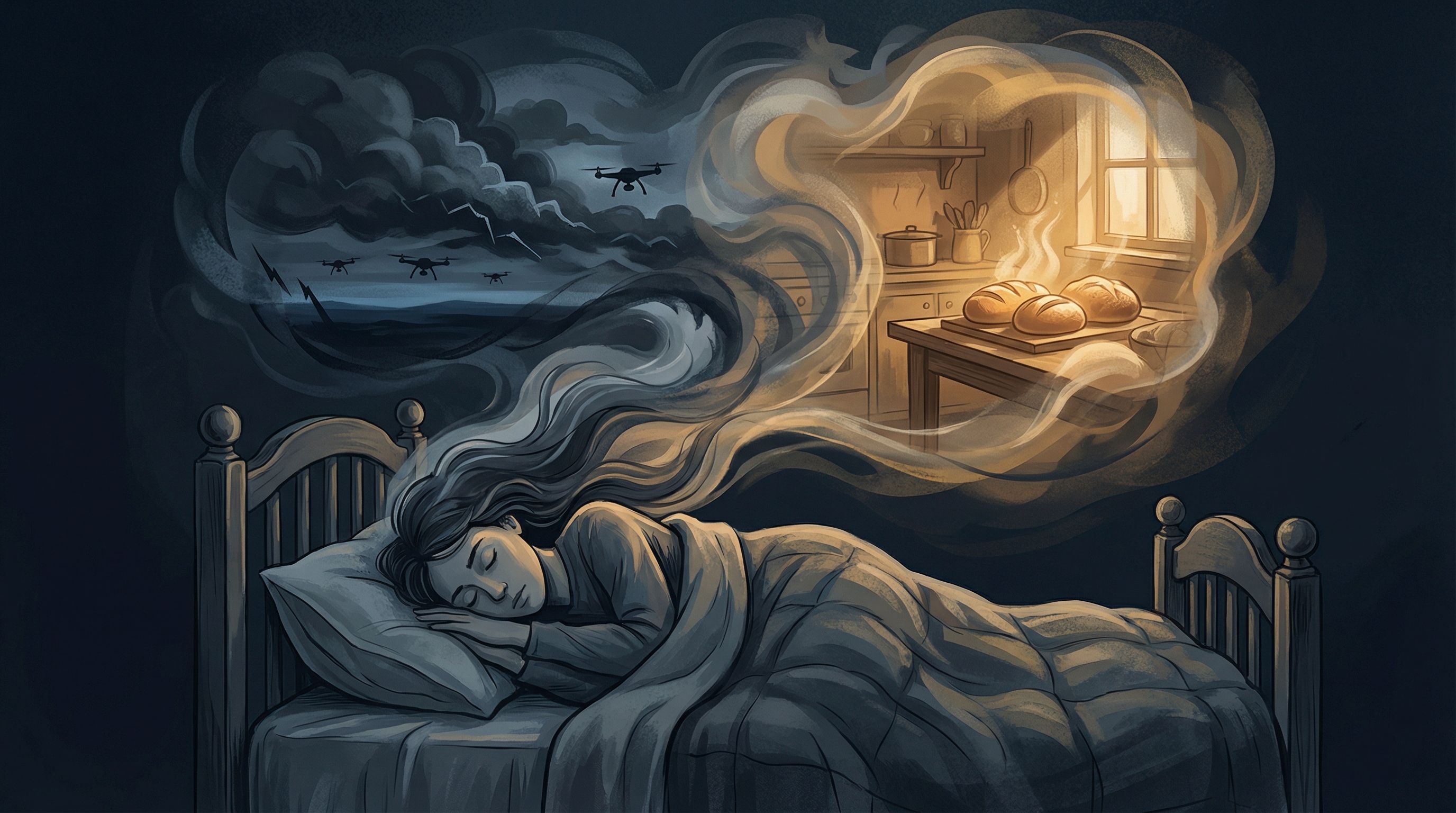
The Architecture of Silence: Why Your Environment Dictates Your Dreams
Your brain is a tireless machine for detecting patterns and contexts. For it, your bedroom should not be an extension of your office or a secondary living room. It must be a space dedicated exclusively to disconnection and psychological reconstruction. When you bring your laptop or your stress into this space, you are telling your brain that the "sentinel mode" must remain active.
From a neuroscientific perspective, the quality of your sleep—and therefore your dreams—depends largely on reducing external stimuli. Some researchers suggest that when the amygdala, the brain's emotional sentinel, perceives a safe and predictable environment, it allows the prefrontal cortex to relax its grip.
It is in this specific release that the purest dream images are born. A cluttered space often mirrors a high mental burden. By decluttering your resting place, you offer your mind a blank canvas on which your dreams can project themselves with greater clarity.
Temperature also plays a silent but crucial role in this architecture. Specialists in sleep hygiene often estimate that a slightly cool room (around 18°C or 65°F) is ideal. A body that cools down slightly signals to the brain that it is time to delve into the deep cycles. An overheated room maintains a biological vigilance that can weaken the REM phase—the very stage where your nocturnal narrative is woven.
🌙 Sora's Echo: Clutter is a dull noise that the mind continues to hear even with its eyes closed. To welcome the dream, you must first silence the material world.
---
The Alchemy of the Senses: Preparing the Terrain of the Unconscious
To transform a simple habit into a true ritual, you must engage your senses consciously. It is not mechanical repetition that creates the sacred, but the attention you pay to each gesture. You are not just "going to bed"; you are preparing for an odyssey.
Light is your first lever. Melatonin, the hormone of the night, is extremely sensitive to the blue frequencies emitted by our screens. By dimming your lights an hour before bedtime, you trigger a biochemical cascade that prepares the ground for a deep dream immersion.
The sense of smell is particularly powerful because it is the only sense directly linked to the limbic system, the seat of your emotions and long-term memory. Using a specific fragrance—such as sandalwood for grounding or lavender for calming—creates a powerful olfactory anchor. Over time, this scent becomes the password that unlocks the doors to your inner world.
Touch should never be neglected. The choice of materials that come into contact with your skin influences your sense of security. Natural fibers, such as linen or organic cotton, promote optimal thermal regulation and a feeling of comfort that invites total surrender.
Finally, your hearing can be lulled by specific frequencies. While the science on "binaural beats" is still evolving, many find that white noise or natural soundscapes mask the erratic sounds of the city. The goal is to create a bubble of serenity where nothing interferes with the fluidity of your thoughts.
---
The Psychology of the Threshold: Habit as an Anchor
A habit becomes a bridge when it is practiced with the intention to remember. The passage from wakefulness to sleep is a transitional zone—a "threshold." It is here that the quality of your memories at awakening is determined.
The pre-sleep ritual acts as a decompression phase. By slowing down your movements and your breathing, you signal to your unconscious that you are ready to listen to what it has to say. This is the ideal time to practice "dream incubation": posing a question or holding an image in your mind that you take with you into the night.
The act of writing, even just a few words before sleeping, prepares the brain for the effort of memorization. By keeping a notebook on your bedside table, you materialize your respect for your nocturnal productions. The mind, feeling that it is being listened to, tends to produce more structured and more frequent messages.
This process requires patience. Regularity is key to stabilizing your circadian rhythms. By going to bed and waking up at relatively fixed times, you calibrate your internal clock. This allows for longer and more stable REM sleep phases, resulting in denser, more vivid dream narratives.
🌙 Sora's Echo: The dream is a shy animal. If you don't prepare a cozy nest and a marked path for it, it will remain hidden in the folds of your shadow.
---
Concrete Example: The Creative Incubation Ritual
Imagine a young architect, let's call her Elena, who feels stuck on a project. Her usual routine involves scrolling through social media until her eyes burn, leading to restless sleep and no dream recall.
She decides to change her "threshold." She replaces her phone with a warm cup of herbal tea and dims the lights to a soft amber glow. She spends ten minutes sketching a simple, abstract version of her architectural problem in her dream journal.
As she lies down, she repeats: "Tonight, I will see the structure I need." By the third night of this ritual, she wakes up not with a full blueprint, but with a vivid image of a spiral staircase made of light. This symbol provides the breakthrough she needed. The ritual didn't "solve" the math, but it allowed her unconscious to present the solution in the language of symbols.
---
Practical Guide: Configuring Your Night Sanctuary
To move from theory to experience, here are some concrete adjustments you can make to your environment starting tonight. These steps are not rigid rules, but invitations to explore your own comfort.
Arranging your physical space:
- Declutter the line of sight: From your bed, your gaze should not cross objects related to work, bills, or unresolved obligations.
- Control the darkness: Invest in blackout curtains or a quality sleep mask to ensure total darkness, which is essential for optimal melatonin production.
- The location of the notebook: Place your dream journal and a pen within arm's reach. You should be able to reach them without having to turn on a bright light or lose your body heat.
The transition protocol:
- Digital detox: Turn off your devices at least 45 minutes before lights out. Replace endless scrolling with contemplative reading or light meditation.
- Conscious hydration: An infusion of soothing herbs (like valerian or chamomile) can be an integral part of the process, acting as a gustatory signal that the day has ended.
- Diaphragmatic breathing: Practice a few cycles of slow, deep breathing to lower your heart rate and signal safety to your autonomic nervous system.
Mental anchoring:
- Positive visualization: Before closing your eyes, visualize a place where you feel perfectly at peace. This place will serve as a starting point for your nocturnal explorations.
- Clear intention: Mentally whisper to yourself: "I will remember my dreams tomorrow morning." This simple autosuggestion reinforces the connectivity between the different areas of your memory.
---
Conclusion: Towards a Rediscovered Intimacy
Creating a night sanctuary is an act of self-respect. It is recognizing that half of your existence, the one that unfolds in the shadows, is as valuable as the one spent in the spotlight of everyday life. By taking care of your bedroom and your rituals, you are not just seeking better sleep; you are opening a dialogue with the depths of your psyche.
Serenity is not the absence of thoughts, but the creation of a space vast and stable enough to accommodate them all, even the most mysterious. Each night is an opportunity to know yourself better, to untangle invisible tensions, and to discover new perspectives on your waking reality.
The path to a deep understanding of your nights begins with a first simple gesture: that of sacralizing your rest. Transform your habit into a celebration of the invisible, and watch how your dreams, in return, begin to illuminate your days.
If you want to explore your dreams more deeply, your Baku is waiting for you.
I once met a weary dreamer who tried so hard to force their bedroom into a perfect, sterile sanctuary that their nightly visions turned it into a cold, concrete fortress. They mistook safety for isolation. There is a delicate, almost poetic difference between burying yourself away in fear and weaving a true nurturing nocturnal nest where your spirit can breathe. A sanctuary shouldn't be a tomb designed to keep the world out, but a clearing in the woods where your tired soul can shed its heavy, waking armor. When you find yourself dreaming of these sacred shelters, do not see it as a retreat from life. Your mind is simply whispering that your current defenses have grown too rigid. You do not need thicker walls; you need a space soft enough to let the starlight reach your wounds.
Honestly, it fatigues me when modern interpreters dismiss these sanctuary dreams as simple escapism, as if seeking rest were a form of cowardice. They treat the night like a broken machine that merely needs oiling to resume production. Our ancestors possessed a far deeper reverence for these liminal spaces; they understood that entering the sleep state was a sacred crossing. In many forgotten night traditions, the dream sanctuary was not a place to hide, but a temple of active incubation where one went to receive guidance from the deep self. Your psyche does not build these quiet altars in your sleep to help you run away. It builds them so you can remember who you are when the noise of the world finally stops demanding your performance.