The Architecture of Your Unconscious
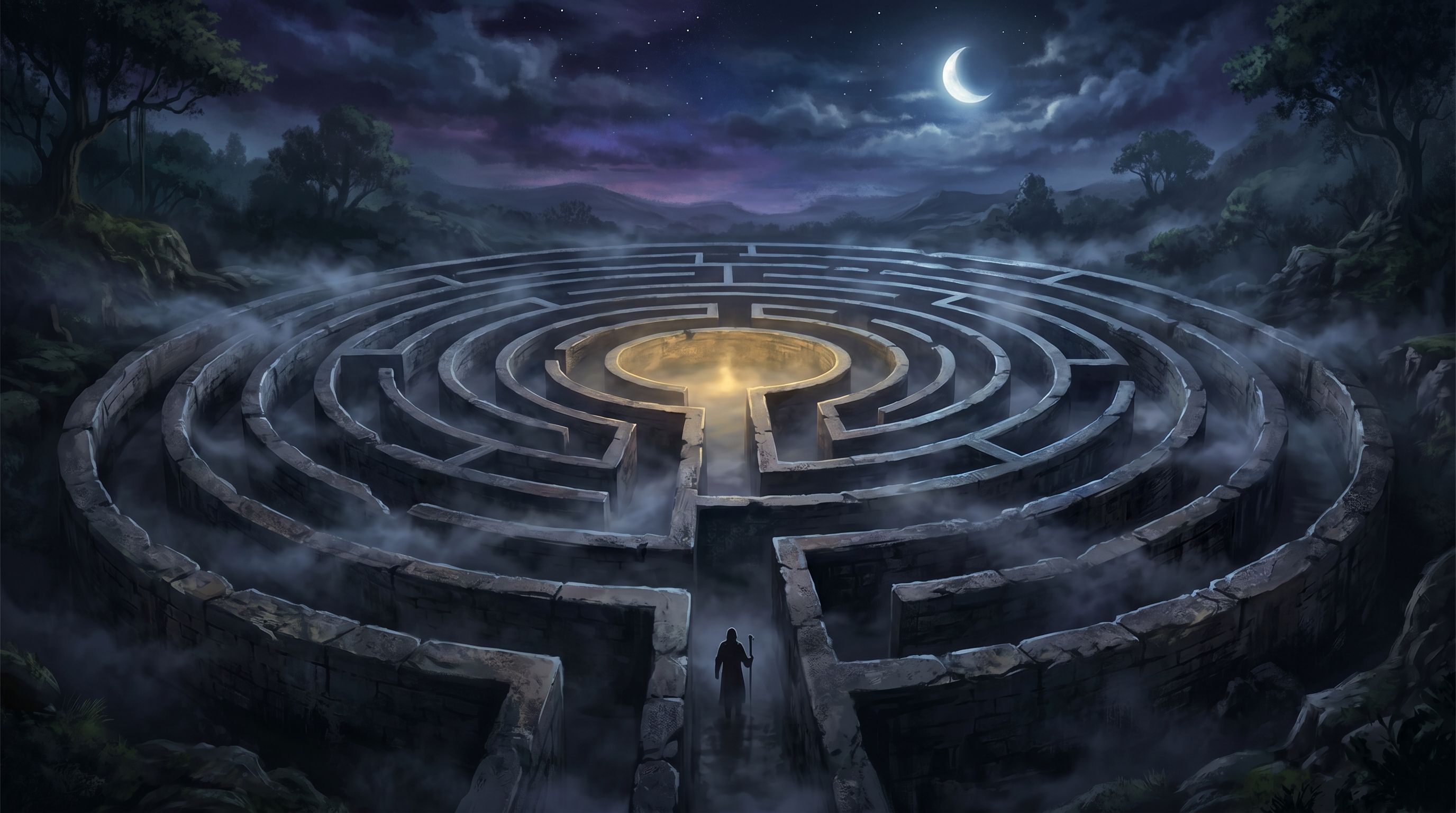
When you dream of a labyrinth, your mind isn't just playing tricks on you. It is presenting you with one of the most ancient symbols of humanity. From the stone carvings of the Bronze Age to the floor of the Chartres Cathedral, the labyrinth has always represented the soul's journey.
In the realm of analytical psychology, Carl Jung viewed such structures as representations of the collective unconscious. You aren't just wandering through your own memories; you are walking a path that millions have walked before you.
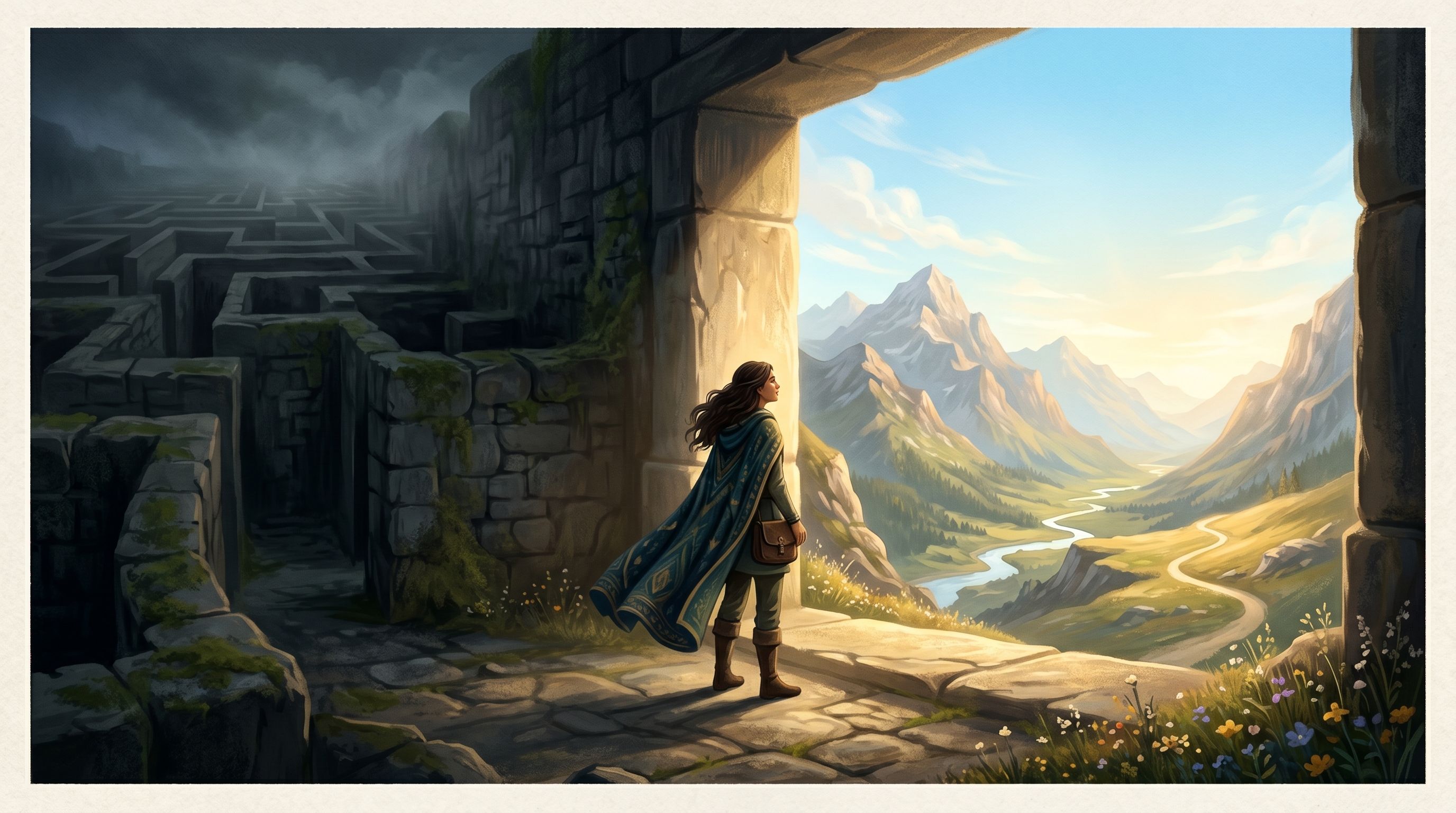
You might feel a sense of dread as the walls close in, but I want you to consider a different perspective. A maze is designed to make you lose your way, filled with dead ends and traps. A labyrinth, however, is unicursal. It has one single path. Even when you feel you are moving away from the center, the path is actually leading you toward it.
If you find yourself in an inner labyrinth during your sleep, your unconscious is telling you that while the way forward is complex, it is not impossible. You are exactly where you need to be to begin your transformation.
---
Meeting the Minotaur: Facing Your Shadow
In the myth of Theseus, the center of the labyrinth held the Minotaur—a creature half-man, half-bull. In your dreams, this monster is rarely a literal beast. It is more likely a personification of your "Shadow."
The Shadow consists of all the parts of yourself that you have rejected, hidden, or deemed "unacceptable." It could be your untapped anger, your hidden desires, or even your unexpressed creativity. When you run away from the Minotaur in your dream, you are running away from a part of your own soul.
"Getting lost is often the only way to silence the ego long enough for the soul to speak."
To find the center is to confront this creature. But notice how Theseus didn't just kill the beast; he had to find his way back. He used Ariadne’s thread. In your life, this thread is your consciousness—your ability to remain aware and present even when the darkness of the psyche feels overwhelming.
Some specialists in dream analysis suggest that the act of "facing" the monster in a lucid state can lead to a significant reduction in waking-life anxiety. By stopping and looking at what scares you, you strip it of its power to haunt you.
---
Concrete Example: The Library of Endless Halls
Imagine a dreamer, let's call her Sarah. She repeatedly dreamt of a library where the shelves stretched into infinity, forming a wooden labyrinth. She felt panicked because she couldn't find a specific book.
After reflecting on her waking life, she realized the "book" was her sense of career purpose. She was looking for a "ready-made" answer in the library of others' expectations.
Once she stopped running and sat down on the floor of the labyrinth, the walls began to glow. She realized the labyrinth wasn't a prison, but a sanctuary of knowledge. By accepting that she was "lost," she finally felt found.
---
The Science of Spatial Navigation in Dreams
While the mystical interpretation is profound, there is also a biological layer to your wandering. During REM (Rapid Eye Movement) sleep, the parts of your brain responsible for spatial navigation—like the hippocampus—are highly active.
Research suggests that your brain uses the dream state to "map" out complex emotional landscapes, much like it maps out physical environments. When you feel lost in a dream labyrinth, your brain might be attempting to resolve a "cognitive dissonance" or a complex problem that you haven't been able to solve while awake.
It is an evolutionary mechanism. By practicing the feeling of being lost in a safe, simulated environment (the dream), you become more resilient when facing uncertainty in the real world. You are, quite literally, training your soul to handle the unknown.
---
How to Navigate Your Own Inner Path
You don't need a physical map to navigate your psyche. You need a shift in posture. Here is how you can approach your next journey into the depths:
- Release the need for an exit. The goal of the labyrinth is the center, not the escape. Focus on the present step rather than the finish line.
- Identify your "Ariadne’s Thread." What keeps you grounded? It might be your breath, a specific ritual, or the act of writing down your dreams every morning.
- Engage with the walls. In your dream, touch the surfaces. Are they cold stone or warm hedges? The texture of your labyrinth tells you about the nature of your current mental blockages.
- Practice radical acceptance. If you hit a wall, don't fight it. Sit with it. Ask the wall what it is trying to protect you from.
The Shadow that we refuse to confront is often the very thing holding the key to our liberation. The labyrinth is not your enemy; it is the training ground for your awakening.
---
I once met a dreamer who kept dreaming of stone walls that smelled of damp moss and ancient rain. He was frantic, scraping his knuckles against the granite, searching for a compass or some ancient scroll to guide him. Honestly? It tires me when modern dream interpreters tell you to immediately look for "the exit" or analyze the layout as if it were a math puzzle. Sometimes, your soul builds these walls simply to force your hands to touch the cold reality of where you are. When you stop running and actually feel the texture of your obstacles, the panic subsides. It is like trying to navigate through a heavy dreaming of fog; you do not need to see the entire forest to take the next step. You just need to feel the ground beneath your feet.
Why do we always assume that being lost is a waste of time? I find myself marveling at how our waking lives demand straight lines—career ladders, schedules, direct routes—while our nighttime minds prefer the beautiful, winding detour of a dreaming of pilgrimage. In many ancient traditions, circling is not a sign of confusion, but of reverence. You circle the temple; you circle the fire. If your dream labyrinth curves gently rather than branching into sharp, frustrating dead ends, you are likely experiencing a softer kind of initiation. It is a slow peeling back of layers, a spiral descent. I often doubt if we are meant to "solve" these dreams at all. Perhaps the winding path is simply a cradle, rocking your restless mind until it is quiet enough to hear what the heart already knows.
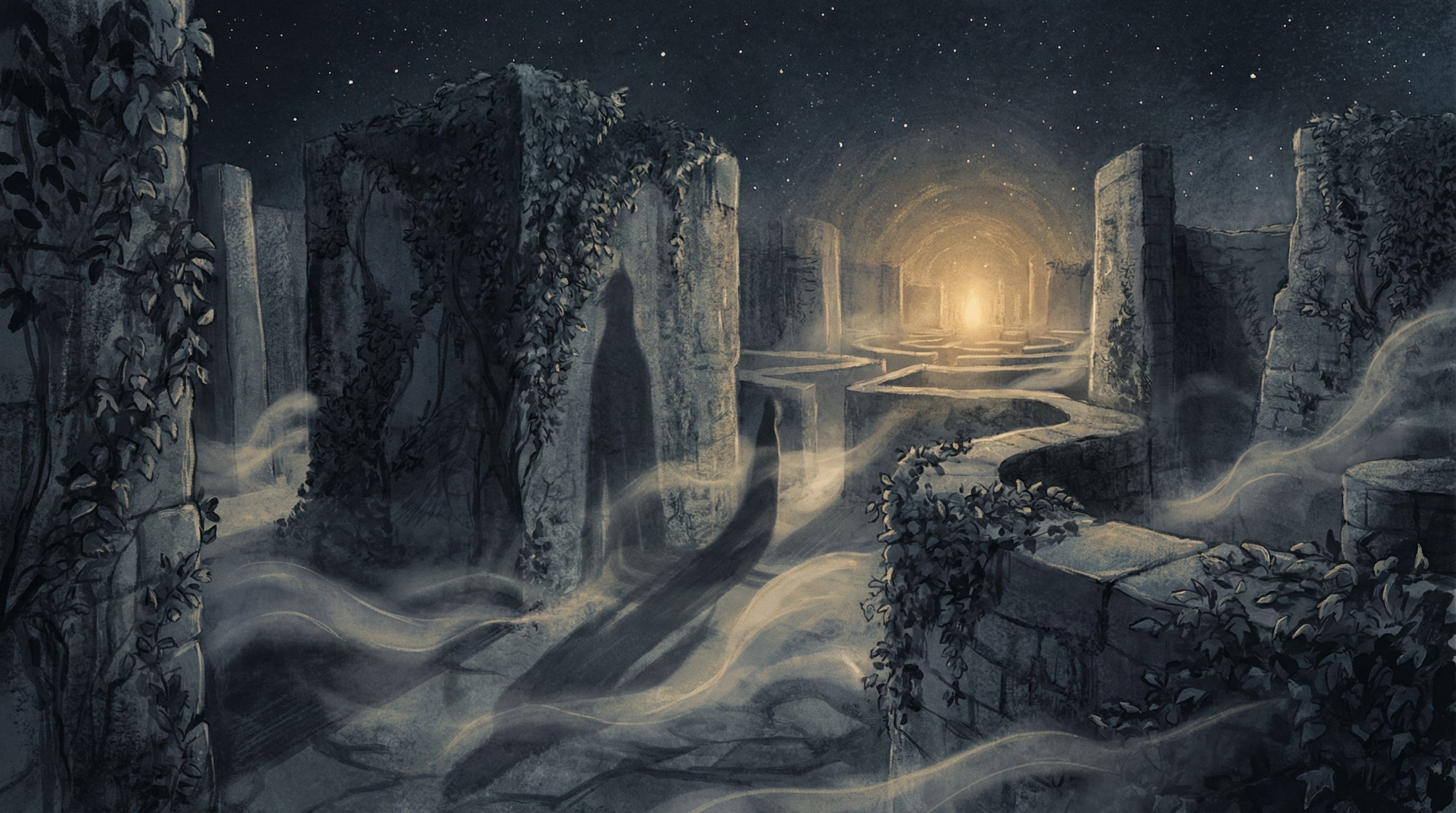
Have you ever paid attention to the physical sensations inside your dream maze? Sometimes, the walls are not made of ancient stone, but of damp, cold moss, or polished steel that smells faintly of ozone and old rain. It is exhausting, this heavy-limbed sensation of turning corner after corner, feeling the damp air press against your skin. Many dreamers tell me they feel a crushing, heavy silence there, where even their own footsteps sound muffled, as if they are walking underwater. I often think this sensory weight is your body’s way of forcing a slow down. In our waking hours, we run so fast, trying to escape the misty uncertainties of life. But when you are dreaming of searching through these quiet, winding corridors, your unconscious is simply asking you to feel the weight of your choices. It isn't a trap; it is a profound pause.
It mildly annoys me when modern dream guides claim that wandering a maze means you are failing or losing control of your life. What a sterile, mechanical way to look at the human soul. We are not machines built for straight lines; we are circular creatures. I once watched over a dreamer who spent weeks pacing a circular labyrinth, panicking because she kept returning to the same curved walls. She didn't realize that her soul was trying to unlearn the exhausting pressure of constant upward progress. There is a quiet, sacred beauty in walking without a destination. The next time you find yourself tracing these winding paths in your sleep, stop trying to solve the layout like a puzzle. Let the walls hold you for a moment. Sometimes, being lost is simply the soul’s way of resting from the noisy demands of a world that demands constant answers.