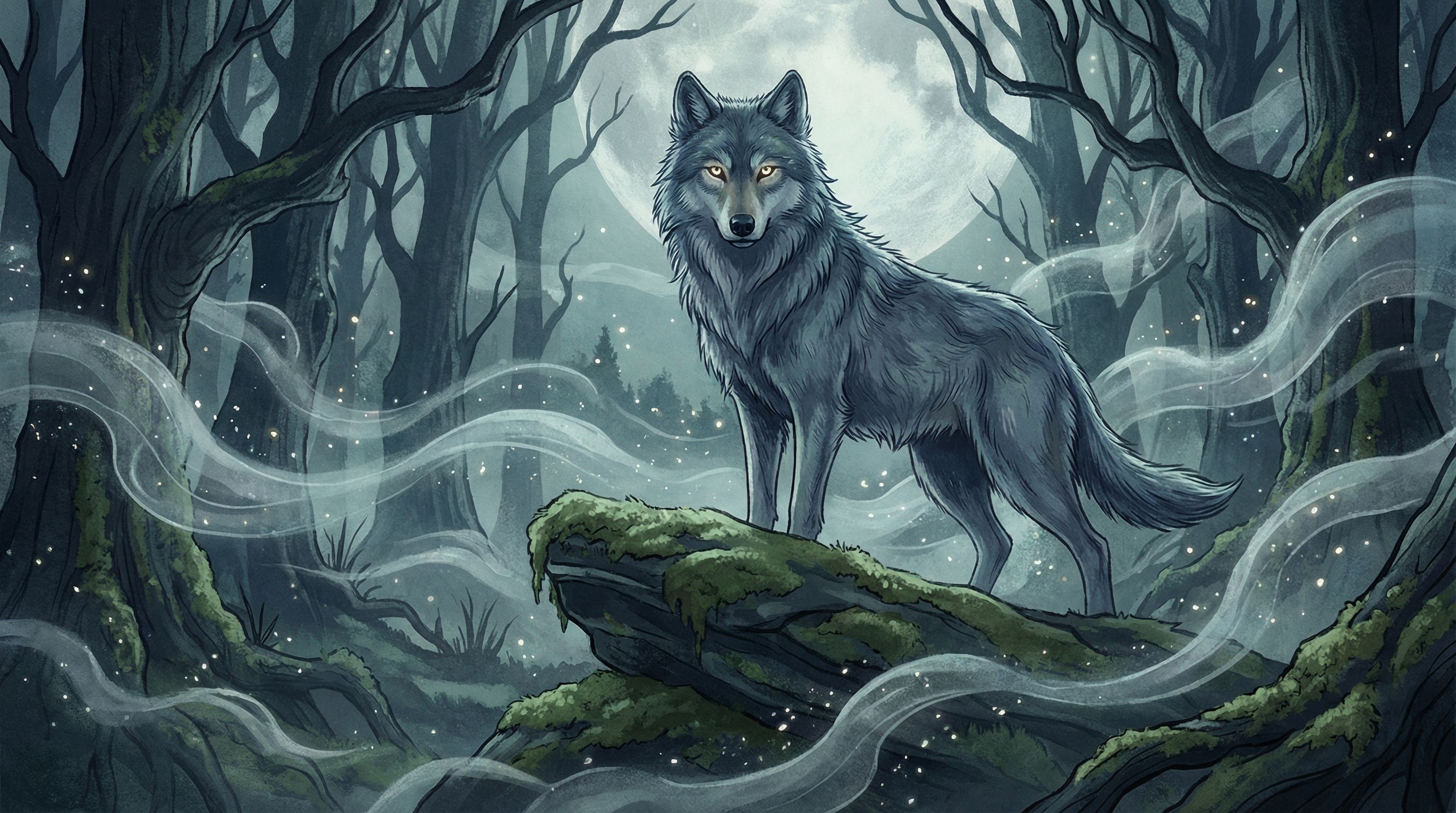
The Architecture of Your Inner Clock
Tu have probably noticed that some people leap out of bed at dawn, while others only truly come alive when the sun begins to set. This isn't a matter of willpower or discipline; it is a fundamental expression of your biology.
Your chronotype is the manifestation of your circadian rhythm, a 24-hour internal clock located in the hypothalamus. It regulates not just when you sleep, but when your body temperature rises, when your hormones fluctuate, and when your cognitive abilities peak.
While the majority of the population falls into the "Bear" category—following the rise and fall of the sun—about 25% of people belong to the more extreme ends of the spectrum. These are the Wolves and the Dolphins.
In my journey as a Baku, I have seen many dreamers struggle because they try to force a "Lion" schedule onto a "Wolf" soul. It is like trying to play a violin with a hammer; the tool simply doesn't match the music.
---
The Dolphin: The Restless Sentinel
If you find that sleep is a fragile thing, easily broken by the slightest sound or a stray thought, you might be a Dolphin. This chronotype represents roughly 10% of the population and is perhaps the most misunderstood.
The name comes from the fact that real dolphins sleep with only half of their brain at a time, staying alert for predators. If you are a Dolphin, your brain often feels like it never truly "shuts off." You might experience what specialists call "tired but wired" energy.
Research in chronobiology suggests that Dolphins often have a higher basal cortisol level at night, which is the opposite of what the body needs for deep sleep. This makes your sleep fragmented and light.
How to find peace as a Dolphin:
- The Power of Routine: Your clock is sensitive. Going to bed and waking up at the same time—even on weekends—is your most powerful tool for stabilization.
- Temperature Control: Because your body temperature may not drop as easily as others, keeping your bedroom cool (around 18°C) is essential.
- The 2 PM Rule: Your system is highly sensitive to stimulants. Try to finish your last cup of coffee before the mid-afternoon to allow your adenosine levels to build up naturally.
"Tu n'es pas un insomniaque par choix, mais un gardien dont l'esprit reste aux aguets. Apprends à rassurer cette vigilance plutôt qu'à la combattre."
---
The Wolf: The Master of the Night
At the other end of the spectrum, we find the Wolf. If you are a Wolf, the morning is a fog that only begins to lift after midday. You represent about 15% of the population, and you are the true "night owl."
Wolves often face a phenomenon known as "social jetlag." This occurs when there is a significant mismatch between your biological clock and the requirements of society (like a 9-to-5 job). For a Wolf, waking up at 7 AM is biologically equivalent to a Bear waking up at 4 AM.
However, once the evening arrives, your creativity and focus soar. While others are winding down, your brain is just hitting its stride. This isn't laziness; it is a delayed phase of melatonin production.
Strategies for the nocturnal Wolf:
- Seek the Light: As soon as you wake up, expose yourself to bright, natural light. This helps suppress melatonin and signals to your brain that the day has begun.
- The Late-Day Peak: If you can, save your most complex, creative, or demanding tasks for after 4 PM. This is when your cognitive performance is naturally at its highest.
- Strategic Napping: A short 20-minute "power nap" in the early afternoon can help bridge the gap between your morning grogginess and your evening peak.
---
Concrete Example: The Wolf in a Corporate World
Imagine a graphic designer named Alex, a classic Wolf. For years, Alex struggled to contribute to 9 AM brainstorming sessions, feeling sluggish and uninspired. After identifying as a Wolf, Alex made one small change: he moved his "deep work" (the actual designing) to the hours between 6 PM and 10 PM.
He used his mornings for low-energy administrative tasks and emails. By aligning his hardest work with his natural energy peak, his productivity doubled, and his chronic fatigue vanished. He stopped fighting his nature and started using it as an advantage.
---
Adapting Your Life to Your Nature
Understanding that specific profiles have very specific needs is the first step toward a more harmonious life. While we cannot always change our work hours, we can change how we treat ourselves within those hours.
If you are a Dolphin, stop blaming yourself for your light sleep. Instead, focus on creating a sanctuary that respects your sensitivity. If you are a Wolf, stop feeling guilty for your late starts. Your contribution to the world happens when the world is quiet.
Some specialists in sleep medicine suggest that our chronotypes evolved for a reason. In ancestral tribes, having "Wolves" to stay awake late and "Lions" to wake up early ensured that the group was almost always protected. Your rhythm has a purpose.
"La nuit n'est pas un vide à combler par le sommeil, c'est un espace où ton intuition peut enfin respirer sans le bruit du jour."
---
Honestly, it tires me to see how modern society treats these alternative rhythms as a moral failing, a lazy refusal to "seize the day." I often hear weary dreamers whisper in the quiet hours, wondering if they are fundamentally broken simply because they cannot greet the sunrise with a smile. It is not a lack of discipline; it is written into your very biology. We forget that our ancestors survived because the tribe had sentinels who watched the embers while others slept. Your restless midnight vigilance is a biological heritage, a natural variation not unlike the fascinating reality of atypical sleep genetics that bypasses standard human clocks. You are not malfunctioning. You are simply carrying a different, ancient architecture designed to keep the world safe while it dreams.
I once met a dreamer, a painter, who wept because she felt exiled from the waking world, convinced her nocturnal life was a curse. She lived in that cold, blue silence between two and four in the morning—a space where the air feels heavier and the mind’s defenses finally crumble. I ate her nightmares of isolation and showed her the quiet beauty of her own watch. When the world quietens, the subconscious speaks without the noisy interference of daytime demands. It is in this stillness that the deep creative currents flow. Once she stopped fighting her nature, she realized her midnight waking hours were not a prison, but a sacred space. To accept your natural clock is to transform what felt like a curse into a profound blessing that nourishes your soul.
I once met a dreamer who spent years crying at dawn, convinced that her inability to wake up early was a profound spiritual failure. She dreamed repeatedly of running through thick mud while an invisible jury judged her laziness. It broke my heart to taste that bitter, unnecessary guilt. We often forget that our internal clock is not a lifestyle choice we pick from a shelf; it is carved into our very DNA. When your unconscious presents you with the image of a rare, nocturnal beast, it is trying to heal the rift between who you are and who society demands you to be. It is a gentle reminder that your struggles might just be an expression of rare sleep genetics, a biological blueprint that is ancient, valid, and absolutely beautiful in its variance.
To be honest, it deeply exhausts me when modern self-help gurus preach that the 5 AM club is the only path to enlightenment. What a terribly narrow view of human nature. Historically, our ancestors understood something we have forgotten: a tribe where everyone slept at the same time was a tribe waiting to be hunted. We needed the restless sentinels, the wolves who watched the embers die down, and the dolphins who awoke at the slightest rustle in the brush. Your biological rhythm is not a disorder to be cured by discipline; it is an ancestral legacy. When you dream of these rare chronotypes, your spirit is calling you back to that ancient fire, asking you to stop apologizing for keeping watch while the rest of the world sleeps.