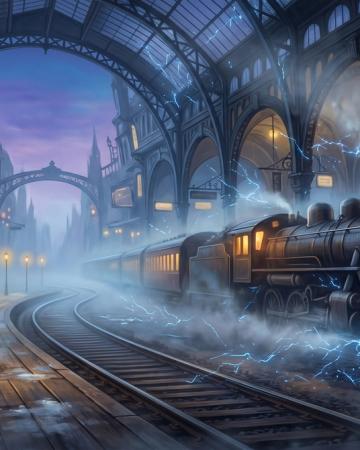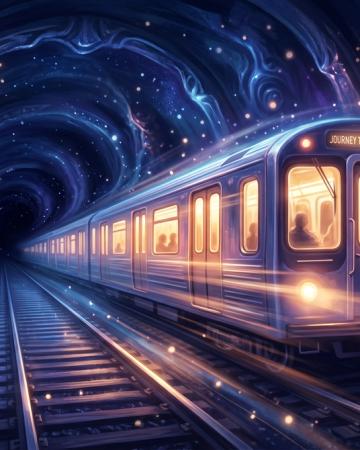

Do you remember the last time you heard the distant whistle of a train? That sweet melancholy, that promise of elsewhere... Dreaming of a train is often like that. A mix of excitement and nostalgia, of movement and destination. But what does it really mean? Don't worry, dreamer friend, we're going to explore the tracks of your subconscious together.
The train is, above all, a journey. A directed, guided journey. Unlike a car where you have total control, the train places you in a more passive position. This can reflect a period of your life where you feel like you're letting yourself be carried along, following a path laid out by others. Perhaps you feel stuck on tracks, unable to change direction. Or on the contrary, maybe this feeling of security and comfort reassures you. In this case, the train becomes the symbol of stable progression, of a predictable journey.
Psychologically, the train can also represent your life as a linear process. Each carriage could symbolize a stage or a phase. If you are at the front of the train, you probably feel in control of your life. If you are at the back, you might feel like you're just following the movement without really influencing the direction. And if you are between the carriages, perhaps you feel torn between different options and aspirations.
From a more spiritual perspective, I see the train as a metaphor for karma. We reap what we sow, and we move forward, carriage after carriage, through the consequences of our past actions. The final destination could represent our ultimate goal, our dharma. It's an image I find powerful, even if it might seem a bit frightening at first.
Of course, dreaming of a train isn't always about destination or control. It can also be about encounters. A station is a place of passage, of crossings. The people you meet on the train in your dream could be important figures in your life, aspects of your personality, or even hidden messages your subconscious is trying to convey. For instance, a dreamer once told me about dreaming of a train full of familiar faces, but all wearing masks. For him, it was a way of becoming aware of the hypocrisy surrounding him.
And let's talk about the variations! A late train? Frustration, blockage, a feeling of not moving fast enough. A train derailment? Fear of losing control, of seeing your life turn upside down. A crowded train? A feeling of suffocation, of not having enough space for yourself. An empty train? Loneliness, the impression of being isolated from your path. The station itself is also important. A busy station can symbolize a rich social life, while a disused station might indicate a lack of connection.
The tracks themselves deserve special attention. They symbolize the path, the direction. Are they well-maintained? In good condition? If the tracks are rusty or broken, it may indicate that you feel stuck, that you feel unable to move in the right direction.
So, what to do with all this? Above all, don't panic! Dreaming of a train is neither good nor bad in itself. It's a message, an invitation to reflection. Take the time to break down the details of your dream. What emotions did you feel? Who were the passengers? What was the condition of the train and the tracks?
Have you ever listened to the heartbeat of your train? Some dreamers wake up not with vivid images of landscapes, but with the steady, metallic clack-clack echoing in their ears. To me, this rhythm is the most fascinating part. It mimics the maternal pulse, a soothing, heavy tempo that lulls your conscious mind to sleep while your soul travels. It is an ancient rhythm of collective effort. If the train in your dream is screaming on its rails, or if the smell of hot iron and burning coal suffocates you, your body is speaking. It is telling you that the pace you are keeping in your waking life is friction-heavy, grinding down your vital energy. We often focus so much on where the train is going that we ignore the physical toll of the ride itself. Listen closely to the engine's sigh; your body is the true passenger.
I must admit, it gently irritates me when quick-fix dream guides lump all rail transit into one generic category. There is a vast psychological difference between traveling under the open sky and plunging into the dark. If your dream-train suddenly dives underground, twisting through concrete tunnels, you have crossed from the collective journey into the deep shadow-work of dreaming of the subway. While the overground train represents your visible life path, the subterranean tracks deal with what you hide from the sun—your raw instincts, the forgotten ancestors, the automatic habits you keep in the dark. It is a descent into the underworld of your own making. Don't fear this sudden plunge into darkness; the tracks down there are still guided, even if you cannot see the stars through the window.
There is a subtle, quiet grief in these dreams that we rarely talk about: the moment you decide to step off a moving train. I once met a dreamer who dreamt of standing on a silent platform, watching her career-train shrink into the horizon. She felt a profound sense of failure in the dream, but waking up, she realized the relief was immense. Sometimes, letting a train leave without you is the ultimate act of self-preservation. It is a conscious choice to reject a collective destination that was never yours to begin with. It takes immense spiritual courage to stand still while the rest of the world rushes forward on pre-determined rails. If you find yourself standing alone on a quiet platform, don't view it as a missed opportunity; view it as a clearing, a blank space where your own feet can finally touch the soil instead of iron.
Honestly, even after eating thousands of nightmares, some train dreams still leave me deeply mystified. I am thinking of those strange nights when the train starts moving backward, or when the tracks suddenly dissolve into a grassy field, yet the heavy steel carriage keeps gliding smoothly over the wildflowers. What is your subconscious trying to say when it defies the very nature of locomotion? Perhaps it is challenging your rigid ideas of linear progress. We are obsessed with moving forward, with "getting on track," but the soul does not care about schedules. A train rolling backward might simply be a gentle invitation to revisit a station of your past, to retrieve a piece of yourself you dropped along the way. Your history is not behind you; it is a landscape you can always return to when the engine reverses.
If you want to go further in exploring this dream and all those that inhabit your nights, why not let yourself be guided by the Bakus of Midnight Mind? They will help you decipher the symbols and build your own collection of interpretations. It's a gentle and creative way to connect with your subconscious and get to know yourself better. Maybe even create a little comic strip, who knows? Your dream might inspire you!