

Picture a loose thread sticking out of a sleeve. You tug it without thinking, and the whole hem comes undone. Dreams about thread often work this way: one tiny detail pulls the rest along, and what matters is less the thread than what it does in the dream. Pulled tight, tangled, snapped, red, drawn out of your mouth, or followed in the dark, it points to different things. Here they are one at a time, with the myths and texts where thread really shows up.
What does it mean to dream of thread?
Almost always a bond: what ties you to someone, to your past, to a project, or what links a decision to its consequences. The exact meaning comes from what the thread does and what you do with it.
A thread is thin, so it is fragile, and yet it holds things together: a seam, a hem, a web. That double nature gives the two basic readings. On one side, continuity, whatever links yesterday to tomorrow without showing. On the other, fragility, whatever can give way if you pull too hard. Following a thread speaks of trust, pulling one of curiosity or recklessness, and a thread that gives way of separation. In my view, the action weighs more than the color or the material, which is why I start there. If your dream was about passing thread through the eye of a needle or mending a seam, the piece on dreaming of a needle covers that gesture. For a thicker bond, one that is pulled taut or binds, see rope. Here we look at the thread itself.
What does a tangled thread, or a spool that never ends, say?
More often an overload than a fault: too many things at once, knotted together, with no loose end to start from.
Picture hunting for the end of a ball of yarn while it keeps growing as you pull. Or a spool that unwinds and never empties. That is the stretch of life when every problem you solve uncovers another. In real life a knot doesn't come undone by pulling: you loosen it first, then work out which strand passes under which. The dream may be offering the same method. When you wake, write down what is on your plate right now, then look for what several of those worries have in common. That common point is often the loose end.
Notice your mood in the dream, too. If you untangle calmly, the patience is already there. If you get angry and tighten the knot, the reading turns toward the pressure you put on yourself. And if sticky threads are wrapping around you like a web, look to the spider instead.
What does it mean when thread snaps, or you cut it?
A separation, felt either as a loss or as relief. Your feeling in the dream settles which one.
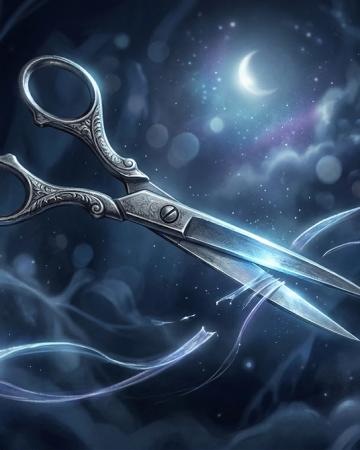
A thread that snaps on its own gives way without your choosing: a relationship wearing thin, a project that stalls. A thread you cut is a decision, and the scissors in the dream deserve a look. The Greeks had a figure for this. Hesiod names three Fates, Clotho, Lachesis, and Atropos, and tradition shows them spinning the thread of a life, assigning each person's share, and then cutting it. The Romans called them the Parcae. A snapped thread in a dream brings Atropos to mind, but the myth is about the length of an entire life, while a dream of rupture almost always concerns one particular bond.
A snapped thread can be knotted again, and the knot will stay visible. That detail matters: some bonds resume with a scar, and others don't need to resume. If the break follows a real loss and the sadness weighs on your days, reach out to someone close, or to a professional.
Where does the red thread of fate come from, and what does the Bible say about scarlet thread?
From East Asia: in China, then Japan, an invisible red thread ties together two people who are meant to meet. In a dream, it reads as a relationship that matters in your story.
Chinese legend gives the job to Yuexia Laoren, the "old man under the moon," a god of marriage. The earliest dated mention is a Tang dynasty proverb, "feet tied by red cords." In Japan the thread runs between each person's little finger and is called unmei no akai ito. In the legend it may stretch or tangle, but it never breaks.
The Bible knows a scarlet thread too, with a different meaning. When twins are born, the midwife ties a scarlet thread on the hand of the one who comes out first (Genesis 38:28). In Jericho, Rahab is told to bind a line of scarlet thread in her window so her house will be spared (Joshua 2:18-21). There the red thread marks, singles out, and protects. If yours ties your heart to someone, ask yourself who, and whether it is taut, slack, or humming: its state tells you how the bond is doing.
Why would you pull endless thread out of your mouth?
Often a held-back word finally coming out, slowly and awkwardly. It shows what you can't put into words while awake.
The feeling is unpleasant: the thread keeps coming, and coming. Since it comes from the mouth, speech is what's at stake. Ask yourself what you are keeping unsaid right now, and to whom you would like to say it. One detail steers the reading: a thread that comes out easily, with relief, looks like a confession in the making. One that chokes you speaks more of pressure, of a secret that weighs too much, of a sentence you are afraid to say.
A practical tip: write the sentence out in full, once, for yourself alone. It is often shorter and less grave than the thread that stood for it. And if that tightness in your throat lingers after you wake, that is a question for a doctor, not for a dream.
What does it mean to follow a thread in the dark?
Trust: you don't need to see the whole way, only what ties you to the exit.
Ariadne's thread is the best known. In Apollodorus's account, Ariadne gives Theseus a thread on Daedalus's advice. He ties it to the door of the labyrinth, unwinds it as he goes in, kills the Minotaur, and follows the thread back out. Notice what the thread doesn't do: it doesn't show where the monster is, it guarantees the way back. In a dream labyrinth, it says the same thing. You don't yet know what you'll find at the center of a decision or a season of life, but something ties you to the entrance.
So look at who holds the other end. In the myth it is the door, a fixed point. In your dream it may be a person, a habit, a value. And if the thread gets lost or snaps in the darkness, the dream is asking what you need in order to feel held while you move forward.
What about a thread that rises into the sky or sinks into the shadows?
Often a link with someone who is no longer here, in the gentlest and slowest part of grief.
Holding a very fine thread, almost invisible, that vanishes upward or into the dark, resembles the calls we'd like to make to someone who has died. The feeling is bittersweet. That thread doesn't ask you to stay in the past: it keeps that person's place in your life. Keep it without forcing yourself to pull. If the dream returns and the sadness wears you out, a trusted person or a professional can help you carry that bond differently.
When you wake, jot down what the thread was doing, taut, slack, red, tangled, or followed, then ask yourself one question: what am I connected to today that I had forgotten? To keep track of that thread from one night to the next, the Midnight Mind journal is made for it, and you can also tell me your dream with its details so we can look together at where the thread is pulled tight.