

Every February 8, at temples around Tokyo, seamstresses and tailors bring the needles they broke over the past year and push them into a block of tofu or konnyaku, a soft jelly. The ceremony is called Hari-Kuyō: people thank the tool for its service and ask to become more skillful. I love this custom because it takes seriously an object most of us forget at the bottom of a drawer. A needle dream does something similar. It puts a tiny tool right in front of you, and what the needle is doing matters more than the needle itself: sewing, pricking, slipping out of sight, snapping, getting inside your body. Each of those deserves its own reading.
What does it mean to dream of sewing with a needle?
Most often, sewing is about repair: you're trying to hold together something that has come apart, whether it's a relationship, a project, or the way you see yourself.
Start with what you were sewing. A loose hem, a button hanging by a thread: something small you've let slide for too long, a misunderstanding two sentences could have cleared up. A clean rip down the middle of a shirt: something broke more decisively, and you're trying to close it. A patch on old fabric: you're extending what you have instead of replacing it.
The pace matters too. Calm, even stitches often mean you've accepted that the repair will take time. Frantic sewing, racing to finish before the fabric tears any further, feels more like a rush to save a situation that's slipping away from you.
People were reading sewing as a matter of bonds a very long time ago. In the second century, Artemidorus considered it a good dream to be a shoemaker if you were hoping to marry or go into partnership, because of the seams and joints that hold things together. In another dream he records, a cloak that had come unstitched down the middle foretold a marriage that wouldn't last. The thread a needle pulls is what stays behind once it has passed through, so ask yourself what you're trying to join, and to whom.
Why does the needle prick you in the dream?
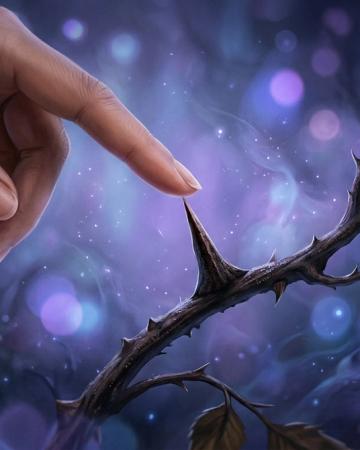
A needle prick points your attention to one precise spot: a detail you overlooked, a remark that hurt, a truth you've been pushing away.
A needle doesn't make a big wound. It touches one point, just one, and that's what sets it apart from a cut or a burn. When you get pricked in a dream, I'd look first at what you were doing at that moment. If you were sewing, the prick often speaks to the cost of repair: fixing a relationship sometimes means getting hurt a little, owning a mistake, hearing a complaint. If the needle came out of nowhere, hidden in a cushion, a sweater, or a bed, think instead of a small irritation you can't trace, like a thorn you can feel but can't find.
The drop of blood beading on your fingertip shows up often in these dreams. It says this is real, that it touches you, even if the wound is tiny.
Before you look any further, rule out a simple explanation. Sometimes a physical sensation slips into a dream: an arm you slept on, a numb hand tingling as it wakes up. If you woke up with pins and needles in your fingers, the prick in your dream may have started right there. In that case it needs no interpretation at all, which is a bit of a relief.
Why won't the thread go through the needle in your dream?
It's an image of a task that calls for calm: the harder you push, the less the thread goes through. The dream often points to a situation where precision matters more than effort.
Everyone knows the routine: wet the thread, squint, aim for the eye, try again. In a dream, it can drag on forever, your hands shaking, the thread fraying. This dream tends to come when you need to pull off something delicate (a conversation, an interview, a decision) and the pressure itself is making you miss. The advice it carries is almost physical: rest your elbows, breathe, aim smaller.
The eye of a needle turns up in some old texts. In the Gospel, "it is easier for a camel to go through the eye of a needle, than for a rich man to enter into the kingdom of God" (Matthew 19:24): the eye becomes the measure of the impossible. In China, on the night of the Double Seventh, the seventh day of the seventh lunar month, young women competed at threading needles by the glow of an ember or a half moon, asking for skill. A Ming-dynasty dream book counts this dream as an excellent omen; more on that in the traditions section.
If the thread finally goes through in your dream, that's encouraging: you've found the right touch. If it never does, ask yourself whether you're aiming at an opening that's too narrow, a single solution where there are others.
What does searching for a lost needle say about you?
This dream often mirrors the sense of hunting for one essential detail buried under too much: too much information, too many worries, too many tasks at once.
"Looking for a needle in a haystack" is an expression in both English and French, and sometimes the dream takes it literally. You dig through a pile of straw, an overflowing drawer, a thick rug, and the needle won't turn up. What you're missing is small, but nothing moves without it: a document, an answer, the one sentence that would unstick a conversation.
To me, this dream says more through how you search than through what you're searching for. Digging in a panic, turning everything over, scraping your hands: that's often a sign you're trying to solve a problem by doing more, when it would ask you to do less. Searching slowly, in good light, maybe with a magnet: you already have a method, even if results are slow to come.
And if someone took your needle, the reading changes. You feel as though the means to fix things are being taken from you. In the Ibn Sirin tradition, it means hard circumstances that drag on; I'd read it more as a question: who, or what, is keeping you from fixing what you want to fix right now?
What does a broken needle mean in a dream?
A needle that snaps often marks the end of an effort: a repair that won't hold, or a bond you've pushed too hard.
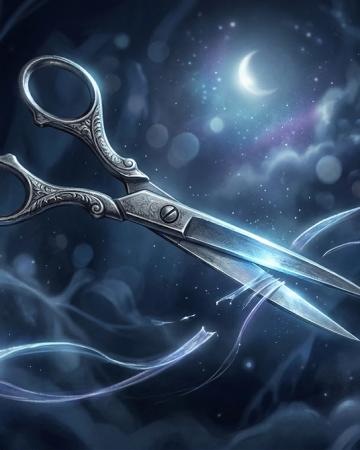
Needles rarely break at random. They break when you force them, when the fabric is too thick or you pull at the wrong angle. So the dream asks a fairly direct question: are you working away at something that no longer wants to be mended? A relationship wearing thin despite everything you do, a project you patch up every week. Sometimes you have to cut before you can sew, and scissors belong in the same sewing box.
This is where Hari-Kuyō comes back to me. A broken needle isn't tossed aside: it's laid in something soft, thanked, and replaced. If your needle snapped in a dream, any sadness you felt makes sense. It doesn't mean you have to start over with the same tool.
The Ibn Sirin tradition is less gentle: there, a broken needle means difficulties and trials. What I take from this dream above all is an invitation to change methods rather than force harder.
Why do people dream of needles under their skin, or of swallowing one?
These dreams are often about words held back: sharp things you didn't say that end up hurting you from the inside.
They're among the most unpleasant needle dreams. You feel something sliding under the skin of your hand, or you swallow a needle and your throat tightens. Your body is involved, and waking up can be abrupt.
Imagine you spent the week biting back a comment, to be polite or to avoid a fight. The swallowed needle looks a lot like that silence: what stings doesn't disappear just because you kept it to yourself. A needle traveling under your skin suggests something more diffuse, guilt or resentment that drifts from one subject to another without you ever naming it.
I don't believe these dreams are out to punish you. They show, in very physical images, what it costs to keep everything in. One simple step: write down the sentence you didn't say, even if you never send it.
If they return night after night and leave you truly anxious, or if a fear of needles is making you put off a blood test or a shot, talk to your doctor. It's a common fear, and it can be treated.
This morning, before the dream fades, write down two things: what the needle was doing (sewing, pricking, hiding, breaking) and what it was touching (a piece of clothing, your skin, someone else's hand). The first tells you what your life is asking you to do, the second where. And if it was closing an old tear, think about what a scar shows: a repair can be seen, and it's allowed to be. If you'd rather not untangle it alone, write it down in the Midnight Mind app, along with the fabric, the color of the thread, and how you felt: I'll read it with those details in mind.