The Silent Observer: When Consciousness Rises Above
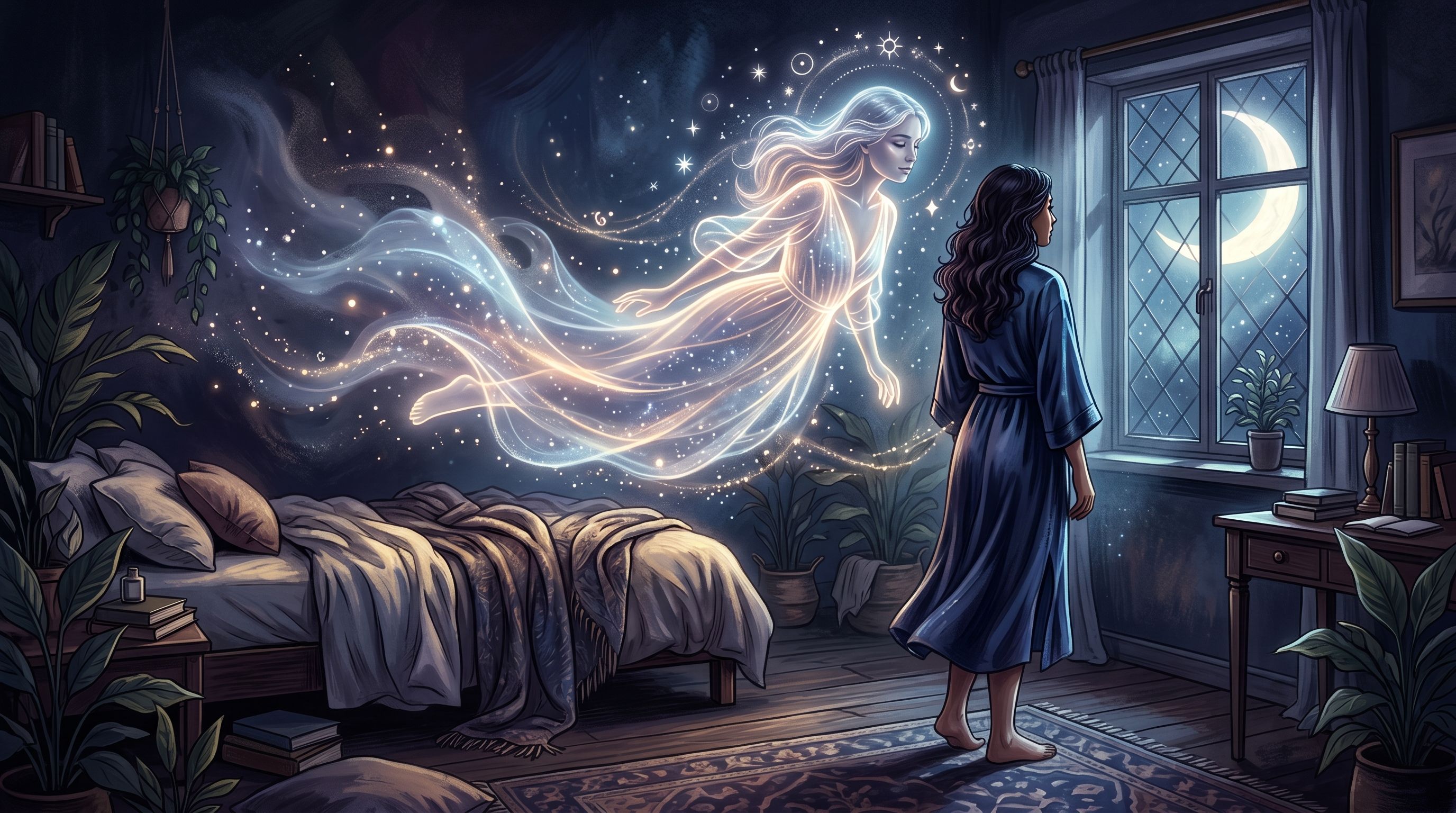
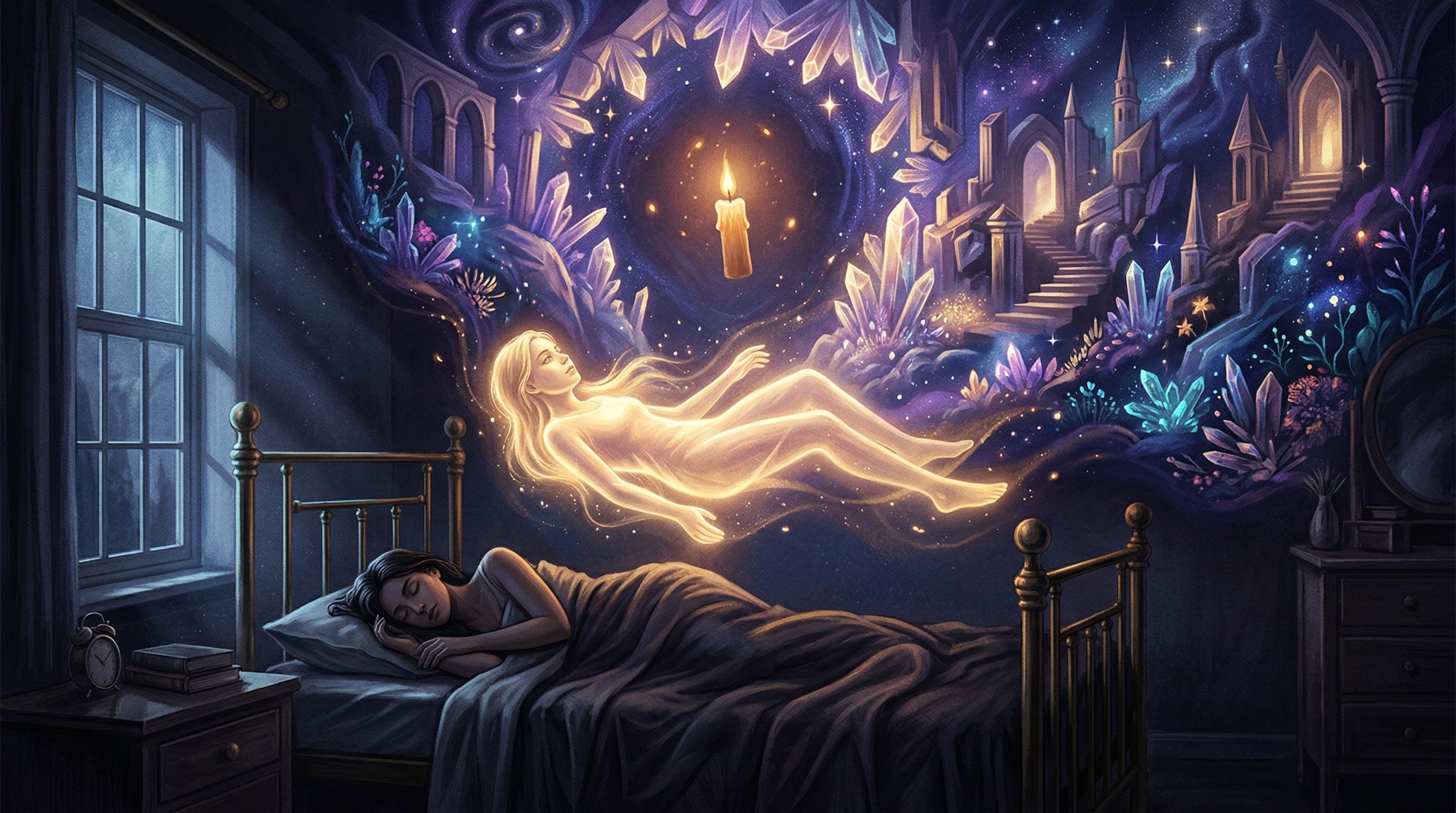
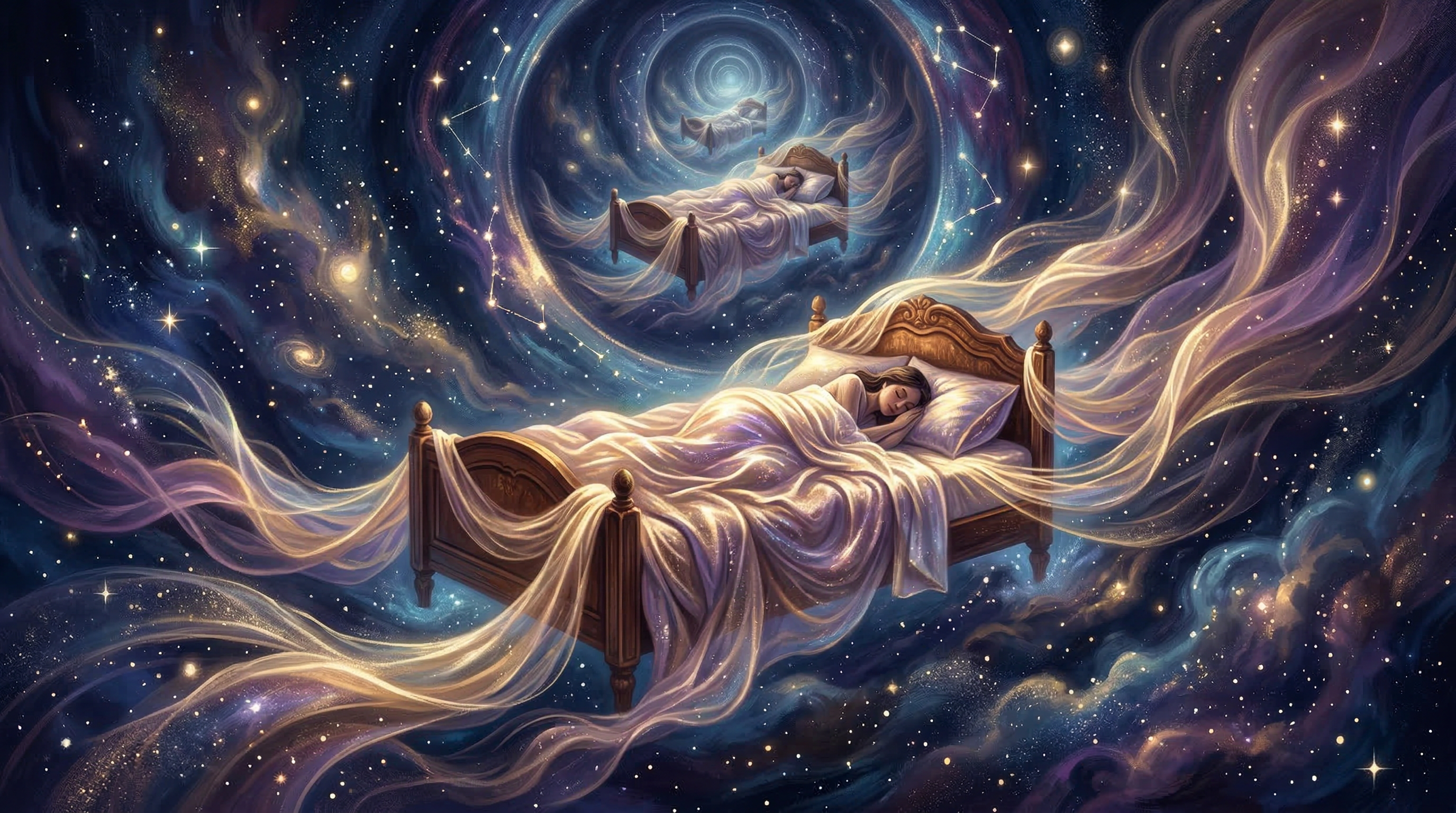
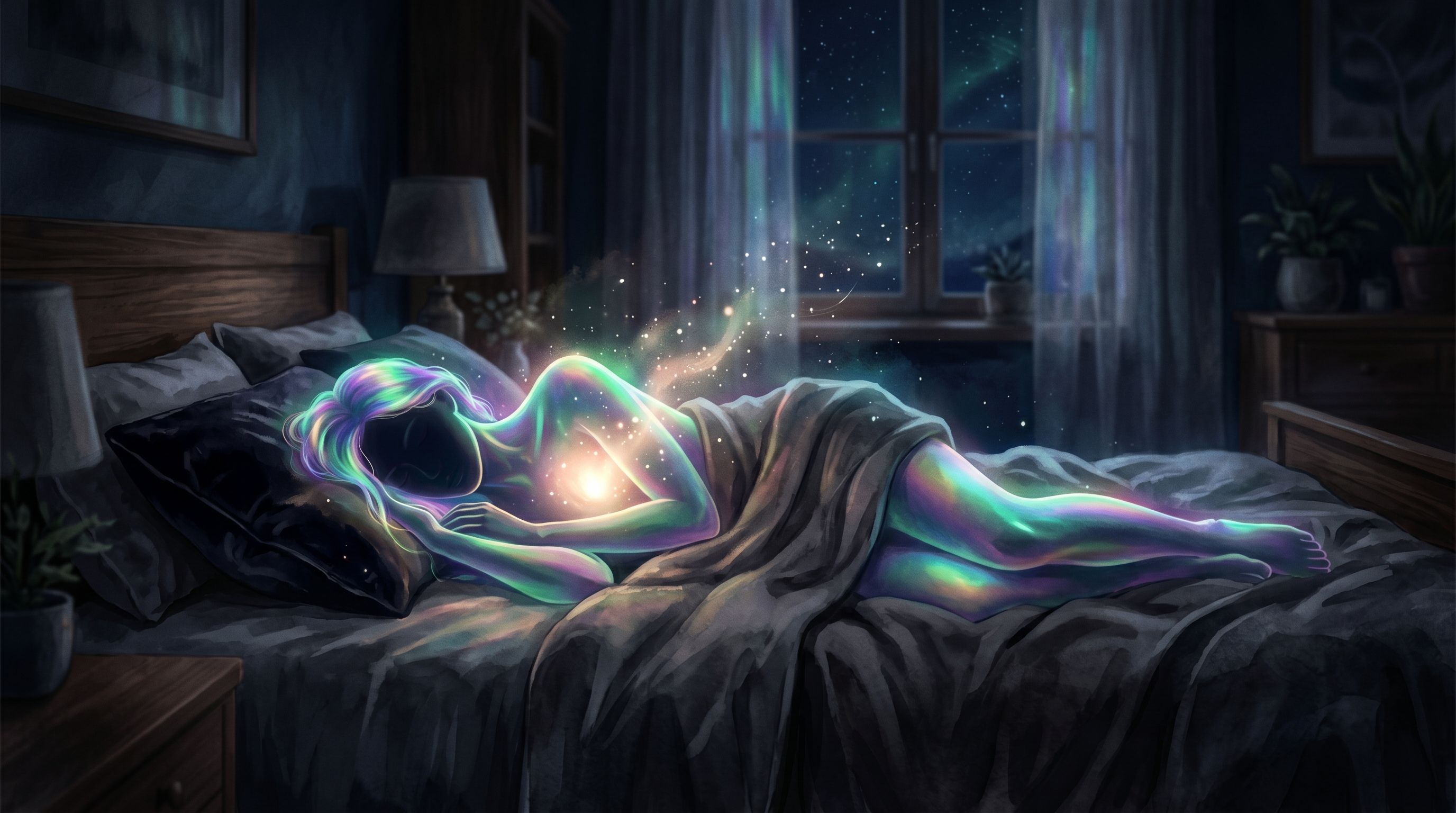
As I wander through your nights to nibble on the shadows of your dreams, I often come across dreamers floating above their beds. They look at me with wide eyes, surprised to find themselves there, so vulnerable beneath the sheets. Honestly, this symbol has fascinated me for years. Why does the mind feel the need to extract itself from its usual "vessel"?
This isn't an "out-of-body experience" in the frightening, esoteric sense that some manuals might lead you to believe. I dislike interpretations that immediately jump to danger. For me, it is a poetic metaphor for detachment. In your waking life, you might be too "in it"—too deep in the action, too buried in emotion, or overwhelmed by stress. Seeing yourself sleep is like pressing pause on a movie to analyze the structure of your life, much like observing the central axis that keeps us upright, but from an outside vantage point.
It is a moment of truth. When you sleep, you cannot pretend. You no longer wear your "social" smile, your work clothes, or your invisible shields. To see yourself this way is to face your own humanity, naked and peaceful. It is an exercise in kindness that your subconscious is gently imposing on you: "Look at yourself—you are here, you are breathing, you are safe. Why do you worry so much?"
The Message from the Shadows: Exhaustion or Awakening?
I won’t lie to you, because dream interpretation is not an exact science and I prefer to remain humble before the mysteries of your mind. Sometimes, seeing yourself sleep is a distress signal from your physical body. If you see yourself sleeping in a very realistic way, with a feeling of heaviness, it might simply mean you are exhausted. Your mind is still active, searching for solutions, but your body has finally surrendered. It is an image your subconscious projects to tell you: "Look at how much you need this sleep; leave me in peace for now."
On the other hand, there is a more luminous dimension. Dreaming of seeing yourself sleep is often the prelude to greater lucidity. It is as if a small glow has suddenly lit up in the darkness of your subconscious. You become aware that you are dreaming. It is a threshold.
I met a dreamer once who saw her double sleeping in a crystal forest. She was terrified of the idea that she couldn't "get back in." I explained to her that dreams never truly separate anything; they only show the different layers of who we are. The detachment you feel is not a rupture; it is an expansion. You are both the one who sleeps and the one who watches. You are the landscape and the traveler. By understanding this, worry fades away, replaced by an immense sense of freedom. You are not a prisoner of your daily problems; you are the vastness observing them.
If this dream returns, do not try to analyze it with cold logic. Instead, ask yourself: "Which part of me needs me to look upon it with kindness?" Sometimes, seeing yourself sleep is simply the most beautiful act of love you can offer yourself: observing your own existence, without expecting anything in return.
Your nights are sacred territories where every image is an outstretched hand. Do not fear this motionless double; it is your anchor, while your consciousness finally learns how to fly.
Sometimes I wonder why we try so hard to control every waking second. I get quite tired of those rigid psychological manuals claiming this dream always points to a severe identity crisis or depersonalization. It is often much simpler, and far more protective. Think about your days: are you currently carrying the weight of everyone else’s expectations? Perhaps you are constantly adapting, managing conflicts, or trying to please a demanding boss who leaves you no room to breathe. When your daily life demands that you wear a heavy armor of efficiency, your sleeping double in the dream is the only version of you allowed to lay down its weapons. By showing you your own sleeping body, your unconscious is staging a quiet mutiny. It is carving out a sanctuary where the productive, stressed-out "you" is forced to remain perfectly still, reminding you that your worth exists outside of what you accomplish.
There is an ancient, quiet wisdom in this image that reminds me of old Eastern philosophies, where the soul is believed to gently hover during deep rest to gather cosmic energy. To me, seeing yourself asleep is not a division of the self, but a rare moment of alignment, highly similar to what some seek through states of deep meditation. You are simultaneously the observer and the observed, the silent witness and the physical vessel. In many indigenous traditions, this double is called the "shadow of breath"—the part of you that stays pure and untouched by the dirt of the earthly world. When you look at your sleeping self, you are catching a glimpse of this untamed, primordial peace. It is a reminder that beneath your temporary worries, your essential self remains entirely whole, deeply anchored in a stillness that no daily storm can ever truly disrupt.
I once met a dreamer, a young painter who had lost his creative spark, who told me he saw himself sleeping inside a massive, hollow oak tree. He was terrified, thinking he was dying or becoming completely hollow inside. Honestly? That dream fascinated me. I told him that his mind wasn't dying; it was simply incubating. When you see yourself asleep, your subconscious might be protecting a fragile transformation that is not yet ready for the harsh light of day. Like a caterpillar in its cocoon, your conscious mind needs to be kept in the dark while the deeper, invisible layers of your soul restructure themselves. Do not rush to wake up your double, and do not panic if they seem unresponsive. Some changes are so delicate that they can only happen in the absolute safety of a dream-state, far away from your own analytical thoughts.
If this feeling of "doubling" leaves you with lingering questions in the morning, you might want to note these visions in your personal journal on Midnight Mind. It is by gathering these fragments of consciousness, like collecting precious pearls, that we eventually understand the grand shape of our own mystery.