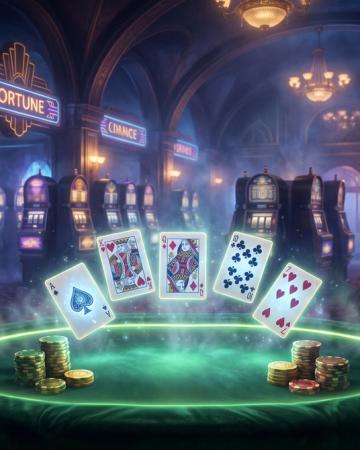

Picture it: you're dealt a hand, you fan it open, and not one card goes with another. Everyone at the table is waiting on you. When you wake up, what stays with you is that suspended moment before the first card goes down. Dreams of playing cards turn up for card-room regulars and for people who haven't touched a deck since childhood, and they almost always circle one question: what do you do with what you were given? Let's take it gesture by gesture.
What does it mean to dream about playing cards?
Most often, a situation where you have to play with pieces you didn't choose and only partly see. In a card game the hand arrives by chance, everyone else's stays hidden, and still how you play is what makes the game.
That's why I look at the gesture more than the card. You shuffle, hesitate, bluff, win, lose, and each of those verbs says something different. How you feel at the table counts just as much. Enjoying the game points to a stretch of life where you're comfortable with the rules. Unease points to a setup that weighs on you.
One word so two dreams don't get mixed up. An ordinary 52-card deck doesn't read like a tarot spread. Tarot began in northern Italy in the mid-1400s as a card game, with 78 cards, and its images (the Magician, the Hanged Man) carry meanings of their own. Its use for divination came much later, around the middle of the 1700s. If you saw tarot cards, start from the image that struck you. In France, "playing tarot" also means an ordinary card game among friends, which muddies things further: if that's the game you were playing, read it like any other game. Here we're talking about the game where everybody plays their own hand.
Why do you keep shuffling, cutting or dealing?
Because you're looking to start over. Shuffling is the wish to reshuffle a situation that no longer suits you, without leaving the table. English knows it too: you reshuffle the deck, you play your cards close to the vest. Your dream acts the phrase out.
The gesture has two faces. If you shuffle calmly, the dream looks like preparation: you're giving yourself time before you choose. If you keep shuffling, the dry snap of the cardboard setting the rhythm of your thoughts, it points to restlessness that postpones the moment of playing. Ask yourself what decision is waiting in your life until you finally sit down and start the game.
Dealing changes the reading too. When you're the one dealing, you set the pace and carry the game: who gets a good hand, who gets a bad one? When someone else deals, the question becomes who, in your life, hands out the chances on your behalf, and how you feel about it.
Cards differ from chess, where everything sits in plain view on the board. Here part of the game stays hidden, and you have to decide without knowing everything. That's what the dream asks you to bear.
Then there's the weak hand. You look at it, it's poor, and the dream leaves you with a choice: bet or fold. The dream isn't grading your cards, in my view. It's watching you choose. Folding counts as a real choice, and so is betting on next to nothing; what you do shows where you stand.
What does it say when you lose at cards?
Most often, the fear of not having enough going for you in a specific situation: an interview, an exam, a conversation coming up. No loss is announced: the dream stages the feeling of not holding the right cards.
Look at who beats you. A faceless opponent speaks of social pressure in general. A familiar face points to something at stake with that person. If what you're left with on waking is shame, ask what standard you're trying to meet, and who set it.
Losing can also bring relief. When you wake up lighter after losing everything, it's often because the stakes weighed more than the game. And if you were betting real money, that's closer to a dream about dice, another kind of luck altogether: nothing hidden, nothing to bluff. Here there's only your play and the way you look at yourself.
Do the suits, the ace, the king or the Joker have a fixed meaning?
No, and I'd rather say it plainly: no ancient code pins a meaning on each suit. The French suits (hearts, diamonds, clubs, spades) settled around 1480, and the Joker only showed up around 1860, in the United States, as a trump in a game called euchre. Charts that say "hearts equal feelings, spades equal ordeals" are recent habits, and no old interpreter could have known them, because cards didn't exist yet (more on that below).
Keep your own associations instead. Do red and black make you think of warmth and gravity? Then hold to that. For the face cards, ask who holds that role around you: a parent, a boss, or you when you're running things. The king in a dream is often an authority, outside you or inside you.
The ace worries some people, especially the ace of spades. Fortune-telling gave it a sinister reputation; in an actual game it's an ace like any other, the one, the beginning, sometimes the card that beats all the rest. The Joker is the newcomer of the deck: a card that takes whatever value the game gives it, a clown slipped in among the kings. In your hand, it signals a resource you haven't used yet. In someone else's, a surprise you can't control.
Who is playing with you, and what do they see?
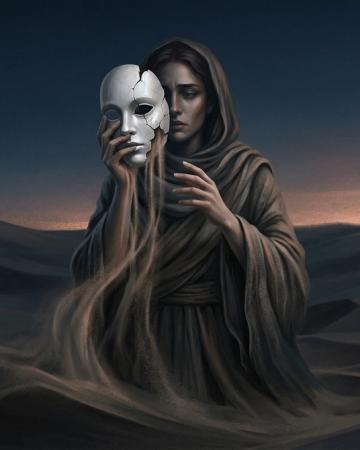
A card game is played with others and runs on hidden information, which makes it a dream about being watched and being real. If faceless opponents surround you, or you feel you have to hide your hand, ask where in your life you're moving forward with a mask on.
Bluffing is nothing to be ashamed of: sometimes it's useful armor. When the dream turns uneasy and you're afraid someone will see your hand, the question becomes where you're wearing a mask that's gotten heavy. Honestly, I prefer the ending where you lay your cards on the table, even at the price of a lost round: you breathe better.
In a team game like belote or bridge, the question is whether your partner can read your play. A partner who plays badly, or a teammate you can't see, speaks of trust and the fear of carrying the game alone.
If you're the one cheating, the dream is about the distance between your actions and the image you want to project. And if the table belongs to friends or family, the game is about a bond more than a stake: look at who deals, who's missing, who changes the rules.
What did the ancients say about a game they never knew?
Nothing about cards themselves. Cards reached Europe in the 1370s, from the East, long after Artemidorus (2nd century) and Ibn Sirin (died 728). Anything attributed to them about "playing cards" is guesswork.
Each did write about the nearest game, though. For Artemidorus it's dice, knucklebones and draughts, and his principle is worth keeping: the meaning depends on who is playing, since a child is not an adult. In the dictionaries attributed to Ibn Sirin, the entry on games is severe (pride, scheming, quarrels), with one exception for the sick person who sees himself playing and recovers. If you're searching for what Islam says about a dream of playing cards, there is no entry under that name: these neighboring entries are what gets read, with the caution that requires.
The fine print sits in the traditions section. What I take from both: who is playing, and in what situation, matters more than the game itself.
Before the dream fades, write down three things: the hand you held, who was at the table, and the moment you hesitated. That hesitation is almost always the knot. For a reading that keeps those details, tell me about the game in the Midnight Mind app and I'll look at your hand, your players and your gesture.