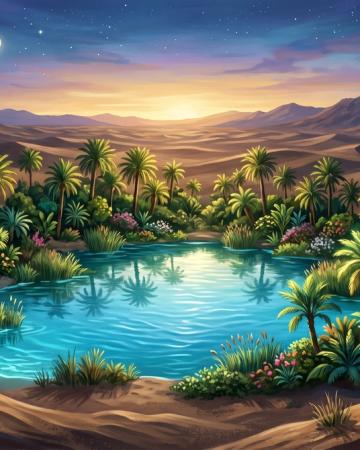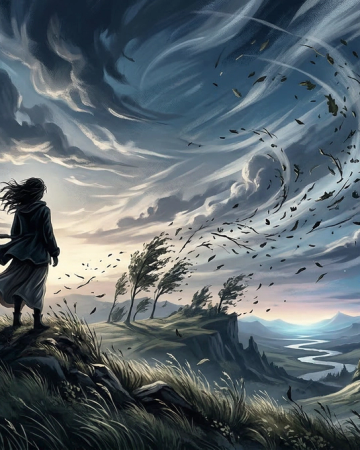


In the desert, you see the palms before you see the water: date palms only grow where their roots can reach it, and an oasis gives itself away from far off by its fronds. So a palm tree growing in a dream is rarely just scenery. It can mean vacation, sure. But it's also the tree that holds on when everything else has dried up, the one that bends in a hurricane, the one people turned into a sign of victory. Green or gray, alone or in a grove, heavy with dates or flattened by the wind: yours tells a different story depending on the shape it took.
What does it mean to dream about palm trees?
Dreaming about palm trees is most often about a resource that holds up through a hard time. Depending on the dream, it points to what still feeds you, your ability to bend without breaking, or a harvest on its way.
The wish to get away is one possible reading, and I'll come back to it, but in my view it's rarely the first. Most of the time, the tree's posture is what carries the meaning.
Standing in the sand
A lone palm in a stretch of dry ground is first of all about a resource: where it grows, there's water, even if you can't see it.
So ask yourself what in your life looks like that sand: a job that wears you out, a relationship where you give more than you get. Then look for the palm, meaning whatever still feeds you, even a little. The dream isn't saying the drought is over; it's showing you there's still water somewhere. If the oasis itself took up most of your dream, its page goes further.
Bent by the wind
A palm tree has no true wood. Its trunk is made of fibers and doesn't thicken year after year the way an oak does, which is what lets it bend so low in the wind, where many trees would snap.
A dream of a palm bent over by a storm is often about how you're handling pressure right now. In my view, it's a reassuring dream when the tree straightens back up: it shows you can give a little without losing yourself. Bend, don't break. If it snaps, that's different. The dream may be pointing to a limit you've reached, and a moment to ask for help instead of holding on alone.
Tall and heavy with fruit
The palm is also the tree of victory. In the second century, Pausanias wrote that most Greek games awarded a crown of palm, and that at all of them "a palm is placed in the right hand of the victor." English kept the image: to "bear the palm," as Shakespeare's Cassius puts it, is to come out on top.
A tall, green palm heavy with fruit often goes with hard work paying off, or recognition you've been waiting for. If you woke up proud, or just happy, that's most likely what it's about.
What does a palm tree mean in an Islamic dream reading?
In the Islamic tradition, the date palm is a very good sign: it usually stands for an upright, generous person, or for your own faith bearing fruit.
This reading rests on well-known texts. In a hadith reported by al-Bukhari, the Prophet compares the believer to a tree whose leaves don't fall, and that tree is the date palm. In the Quran, Mary, in the pains of childbirth, leans against the trunk of a palm tree; she is told to shake it so that fresh, ripe dates will fall to her (Surah 19, verses 23 to 25). There, the palm is support at the hardest moment.
The Islamic dream books under Ibn Sirin's name follow the same line: the palm stands for a noble man, a scholar who passes on what he knows (the details are in the traditions below). If you read your dream within this tradition, first check whether the tree is alive, then ask who it might stand for in your life.
What does the fruit on the palm tell you?
The fruit shows where you are in an effort: ripe dates mean harvest, green fruit means patience, a palm with no fruit means an off season.
Heavy with ripe dates, the palm is about harvest: patience coming to an end, effort starting to pay off. With fruit still green and hard, it's asking you not to pick too early: what you're waiting for is on its way. With no fruit at all, it isn't necessarily about failure. Dates ripen once a year, and a palm with no fruit may simply be between seasons. The tree is still standing.
Eating the dates often goes with a pleasure you're finally allowing yourself; a cluster too high to reach, with a reward you can see but can't grab. If the fruit is what stayed with you most, the page on fruit has more to go on.
What does it mean to dream of palm nuts or an oil palm?
Most often, work that pays off: palm fruit is picked, gathered and pressed, and this dream tends to be about what your effort produces.
A lot of people look up this dream "in Islam." I'd rather be straight with you: I haven't found any entry on palm nuts in the collections attributed to Ibn Sirin. They were compiled in the Middle East, date palm country, while the oil palm comes from West and Central Africa. A precise "Islamic" meaning for this dream has nothing to stand on.
What you can read is what the dream shows. Gathering palm nuts off the ground is harvesting what has already fallen: humble work, but work that feeds you. Buying them is more about support you go looking for from other people. Oil takes processing: a dream where you press the nuts or make the oil can go with a project that needs time before it gives anything back. As for the red of the fruit or the oil, it's first of all the color of ripe fruit; I wouldn't look for a hidden meaning in it.
Was your palm tree green, dried out, or plastic?
The state of the tree and the setting around it often matter more than the palm itself: they tell you whether the dream is about strength, exhaustion, or rest.
A healthy palm points to strength you can draw on; with gray fronds falling off, it points more to exhaustion, to giving without recharging. On its own, it puts the focus on your own resources; in a grove, on your support, the people you can count on. The setting plays a part too: in the desert, a palm is a rare resource, while on a beach it's more about rest, or even wanting to get away.
Now picture yourself walking up to a palm tree and finding out it's plastic. That detail is worth stopping on: it can point to rest that's only for show, a situation that looks peaceful without really being so. And if you're still unsure, think back to how you felt looking at it: relief, pride, and weariness each lead somewhere different.
Why does the shade of a palm tree matter?
Because sitting in the shade of a palm means stopping. This dream is often about needing rest, and sometimes about wanting to leave everything behind.
In the middle of the desert, it's the palm's shade you're after, not its height. If your dream lingers on that moment, lying under the fronds and doing nothing, your mind may be asking for a real break, not a pause between two chores.
And the urge to run away? That's real too. A dream of palm trees on a postcard beach, at a time when your days feel heavy, may simply be saying: I can't take any more. The question is whether you're looking for a break so you can come back, or a way out so you don't have to. If it's the first, give yourself that rest. If it's the second, the dream may be showing you a situation that needs to change, not just a few days away from it. And if that weariness doesn't lift even after a few days of real rest, and it's eating into everything else, bring it up with your doctor: exhaustion is easier to treat early than late.
What do the palm tree and the phoenix have in common?
A word: in ancient Greek, phoinix means the date palm, the phoenix bird, and a deep purple-red.
The date palm's scientific name still carries it: Phoenix dactylifera, the "finger-bearing phoenix," because dates are shaped like fingers. The Roman poet Ovid ties the two together in his Metamorphoses (Book XV): he puts the phoenix's nest at the top of a palm tree, where the bird dies on a bed of spices before a young phoenix is born from it.
To be clear, it isn't the palm that rises from its ashes; it's the bird. But if your dream brings the two together, say a palm still heavy with fruit in a burned or gray landscape, it's often about something starting again after a loss. The phoenix has its own page if the bird itself showed up in your dream.
Before the image fades, sketch your palm tree, however roughly: how tall the trunk was, the color of the fronds, what lay at its foot, sand, sea, or fallen fruit. A thirty-second drawing holds on to details that words let slip, and those are exactly the ones that steer the reading. Keep one question with you for the day, too: what kind of wind was blowing through its fronds, a breeze or a storm? If the sketch isn't enough, describe the palm in the app: I'll read it from its own details rather than the dictionary's, and the Studio can turn it into a comic panel with your tree, its shade, and its wind.