The Mechanics of Flight: Between Effort and Grace
I am always fascinated by the way you describe your takeoff. It is never quite the same, is it? Sometimes, you flap your arms frantically, as if you have to tear every inch of progress away from gravity’s stubborn grip. It is exhausting, even for me as I watch you from the shadows of your subconscious. This type of flight often reflects a fierce, almost desperate will to succeed in your waking life—a will that is running out of breath. You seek elevation, but perhaps you are putting in too much muscle and not enough trust.
Conversely, there are those flights where you do nothing but glide. You spread your invisible wings and enjoy the oniric buoyancy of the air. There, we touch upon true freedom. It is a sign that you have finally agreed to trust your intuition. Unlike the mechanical movement you might experience when dreaming of a vehicle, where speed is tied to an external engine, here, the engine is your own breath and your own spirit.
Some researchers in the field of neurobiology suggest that these sensations are linked to the activation of your vestibular system during REM sleep. While your body is paralyzed to keep you safe, your brain’s balance centers are firing, creating the vivid illusion of movement through space. It is a beautiful dance between your biology and your deepest desires for transcendence.
---
Changing Perspective: The View from Above
When you adopt a bird's-eye view, the problems that seemed insurmountable on the ground—the conflicts, the deadlines, the clutter of the everyday—become mere patterns on a map. This is what I call the "global gaze." We often forget that flying isn’t just about getting away; it’s mostly about seeing better.
If your dream takes you above the clouds, much like an eagle, your subconscious is likely inviting you to gain perspective on a difficult decision. On the ground, you are lost in the labyrinth. In flight, you hold the map of the labyrinth in your hands. You see the exits, the dead ends, and the path forward that was hidden by the walls of your own making.
But be careful, for there is a certain solitude in this elevation. The higher you climb, the thinner the air becomes. Sometimes you might feel exhilarated; other times, you might feel a sudden, sharp disconnection from the reality of others. I’ve often noticed that very cerebral people fly a lot in their dreams. It is their way of extracting themselves from the "mud" of the emotional world. But do not forget that even the strongest bird must eventually land. Flight is not a permanent escape; it is a sacred pause to regain your strength.
🌙 Yume's Echo: To fly is not to escape the earth, but to learn how to love it from a distance before returning to it with a lighter heart.
---
The Baku's Doubt: The Vulnerability of the Sky
Honestly, I am often wary of flight dreams that are too perfect. Those where everything is easy, where the sky is a spotless, synthetic blue. They are sweet to consume, certainly, but they sometimes lack the substance of true growth. The most profound flight dreams are those where you feel the wind shift, where you must adjust your trajectory against a sudden gale. That is where your resilience reveals itself.
If you feel yourself losing altitude or your wings becoming heavy, do not panic. This isn't necessarily a threat of falling; it is a reminder of your connection to the earth. Your mind might be telling you it’s time to bring that freedom back into your waking life, rather than leaving it tucked away in your nights.
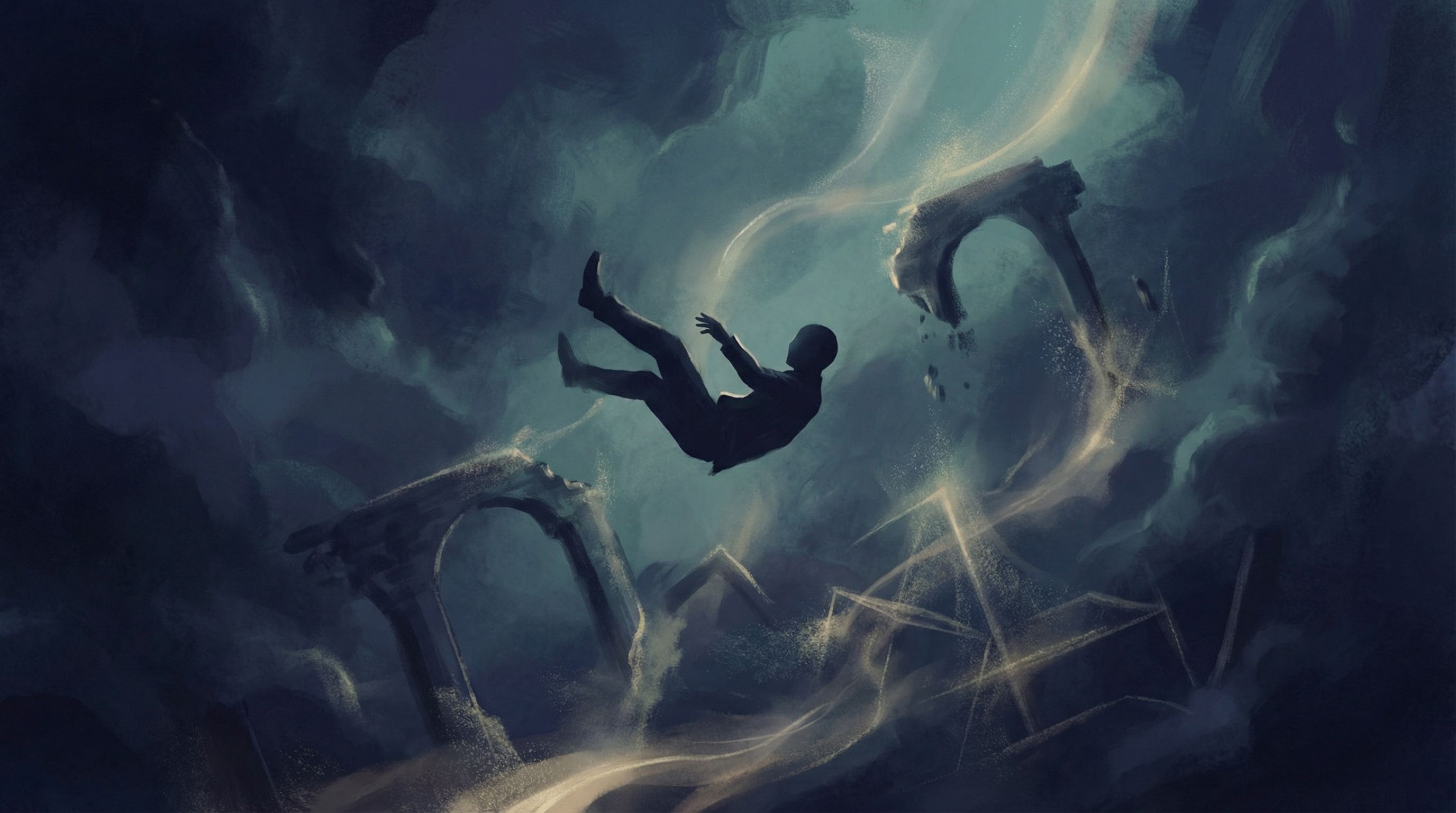
Sometimes, the fear of falling in a dream can be as intense as the pain of betrayal. Both involve a loss of support and a sudden confrontation with gravity—whether physical or emotional. If you find yourself plummeting, ask yourself: what or who am I afraid will let me down?
---
Concrete Example: The Weight of the Unseen
I remember a dreamer who came to me, exhausted by recurring dreams of trying to fly but always being pulled back down by an invisible tether. In her dream, she was a hawk, but her feathers felt like lead.
We looked closer at her waking life and realized she was carrying the emotional burdens of her entire family. In her next dream, she consciously decided to "drop" a heavy backpack she didn't know she was wearing. The moment it hit the ground, she shot up into the stratosphere.
This is the power of the bird-flight dream: it shows you exactly what is holding you back, provided you are brave enough to look at what you are carrying.
---
Integrating the Flight into Your Day
A dream is a message, a compass, a feather left on your pillow. If you flew last night, I want you to ask yourself: "What did I leave behind when I took off?" The answer is often the key to your current well-being. Was it a person? A specific worry? A version of yourself that no longer fits?
I encourage you not to let this memory evaporate with your first cup of coffee. The sensations of flight are precious; they are proof that your spirit knows how to break free from the barriers you impose on yourself. Hold onto this feeling of lightness dearly.
When you feel the weight of the world pressing down on you today, close your eyes for a moment. Remember the wind against your face and the way the trees looked like tiny moss patches from above. That version of you—the one that knows how to soar—is still there, just beneath the surface of your waking mind.
If you wish to explore these heights further and keep a record of your journeys through the clouds, your Baku is waiting for you. Take care of your wings; the sky is vast, and it has always belonged to you.
Have you ever paid attention to the temperature of your dream sky? It is rarely talked about, yet the sensory details of your flight carry their own silent truths. Some dreamers tell me of a wind so icy it freezes their throat, or a smell of ozone that warns of an impending storm. To me, these somatic details suggest that your flight isn't just a metaphor; it is a physical escape. When waking life becomes too heavy—perhaps during a painful breakup or a period of intense burnout—your consciousness might choose to detach from your physical form entirely. It is a gentle form of dissociation, a protective reflex. You leave the heavy, hurting shell of your body on the mattress and seek refuge in the weightless current. But ask yourself: are you flying toward something, or are you simply running out of air on the ground?
There is a profound difference between simply floating and actually feeling the anatomy of a bird. I am always deeply moved when a dreamer describes the sudden, strange weight of feathers growing from their arms—a physical sensation of dreaming of wings on the body that feels more real than their actual hands. In many ancient traditions, this shape-shifting is seen as a call to initiation, a sign that your soul is ready to cross a threshold. You aren't just escaping; you are transforming. This often happens when you are on the verge of a major life transition, like stepping into parenthood or finally leaving a stifling career. Your sleeping mind is testing out a new skin, experimenting with the mechanics of a wilder, more instinctive version of yourself to see if you are ready to carry the weight of your own potential.
I once met a dreamer who spent months returning to the same sky every night, desperately trying to build a permanent home there. She described navigating toward a glittering, fragile sanctuary, reminiscent of a city in the clouds, hoping she would never have to wake up. It was a beautiful dream, but it was also a slow poisoning of her waking life. I watched her grow more and more detached during the day, treating her real life as an annoying intermission between flights. This is the quiet danger of the sky. It is easy to mistake the peace of isolation for true healing. If your flight is too long, too solitary, it ceases to be a liberation and becomes a prison of air. The true magic of the bird is not that it stays in the sky forever, but that it knows how to fold its wings and walk upon the earth without losing its memory of the heavens.