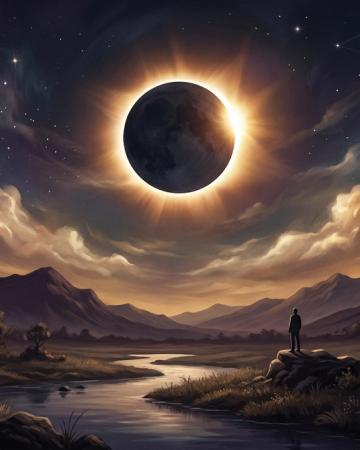


Picture a ring of orange light with a round black spot in the middle and nothing to see inside it. That is roughly what the first real image of a black hole looked like when it was published in April 2019, and it is probably the kind of scene your dream borrowed its set from. The question is what it wanted to say with it. Did the dark leave you with fear, weight, or a strange calm? The sections below help you sort it out, detail by detail.
What does it mean to dream of a black hole?
Most often, a black hole stands for something in your waking life that takes up all the room, with everything else slowly bending toward it. It can also mean you need to switch off for a while, when you're running on empty.
The dream doesn't name that center, and I won't guess it for you. You may already know it: a relationship that drains your energy, a secret that gets heavier to carry, a job that eats your evenings, a loss you haven't finished living through. Ask yourself what everything circles back to the moment you stop running. The dream is more exact than it looks. It stages a balance of forces, one enormous thing and the rest of your life orbiting it.
Your feeling splits the readings into two families. If you wake up with terror, vertigo, the sense of losing your grip, the dream is about control: something is bigger than you. If the dark felt strangely calm, even a relief, it points more to silence, withdrawal, a stop. Quick readings often reduce the black hole to death or depression. I see nothing in the dream that requires that, and I'd rather start from what you felt.
Is there an old tradition about black holes?
No. The black hole is an object of modern physics, and no ancient dream book mentions one.
In 1783, the English clergyman and natural philosopher John Michell imagined a star so massive that light could not escape it. The name "black hole" is even newer: it caught on in the late 1960s, popularized by the physicist John Wheeler. And nobody had a picture until 2019. So your dream borrowed from a film, a documentary, an illustration, or a conversation to give shape to a sensation that is far older.
The old texts that come close talk about the abyss, the pit, darkness before the light, emptiness that is useful. You'll find four of them below, including Genesis and a psalm. None of them mentions black holes, but they show that the image of a bottomless dark is older than astronomy. I find that moving: an object no dreamer of the past could have seen slips into a very old fear. If what stayed with you is falling into the dark, read dreaming of an abyss too. If it was the immensity, dreaming of space picks up from there.
What does the event horizon say in a dream?
The event horizon is the boundary of a black hole: past it, nothing comes back, not even light. In a dream, standing at that edge points to a choice or situation approaching the point of no return, or one that has already crossed it.
Physics adds a detail I find telling. For a large enough black hole, someone crossing the horizon feels nothing special at that exact moment. From far away, it looks completely different: they seem to slow down, redden, and fade out gradually. Carried over to a life, that gives one possible reading. The person who tipped over often didn't hear a sound at the moment of the jump, and it is the people watching who see them drifting away.
So look behind you. A yes said too fast, a resignation, a breakup, a move, a decision made without ceremony whose weight you are only now measuring? If the dream leaves you at the edge without letting you cross, the question changes: you still have some room, and how you use it matters.
Why do you feel pulled in, and by what?
Feeling pulled in points to a situation you can't pull away from, one whose grip tightens the closer you get.
A fact from astrophysics corrects the usual picture. A black hole is no vacuum cleaner. From a safe distance, its pull is the same as that of any star of the same mass, and planets could orbit it without ever falling in. The fall only begins up close. Read your dream with that in mind: whatever is drawing you in may not have an enormous force, but the distance has melted away in small steps. When did you stop keeping your distance? One more evening, one more message, one more promise.
If, in the dream, you move away with all your strength and the pull seems to get worse, that often reads as an exhausting fight against a situation you refuse to look at squarely. Backing away calmly, one step at a time, costs less than thrashing. The vertigo is close to that of a dream of falling, minus the ground.
What does a growing black spot mean, or a black hole opening in your home?
A black hole that keeps growing most often reads as a worry that started tiny and takes up more and more of your time and head space. At home, it puts that worry in your private space.
Black holes grow by swallowing what passes too close. Picture a dark stain on your bedroom wall, at first the size of a coin. The next day it has eaten the picture frame, then the lamp, then the door. Watch the order in which things vanish: it's an inventory. If it's your belongings, the dream is about your comfort and material security. If it's faces, your relationships. If it's light and sound, your energy or your sleep.
This kind of dream often shows up in periods of overload, when one subject fills the whole mental room. A familiar room losing its substance points to something that should protect you and no longer does. When the whole setting collapses, the reading widens, and dreaming of the end of the world explores that. And if the dark comes from a star going out, an eclipse sheds its own light.
Why is the dark so silent?
Silence and the absence of light strip away your bearings all at once, which explains the panic. They can also point to a need for a pause.
No ground, no up or down, no sound to orient you: that bareness is frightening, and that's normal. Still, you can also wake up calm, almost rested. In that case, my view is that the dark marks a stop. A part of you wants less stimulation (screens, expectations, conversation), and the dream gives it that.
The title of this page speaks of a fertile void. It is only fertile if you come out of it rested, and only your waking can confirm that. An old image from the Daodejing helps here: a vessel is useful because of its hollow. An empty space can serve you, as long as you leave it empty and don't refill it with screens and tasks right away. If the dark felt more like a presence you're avoiding, shadows is a neighboring path.
What should you do if the dream keeps returning, and when you wake up?
A recurring dream mostly signals a subject that is still open, not a danger in itself. When you wake up, one move is enough.
Keep a notebook by the bed and write down, each time, what comes right before the darkness: a place, a voice, a person, a sound. After a few nights, a pattern often appears. Then write one line about what took up the most room in your week and what it has already taken from you: sleep, time, other relationships. That list is more useful than any interpretation, because it starts from your life.
One caveat: when a lingering weariness, dark thoughts, dread of going to sleep, or an empty feeling in broad daylight come along with these nights, see your doctor or a therapist. They deserve to be heard by someone, and an article can't judge them for you.
If you want to see it more clearly, tell your dream in Midnight Mind. The more detail you give (the edge, the sound, what vanished first), the more precise the reading I can offer you.