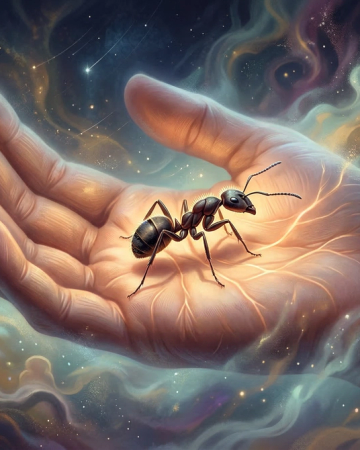


A scarab throws nothing away. The ball it rolls across the ground is made of waste, but it doubles as a pantry and, in some species, a nursery: the female lays her eggs inside, and the larvae feed on what surrounds them. Few animals say so plainly what many dreamers hope a dream will tell them: that what they gave up for lost can still be put to use. Here is what the beetle usually means, from ancient Egypt to Jung, and which details of your dream change the reading.
What does it mean to dream about a beetle?
Dreaming about a beetle usually points to a slow rebirth, built from what you left behind: a grief, a failure, an idea you abandoned. The insect promises no miracle; it shows work in progress.
I don't care for readings that shrink the scarab down to luck or money, as if seeing one were enough to bring a fortune. What I find strongest about this symbol is its gesture: it takes what's in the way, pushes it ahead with stubborn effort, and turns it into something alive. In a dream, the ball can stand for a memory, a grudge, a habit, an unfinished project. Ask yourself what the beetle is carrying, and what you'd do with that load if you stopped thinking of it as useless. One man's trash, as the saying goes, is another man's treasure.
A note on words. "Beetle" covers hundreds of thousands of species, and the one in your dream wasn't necessarily the sacred scarab of the Egyptians. A shiny black shell, legs scratching at the ground, a stubborn walk: even without a ball of dirt, you still get the idea of persistence and work done in the dark. For other creatures that come out at night, see dreaming of insects.
Why did the Egyptians make the scarab a sun god?
Because they saw the beetle pushing its ball as an image of the sun crossing the sky, and the young emerging from it as a birth with no visible cause. Khepri, the scarab-headed god, is the morning sun.
His name comes from the Egyptian verb kheper, "to become, to come into being." Young scarabs come out of the ball and no one had seen eggs, so the Egyptians took them to be born from nothing, according to Egyptologists. In On Isis and Osiris (§ 74), Plutarch gives a Greek version of the belief: scarabs have no females, he writes, and the males deposit their seed in the ball they roll, the way the sun seems to turn the heavens against its own course. The biology is wrong; the image has lasted. In the Amduat, the Egyptian book of the underworld, Khepri steers the sun's barque in the twelfth hour and brings it out of the night. And a "heart scarab," an amulet inscribed with a spell from the Book of the Dead, was placed on the chest of the dead so that the heart would not testify against its owner at the judgment.
You may never have heard of Khepri, but the image explains itself: what is dark and buried can become the start of a day. If you woke up with the feeling of a passage, of coming out of a tunnel, this is the reading that fits.
What does a beetle rolling a ball of dirt mean?
An effort under way whose result you can't see yet. You're carrying something heavy (a loss, a breakup, a career change), and the dream scales it down to an insect, in the mud and the dirt.
Imagine watching a beetle push a ball three times its own size across loose ground, slipping at every step. Ask yourself who you identify with: the beetle that keeps at it, or the ball being pushed? In the first case, the dream is acknowledging your courage. In the second, it points to something in you that is waiting to be moved.
One more detail, for the curious. Researchers showed in 2013 that a nocturnal African dung beetle, Scarabaeus satyrus, uses the Milky Way to roll its ball in a straight line (Dacke and colleagues, Current Biology). Moving forward without a map, in the middle of the night, keeping your heading on something you can barely see: that sounds like what it's like to rebuild a life. And if the ball looks crushing, if the insect slips and starts over, that's a good reason to ask someone close to you for help instead of pushing it all alone.
Does the color of a golden, black, or green beetle change the meaning?
A little. A golden or iridescent shimmer puts the weight on what is already ripe; a dark color, on what is still working in the shadows.
A golden beetle, bright as a coin or an emerald, is often read as an idea, a quality, or a truth you've just recognized in yourself. Gold here has little to do with wealth: it's the color of what has been sorted, worked, and separated from the rest. Alchemists made it the image of the goal of their work. In my view, this dream often arrives after long months of giving a lot without seeing what it produced.
A black beetle, matte, nearly invisible on a dark floor, speaks of what moves forward in the dark: a decision that's ripening, a change you can't name yet. It's simply earlier in the process than the golden one, and no more worrying. If you woke up curious rather than frightened, give it time. An attic or a cellar in the same dream adds the idea of things stored away for too long.
Why can a beetle be frightening in a dream?
Because it touches disgust, soil, and things that swarm. Your reaction in the dream is information: what you push away in a dream, you often push away awake.
The beetle lives in filth, and lives off it. Your dream may be putting you in front of something you judge dirty, shameful, or useless: a past mistake, a feeling you don't admit to, a memory you avoid. Feeling repelled by the insect can mean feeling repelled by that part of yourself. I'm not asking you to love it. Look at it for a minute, the way you'd look at something you found on the ground before deciding whether to throw it out. Nothing says you have to touch it today.
If insects crawling on you come back night after night and you wake up anxious, your sleep deserves attention: confide in someone you trust, or see a health professional if it settles in. A dream can flag tension, but it can't replace someone who listens. And if this dream brings you back to an ending, dreaming of death follows what the beetle says about endings that open something.
Is the shell always good protection?
No. It protects as long as it lets something through, and it isolates once nothing gets in.
Many readings present the beetle's shell as the ideal protection, and I understand the appeal: if you feel vulnerable right now, that natural armor is reassuring. I'm more cautious. Armor yourself against every disappointment and you can end up shutting yourself in. If the beetle in your dream is heavy, can't turn over, or has a shell that looks sealed, ask yourself what you're guarding against so carefully. Protection that keeps you from feeling a caress, or from being moved by an honest conversation, becomes a wall.
Beetles, by the way, keep wings folded under their elytra, the hard cases covering their backs. Armor and flight live in the same body. Sometimes the bravest move is to let the shell open a little instead of thickening it. A butterfly says the same thing in a different outline.
What should you do if a beetle shows up in your life the day after the dream?
Smile first, then don't treat it as proof. A coincidence tells you nothing about the future, but it can show you what already occupies you.
This is the case that made the scarab famous among psychologists. In Synchronicity (Collected Works, vol. 8, § 843), Carl Jung tells of a very rational patient who had just dreamed that someone gave her a golden scarab. During the session, Jung heard a light tapping on the window: a beetle, the rose chafer (Cetonia aurata), whose color comes closest to a golden scarab, was trying to get in. He caught it and handed it to her. Jung considered that this episode shook the patient's rationalism and moved the therapy forward, and he gave this kind of coincidence the name synchronicity.
I'm not suggesting you believe in signs, or dismiss them. Look instead at what the coincidence touched in you. For Jung's patient, what mattered had less to do with the insect than with having her dream taken seriously at a moment when reasoning no longer protected her.
One simple step from here: write down your beetle dream this morning with its sharpest detail (the color, the ball, what you felt), and look again in a few weeks at what has changed in the part of your life it pointed to. If you'd like somewhere to put it, tell it to me in the app: I'll stick to its own details and won't bend it into a ready-made meaning. And for more on what gold means in dreams, dreaming of gold picks up the thread.