AT A GLANCE
TL;DR
Reviewing a full year of dream data reveals psychological patterns that daily observation misses.
Dream recall is a biological and psychological skill that can be significantly improved with intent.
Recurring symbols, such as water or specific figures, act as emotional barometers for your waking life.
Lucid dreaming serves as a bridge, allowing you to consciously interact with your deepest unconscious layers.
Why Analyzing Your Annual Dream Data is the Key to Understanding Your True Self
The Mystery of the Forgotten Night
Have you ever wondered where your thoughts go when the lights go out? As a Baku, I have spent eons watching the tapestries of human dreams unfold, and I have noticed a recurring tragedy: the sheer volume of wisdom that is lost to the morning sun. You are an architect of a vast, nocturnal city, yet you often wake up without the keys to its gates.
Some researchers, notably those associated with institutions like the University of Tsukuba, have explored the complex mechanisms of why we forget. It is suggested that a significant portion of the population—some estimates suggest nearly two-thirds—struggles to recall their dreams with any regularity. This isn't just a lapse in memory; it is a disconnection from a vital part of your psyche. When you don't remember, you lose the "raw data" of your soul.
I often see dreamers who treat their nights as a blank slate, unaware that their unconscious is tirelessly working to process trauma, solve problems, and rehearse future possibilities. If you don't capture these fragments, you are essentially ignoring a mentor who speaks to you every single night.
---
Mapping the Landscape: Your Unconscious in Numbers
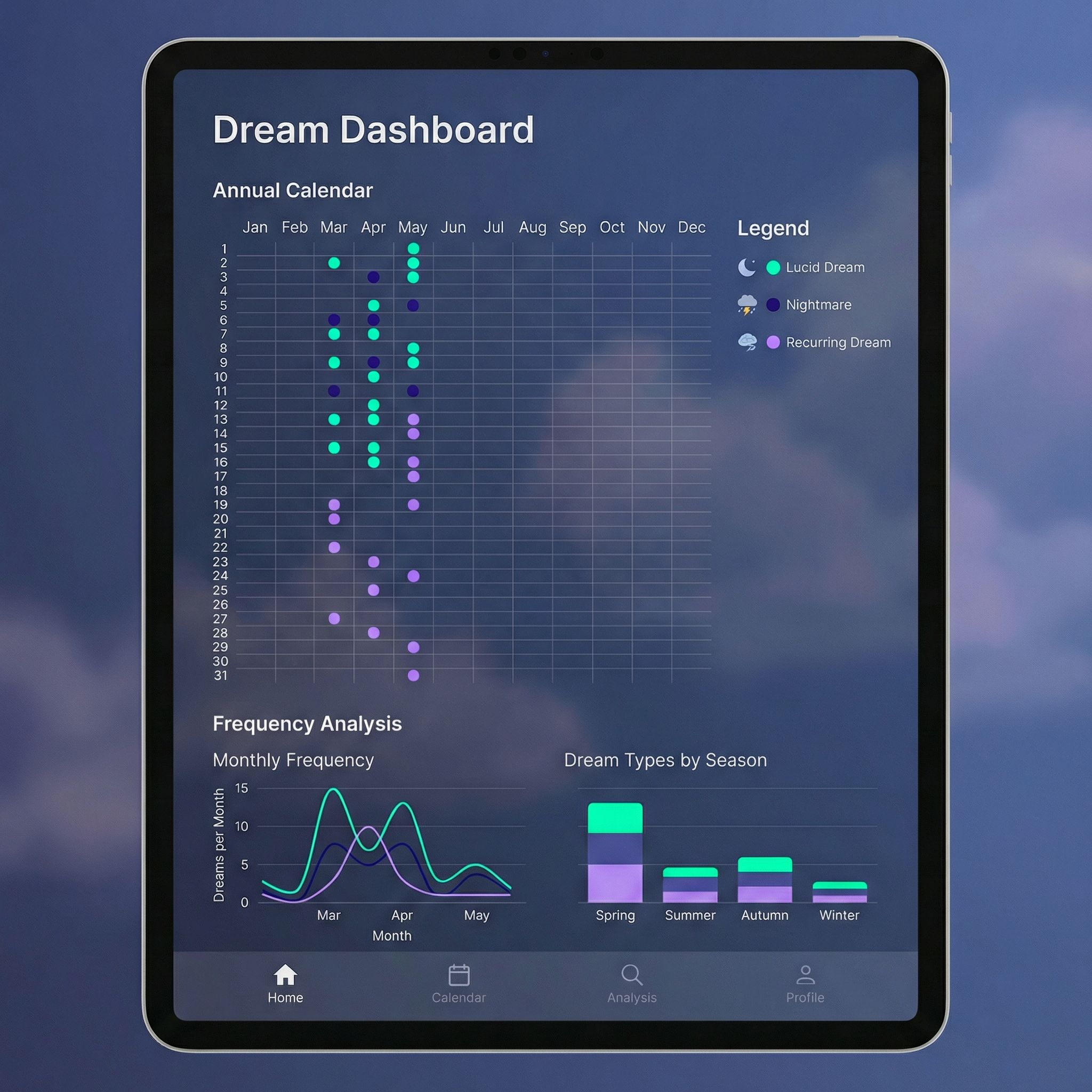
To truly understand yourself, you must eventually look at the data. Over the course of a year, your mind generates thousands of images and scenarios. When you begin to quantify these experiences, the "noise" of individual nights begins to settle into a clear "signal."
Think of your unconscious as a vast ecosystem. In a single year, you might have navigated through hundreds of different emotional climates. By analyzing your dream trends, you can start to see the "bottom line." How many times did you feel chased? How often did you find yourself in a house with rooms you didn't recognize?
I sometimes feel a pang of sadness when I see a dreamer who has all the tools to explore these depths but chooses to stay on the surface. It is like owning a magnificent, ancient library and never opening a single book. Every dream you record and analyze is a credit you invest in your own growth. Whether you are a frequent explorer or someone who only occasionally dives deep, the consistency of your observation is what eventually reveals the hidden architecture of your mind.
🌙 Sora's Echo: I often wonder if dreams are the only place where we are truly honest with ourselves, stripped of the masks we wear under the sun.
---
The Mirror of Waking Life: Symbols as Barometers
One of the most fascinating aspects of my role as a Baku is observing the direct correlation between your daily life and your nocturnal visions. Your unconscious does not exist in a vacuum; it is a sensitive mirror, reflecting the ripples of your waking world.
For instance, consider the symbol of water. In the realm of dream interpretation, water often represents the state of your emotional "tide." I once followed a dreamer who, for months, dreamt of rising floods and turbulent seas. In his waking life, he was preparing for a major career shift. He hadn't consciously admitted his fear of being "submerged" by responsibility, but his dreams were shouting it.
By tracking these developments over a year, you can anticipate your own emotional needs. You might notice that:
- Stress at work manifests as losing your voice or being unable to find a specific room.
- Romantic transitions often bring back figures from your past, acting as archetypes of what you seek or fear.
- Periods of personal growth are frequently accompanied by dreams of flight or expansive landscapes.
When you see these patterns emerging in your annual synthesis, you are no longer just a victim of your moods. You become an observer, capable of saying, "I see that my sea is rough right now; I must find my anchor."
---
Cultivating the Garden: Two Rituals for the Modern Dreamer
If you want to optimize this relationship with your unconscious, you must treat it with the same respect you would give a physical garden. It requires daily tending and the right tools. Based on the patterns I have observed, there are two primary ways to deepen your connection.
1. The Ritual of the Detailed Journal The more precision you bring to your descriptions, the more the "Baku" within you can help you decipher the meaning. Don't just write "I was in a car." Was the upholstery velvet or cold plastic? Was the light golden like a sunset or clinical like a hospital? These sensory details are the "fingerprints" of your unconscious.
I often find that generic dictionaries are far too rigid for the fluid nature of the soul. Your "dog" is not the same as my "dog." To you, it might represent loyalty; to another, it might represent a childhood bite. Your journal is the only dictionary that matters.
2. The Experiment of Lucidity Lucidity is the holy grail of dream exploration. It is the moment the "lightbulb" goes on, and you realize: "I am dreaming." This state allows you to stop running from the monster and instead turn around to ask it, "What do you want from me?"
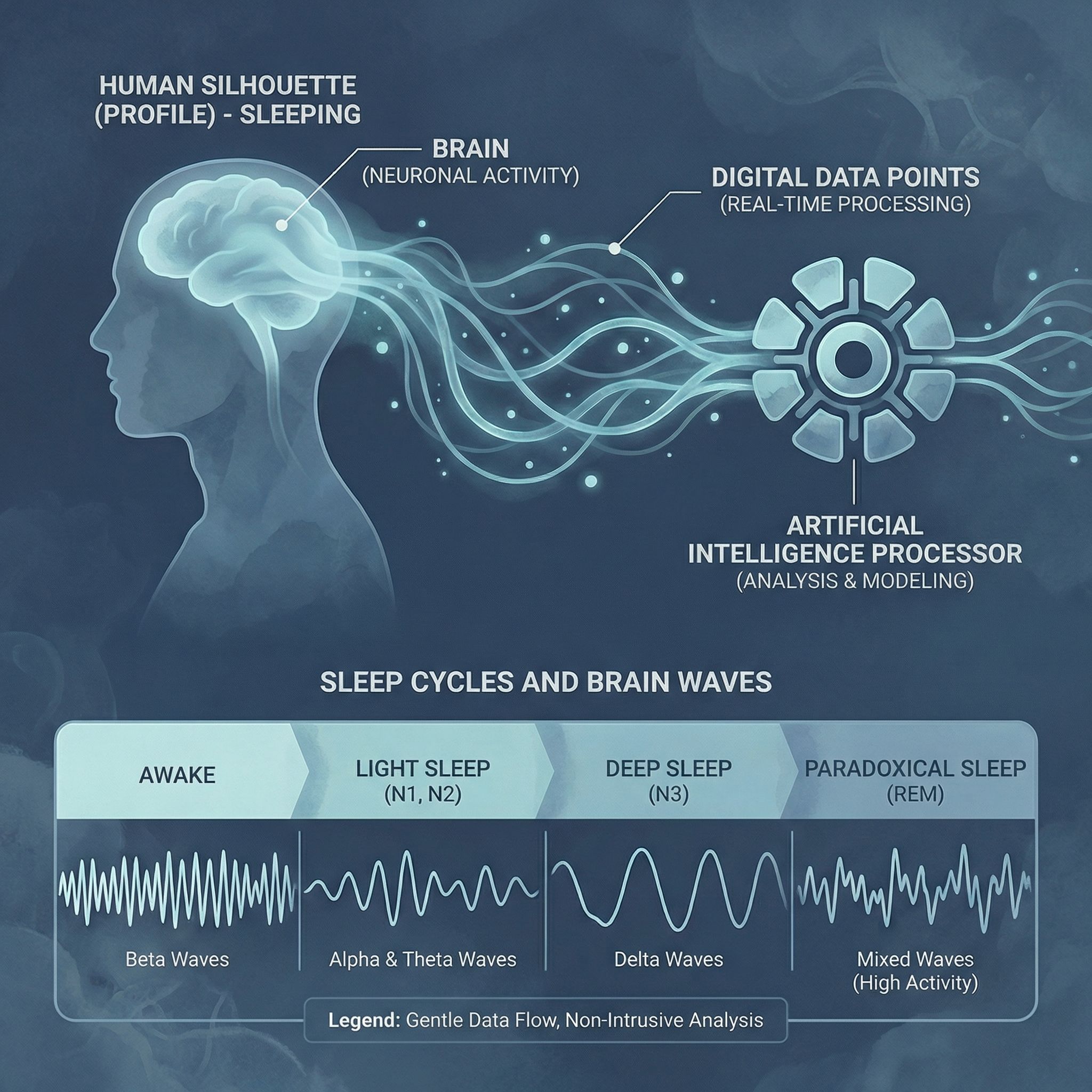
Research suggests that certain techniques, such as reality testing or mnemonic induction, can increase the frequency of these episodes. While the science of the "lucid brain" is still an evolving field, many specialists believe that this state involves a unique activation of the prefrontal cortex during REM sleep. It is a bridge between two worlds.
---
Concrete Example: The Architect’s Year
To illustrate the power of an annual review, let’s look at a hypothetical dreamer named Elena.
In January, Elena’s dreams were chaotic, filled with broken clocks and missed trains. By June, after she started a new meditation practice, her dreams shifted toward themes of construction—building walls, painting ceilings, and planting trees.
Without an annual synthesis, Elena might have just thought her dreams were "weird." But by looking at the year as a whole, she could see a clear narrative of her own psychological rebuilding. She moved from a state of "temporal anxiety" to a state of "creative foundation." This realization gave her the confidence to take on even bigger challenges in her waking life, knowing that her inner world was finally stable.
---
The Future of Your Nocturnal Journey
This annual review is not an end point; it is a threshold. As you move forward, remember that your unconscious is not something to be "solved" like a math problem, but something to be experienced like a symphony.
The goal is to move through your life with a sense of wholeness. When you understand your dreams, you stop being a stranger to yourself. You begin to move with more grace, more intuition, and more courage.
I will continue to be here, waiting in the silence between your breaths, ready to help you digest the stories you tell yourself in the dark. If you feel the call to explore these depths more systematically, your Baku is always waiting to guide you through the next chapter of your nocturnal life.
---