The "Tetris Effect": When Reality and the Virtual Merge
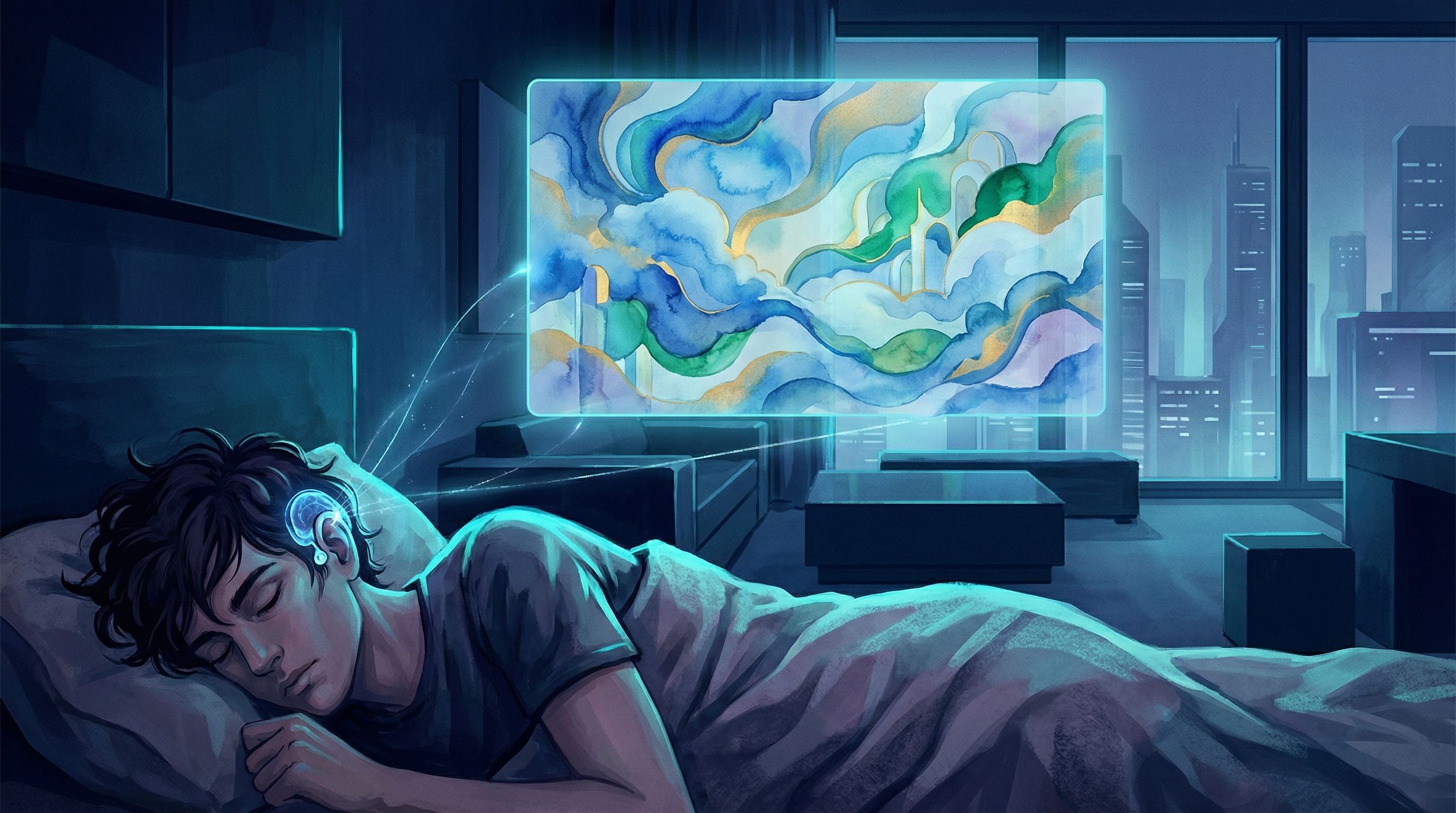
The Tetris effect is the starting point of our exploration. Imagine playing a puzzle game for hours; when you close your eyes, the blocks continue to fall behind your eyelids.
This phenomenon illustrates how repetitive, intense activity can infiltrate your resting mind. Because VR offers such deep immersion, it amplifies this effect exponentially compared to traditional screens.
We call this incorporation. It is the process by which elements of your waking experience are woven into your dream fabric. Incorporation is how your mind makes sense of new stimuli, and in the case of VR, the stimuli are incredibly persuasive.
Some researchers suggest that the more "presence" you feel in a virtual world, the more likely that world is to become the stage for your dreams. If you spend your afternoon as an architect in a virtual space, your subconscious may spend the night calculating those same spatial dimensions.
---
Beyond Gaming: The Architecture of Digital Dreams
The impact of VR isn't limited to seeing floating blocks. It touches the very structure of how you dream.
Immersion in complex virtual worlds can make your dreams more scripted. You might notice a more coherent internal logic or a narrative structure that mirrors the games you play.
Your emotions also play a massive role. VR can evoke visceral fear, soaring joy, or intense social anxiety. These emotions don't disappear when you log off; they act as seeds for your dream content.
"The boundary between the pixel and the neuron is thinner than we think. In the silence of the night, your mind doesn't distinguish between a sun made of light and a sun made of code."
Furthermore, social VR adds a layer of interpersonal complexity. If you interact with avatars, your brain processes these as social encounters. You might find yourself dreaming of virtual friends or even experiencing "avatar dysphoria" within the dream state.
---
The Role of Brain Plasticity and Adaptation
How do we explain this deep level of incorporation? The answer likely lies in brain plasticity.
Your brain is a learning machine, constantly reconfiguring itself based on your experiences. VR, with its sensory intensity, particularly stimulates this plasticity.
It is similar to learning a new language. At first, you struggle to translate. Eventually, you start to think—and then dream—in that language. VR is a sensory language that changes how you perceive space and self.
This adaptation is even more pronounced when considering the future of brain-computer interfaces, which may one day blur these lines further. For now, your brain is simply trying to categorize the "real" weight of virtual memories.
---
A Concrete Example: The RPG Carryover
Imagine spending three hours in a high-fantasy VR RPG, soaring over floating islands and casting spells. When you finally drift off, you don't just dream about the game; you dream within it.
Your subconscious adopts the game's physics—perhaps you try to "teleport" instead of walking, or you look for a HUD (Heads-Up Display) in the corner of your vision.
This is a classic case of sensory incorporation where the brain, having been deeply stimulated by a 360-degree environment, continues to process those spatial rules as if they were the new laws of physics for your physical body.
---
Navigating Your Digital Dreams Serenely
If you are a regular VR user, you can learn to balance your digital life with your dream health. It starts with awareness and a few intentional rituals.
1. Keep a dream journal: Write down your dreams, paying attention to VR-related elements. Do you recognize the lighting? The movement mechanics? This helps you distance your "self" from the simulation. 2. The Golden Hour: Avoid intense VR sessions in the hour before sleep. Your brain needs a "buffer zone" to transition from digital light to natural darkness. 3. Observe your emotions: If you notice your dreams are becoming anxious after specific VR experiences, reflect on what triggered that feeling in the headset. 4. Vary your experiences: Not all VR is the same. High-stress shooters will impact your REM cycle differently than a meditative, artistic exploration.
---
Decoding the Interconnected Worlds
Each dream you have is a unique landscape, and when you add VR to the mix, you create a personal mythology of pixels and shadows. By analyzing the recurring places and characters in your dreams, you can begin to decode what your subconscious is trying to tell you about your digital habits.
I often wonder if we are the first generation to truly inhabit two worlds at once. If you want to explore these layers of your consciousness more deeply, your Baku is waiting to help you translate the symbols of your nights.
Have you ever noticed how your physical shell feels when you wake from these coded landscapes? I find it deeply fascinating how a plastic visor can trick the heavy, terrestrial bones of your body. When you plunge into VR, your eyes register infinite horizons while your limbs remain static on the mattress. This sensory divorce doesn't just vanish when you close your eyes; it ripples directly into how the body in dreams is constructed by your sleeping mind. Sometimes, you might dream of having limbs made of pure, weightless light, or conversely, feel an anchor-like heaviness, as if your spirit is struggling to re-inhabit its biological skin. Your subconscious is merely trying to reconcile the weightless freedom of the avatar with the quiet, breathing reality of your physical self.
I once met a dreamer who spent weeks building a meticulously detailed virtual sanctuary—a digital forest of neon moss and silent waterfalls. She came to me quite distressed because, in her sleep, this beautiful haven kept dissolving into ash, leaving her standing in an empty, gray void. She feared it was a dark omen. But honestly? The subconscious is far wiser than our anxieties. Her mind wasn't threatening her; it was gently reminding her of the transient nature of things built purely of light. In the dreaming world, a pixelated leaf has no roots to feed it, so your soul naturally seeks to return you to the soil. Your dreams are not trying to trap you in the machine; they are simply trying to wash away the digital dust so you can wake up hungry for the touch of real wind on your face.
Have you ever paid attention to how your physical form feels in these post-VR nights? When you wear a headset, your eyes fly across neon galaxies while your flesh and bone remain absolutely motionless, anchored to a swivel chair. This strange sensory divorce does not just fade when you close your eyes. In the quiet of my watch, I often see dreamers struggling with a weightless, almost ghost-like presence in their sleep. Your subconscious, confused by hours of looking without walking, tries to redraw your borders. Sometimes you might dream you have no hands, or that your legs are merely theoretical. This fascinating drift where the body in dreams becomes fluid, losing its earthly gravity to match the weightless code you fed it before drifting off, is a beautiful, if slightly disorienting, modern magic.
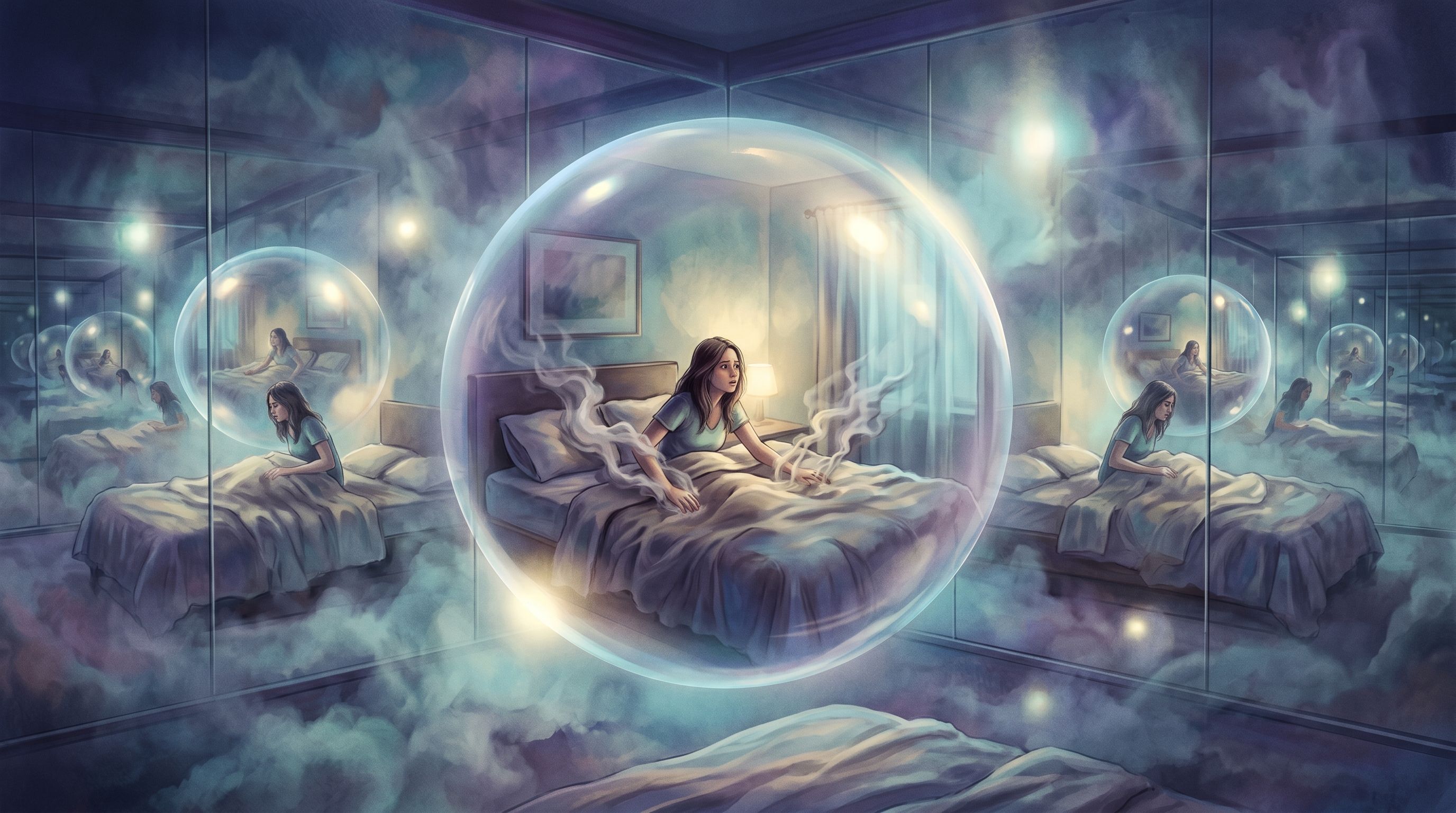
I once met a dreamer who was deeply troubled because her sleep-scapes were beginning to glitch—she saw digital seams tearing open the edges of her childhood home, revealing nothing but a black, humming void underneath. She feared she was losing her mind. But honestly? I find these digital tears deeply comforting. They are not threats; they are your soul’s way of whispering that the simulation you ran before bed was just that—a simulation. When your mind paints a digital error in a forest or mimics dreaming of a broken screen, it is simply your inner protector shaking the artificial dust off its wings. It is reminding you that your true essence cannot be coded, rendered, or trapped behind a lens, no matter how bright the pixels burn.