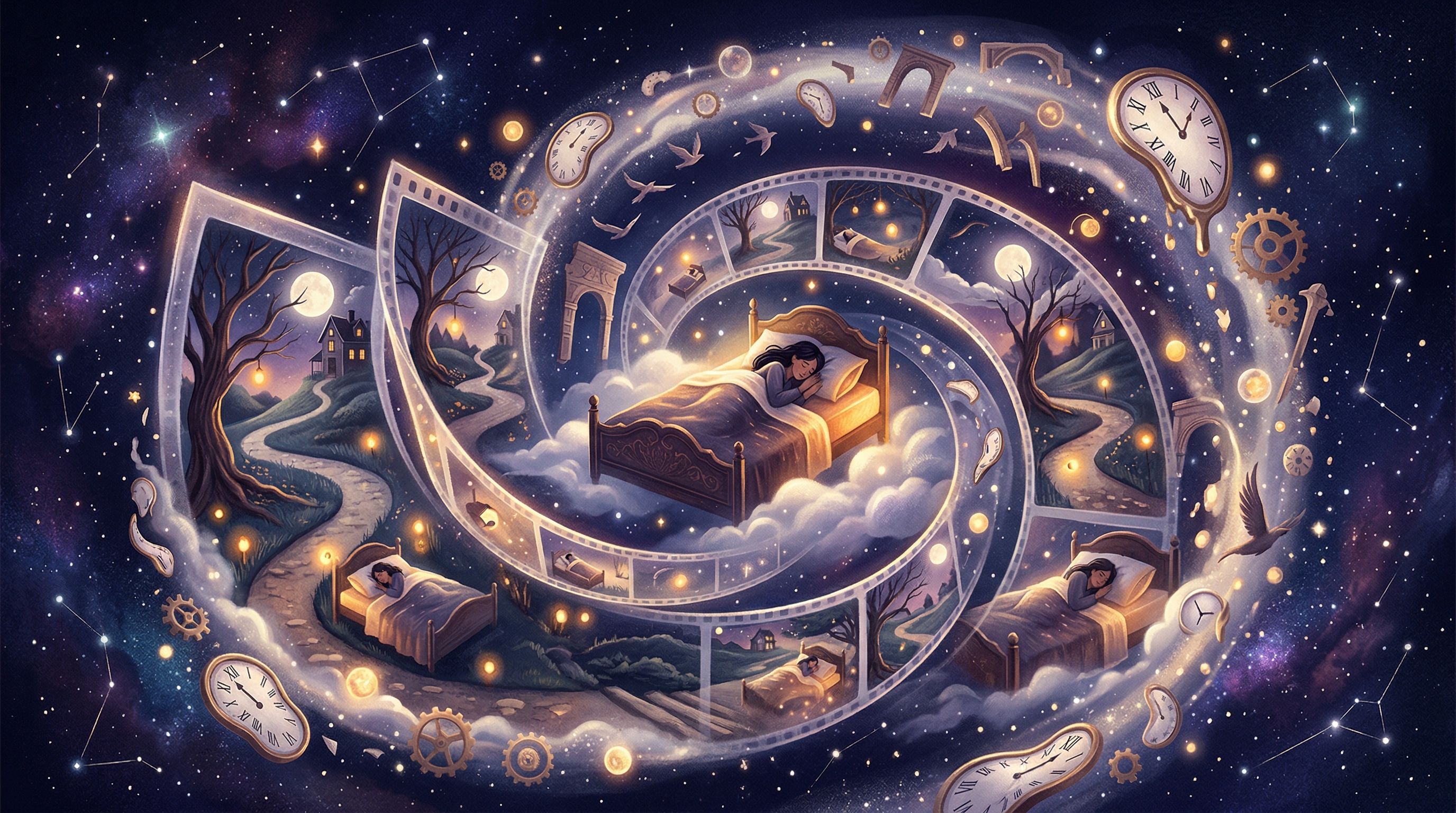
The Dream as a Mirror of Your Inner Resistance
Imagine a broken mirror. Your recurring dream is like one of its fragments—distorting, certainly, but still reflecting a vital aspect of your inner reality. This haunting image points to a being pursued: what you flee defines you. It is something that is preventing you from moving forward in your waking life.
Repetition is the insistence of the unconscious. It knocks on the door of your consciousness, again and again, until you deign to open it. It shows you the same scene, with the same actors, until you finally understand the role you play and the message it is trying to convey.
In my wanderings through the dreamscape, I often see these loops as "unfinished business." Your mind is a natural problem-solver; if it encounters a psychological knot it cannot untie, it will replay the problem every night, hoping that this time, you will find the key.
"La répétition n'est pas une punition, c'est une main tendue par ton ombre pour t'aider à ne plus trébucher sur la même pierre."
---
The Roots of the Block: Diving into the Unconscious
But where does this block come from? What are the roots of this infernal repetition? Often, it is an unhealed wound—a buried trauma, a repressed fear, or an unfulfilled desire. The unconscious, with its relentless logic, confronts you with this wound until you have the courage to face it.
Sometimes, it is a limiting belief. This is a false idea you have about yourself or your abilities that acts like a virus in your mental software. The recurring dream shows you the consequences of this belief, manifesting as obstacles or failures that feel inevitable.
Then, there is the question of archetypes. These universal figures populate the collective unconscious: why we all dream of falling. The Hero, the Shadow, the Wise Old Man... these figures can manifest in your recurring dreams to embody parts of yourself that you ignore. If you are constantly pursued by a menacing figure, it may be your Shadow claiming its right to be seen.
Concrete Example: The "Missing Exam" Loop
Consider a common case: dreaming of failing an exam years after graduating.
- The Surface: Fear of failure.
- The Depth: You might be facing a "test" in your current life—perhaps a new job or a relationship—where you feel like an impostor.
- The Resolution: Once you acknowledge that your current anxiety mirrors your old academic stress, the dream often vanishes. You have "passed" the psychological test by recognizing the pattern.
---
Breaking the Cycle: Practical Tools for Decoding
How do you transform this "bug" into an opportunity for growth? Based on psychoanalytic traditions and modern sleep observations, here are a few avenues to explore:
1. Keep a dedicated journal Write down your recurring dreams with as much detail as possible. Look for the "invariants"—the things that never change—and the "variables"—the tiny details that shift. These shifts often show that you are beginning to process the emotion.
2. Explore the personal symbols Avoid generic dream dictionaries. Instead, ask yourself: "What does this specific object mean to me?" If you dream of a locked door, don't look up "door" in a book. Ask yourself what is behind the doors you keep closed in your daily life.
3. Dialogue with the characters In your mind, while awake, try to talk to the "antagonist" of your dream. If a monster is chasing you, turn around in your imagination and ask: "What do you want from me?" The answer might surprise you.
4. Practice "Lucid Scripting" Before falling asleep, tell yourself: "If I find myself in that hallway again, I will stop and look at my hands." This small act of agency can break the script of the dream and allow your unconscious to move on to a new narrative.
---
Conclusion: Your Unconscious as a Powerful Ally
Recurring dreams are not a fatality; they are invitations. They are opportunities to know yourself more deeply, to free yourself from your blocks, and to fully realize your potential. When you stop running from the repetition and start listening to its rhythm, the "bug" becomes a teacher.
As you begin to map these patterns, you might find that the symbols in your nights start to form a coherent story. If you feel the need to explore these symbols more deeply, your Baku is always here to help you gather the fragments.
What is the one thing your dream is trying to tell you that you are still afraid to hear?
Have you ever noticed how these nocturnal loops carry their own distinct weight in the body? It is rarely just a visual rerun; it is a physical atmosphere. For some, it is a sudden drop in temperature, a freezing chill that settles in the bones before the familiar scene even begins. For others, it manifests as a desperate struggle to speak, a sensation akin to dreaming of a muffled scream where the throat tightens and no sound escapes. I find this sensory lock fascinating and deeply tragic. Your unconscious is not just showing you a picture; it is trying to make you feel the somatic reality of your stuckness. The dream uses your physical body as a sounding board, vibrating with the unresolved tension of your waking hours. When you wake up with your heart racing or your jaw clenched, your body is remembering what your conscious mind is still trying to deny.
It tires me when people treat these repeating dreams as mere glitches in brain chemistry, as if the mind were just a faulty machine. More often than not, these loops emerge during profound life transitions—when you are standing at a crossroads but refuse to choose. You might be quietly grieving an old version of yourself, or perhaps you are trapped in a relationship that has run its course. In these moments of hesitation, you might find yourself dreaming of an impasse, a literal dead-end road or a wall that grows taller every night. This isn't a punishment. It is your inner compass pointing out that your waking life has stalled. The dream repeats because you are trying to move forward using old, outdated maps. Until you accept that the path behind you is closed, your sleeping mind will keep bringing you back to that same brick wall, waiting for you to turn around.
I once watched over a dreamer who spent months fleeing a terrifying shadow through a maze of gray corridors, night after night. He was exhausted, convinced he was battling some ancient inner demon. But when we looked closer at the edges of his nightmare, we noticed a small, quiet detail he had ignored in his panic: a figure standing quietly by the exit, trying to hand him a sealed envelope. It turned out his mind wasn't trying to terrorize him; it was simply trying to deliver a truth he was too afraid to face. We often brace ourselves for monsters, forgetting that the unconscious can be incredibly gentle in its persistence. The loop exists not to torture you, but because you keep running past the very thing meant to save you. Sometimes, the key to breaking the cycle is not to fight the storm, but to stop, breathe, and look at what is quietly waiting in the corners of your mind.