The Primal Fear of Losing Your Grip
It irritates me a little to see how dream interpretations are often reduced to simplistic, scary generalities. You've probably seen those "dream dictionaries" that claim losing teeth means someone close to you will die.
The human psyche is far more nuanced than a checklist. In reality, your teeth are your tools for survival. They allow you to nourish yourself and to defend yourself.
When you dream they are falling out, you are often facing a situation where you feel vulnerable. You might feel that you are losing your "bite"—your ability to assert your will or to seize the opportunities life is placing in front of you.
It is a reflection of your integrity. Not just moral integrity, but the structural integrity of your life. If a part of your foundation feels shaky, your unconscious might use the image of a loose tooth to get your attention.
---
A Necessary Shedding: The Symbolism of Transition
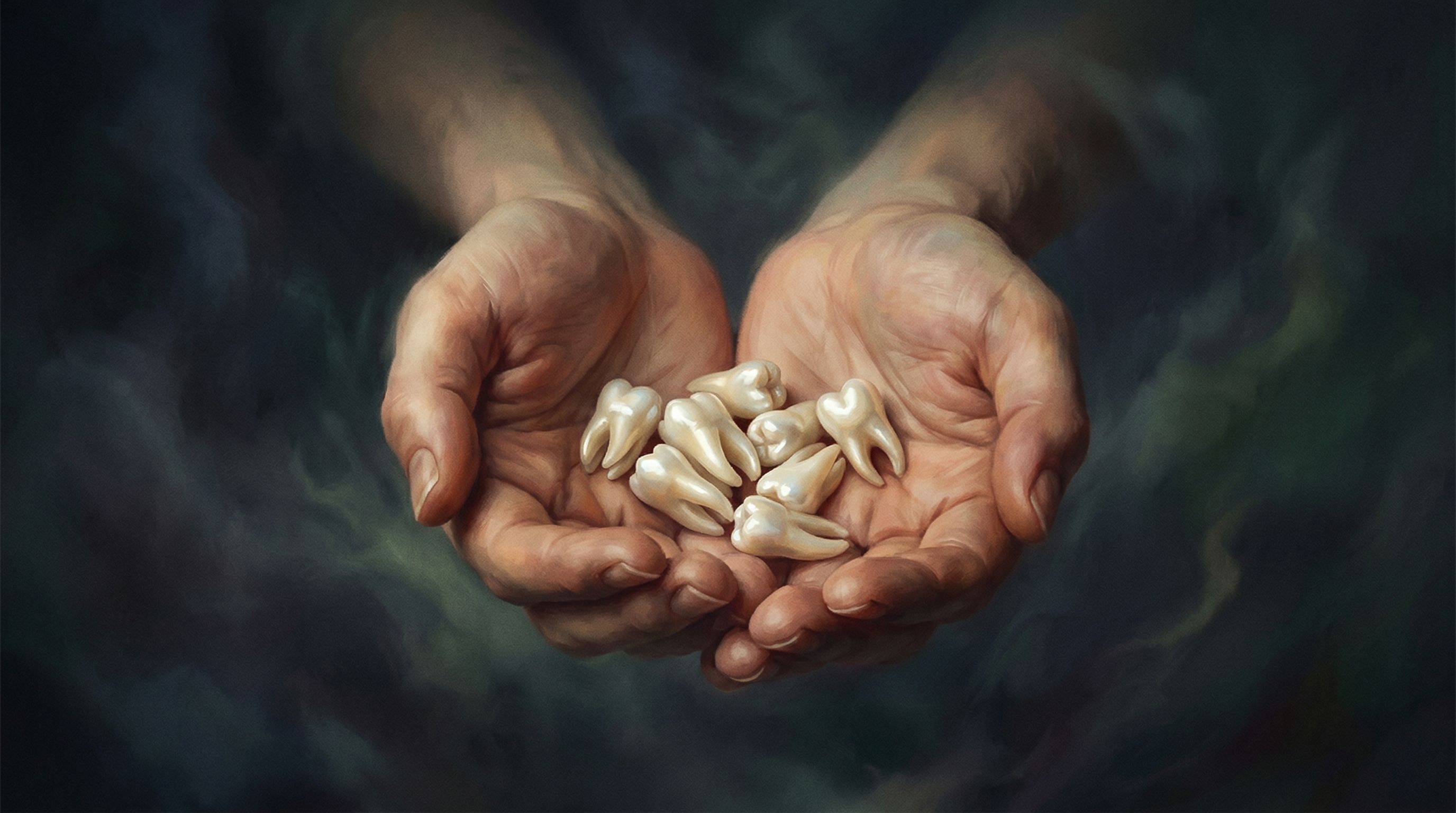
Not every loss is a tragedy. Think back to your childhood. Losing a tooth was a rite of passage, a sign that you were becoming stronger and more capable.
An invitation to transition often wears the mask of loss. Your unconscious might be whispering that it is time to shed what has become obsolete.
Perhaps you are holding onto beliefs, relationships, or career paths that no longer serve you. Just as baby teeth must fall out to make room for adult ones, your old "tools" for navigating the world might need to be replaced by something more resilient.
"Parfois, l'inconscient doit briser une partie de nous pour nous forcer à reconstruire quelque chose de plus vaste. La chute n'est pas la fin, c'est le début de la repousse."
---
Concrete Example: The Weight of the Unspoken
I remember a dreamer who came to me some moons ago. He was navigating a severe professional crisis, feeling trapped in a role that demanded he stay silent while his values were being compromised.
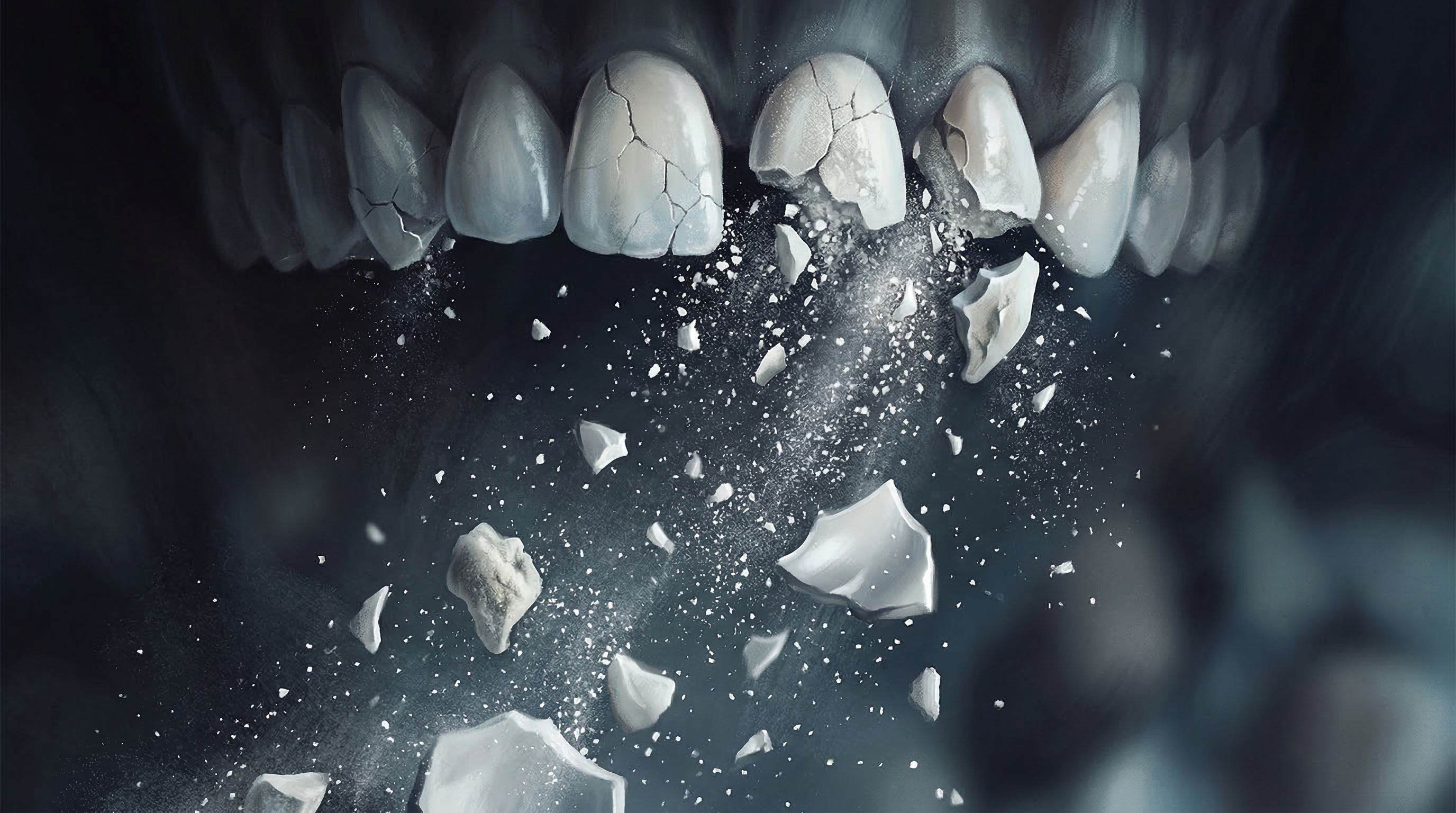
Night after night, he dreamed his teeth were crumbling into fine dust. He couldn't even spit them out; they just filled his mouth until he felt he was choking.
We explored his feeling of illegitimacy. He realized the dream wasn't about his health or a literal failure. It was about his voice. By refusing to speak his truth at work, he was "losing his teeth"—his ability to communicate and defend his boundaries.
Once he decided to transition toward a path more aligned with his values, the dreams stopped. He had found a new way to "bite" into his reality.
---
The Science of the Dreaming Body
While we often look for psychological meaning, we must also remain anchored in the physical. Some specialists suggest that a dream of falling teeth might have a physiological trigger.
Bruxism, or the grinding of teeth during sleep, is often exacerbated by stress. The physical pressure on your jaw can translate into a dream narrative where your teeth are under threat.
Furthermore, the fear of death or aging is a common underlying theme. Teeth are a visible marker of time passing. Their loss in a dream can be a safe space for your mind to process the inevitable changes of the human body.
---
How to Sit With This Dream
If you find yourself frequently losing your teeth in the dream world, I invite you to pause and reflect on these questions:
1. Where do you feel powerless? Identify the areas of your life where you feel you have no "grip" or influence. 2. What are you struggling to digest? Consider if you have taken on more responsibilities than you can realistically handle. 3. What is left unsaid? Reflect on whether you are censoring yourself to please others or out of fear of conflict. 4. What is trying to grow? Look past the loss and ask yourself what new version of "you" is waiting to emerge.
Dream interpretation is a deeply personal journey. I don't have all the answers, and neither does any book. Your own feeling when you wake up—that specific mix of relief and lingering dread—is your best guide.
Have you ever noticed the bizarre, tactile hyper-realism of this dream? It is rarely just a visual event. Your tongue feels the empty, raw space in your gums; you taste the metallic tang of copper, or feel the dry, gritty texture of crumbling enamel. I often wonder why our sleeping mind chooses such sharp, physical discomfort to wake us up. It is as if the unconscious knows that abstract anxiety won't move you, but the physical sensation of losing your skeleton will. It forces you back into your body. This sensory shock isn't a punishment. It is a violent, beautiful awakening, a reminder that you are flesh and bone, and that some pressures in your waking life have become too heavy for your body to carry silently.
There is a quiet majesty in our anatomy that we often ignore. Dentists call the visible part of the tooth the 'crown.' When you lose them in a dream, could it be that you are quietly relinquishing your inner sovereignty? I once met a dreamer, a gentle woman who had spent decades catering to everyone else's demands, who dreamed of her crowns snapping off one by one like cheap plastic. She wasn't sick; she was simply tired of ruling a kingdom of obligations that wasn't hers. When your teeth crumble, your unconscious might be stripping away a false crown of responsibility you were never meant to wear. It is a painful abdication, yes, but a necessary one if you ever want to rule your own life with genuine peace.
In several ancient cultures, teeth are not just tools; they are considered the outer extensions of our bones, the only visible part of our skeleton. They represent our lineage, the deep-rooted ancestral heritage we carry in our jaw. When they fall out, it can feel like a terrifying rupture in your history. But honestly? I see this as a profound moment of liberation. You might be shedding inherited patterns, breaking family curses, or finally letting go of generational expectations that have kept you clenched for years. To fully understand the deeper mysteries of teeth in your night-travels, you must look at what you are ready to inherit—and what you must bravely leave behind in the soil of the past.
I have always found it fascinating how much we rely on our smiles to navigate polite society. We polish, we straighten, we hide behind these little white stones. When you find yourself dreaming of teeth crumbling, your unconscious might simply be stripping away your social mask, forcing you to look at who you are when you cannot perform charm. It is a terrifying thought, isn't it? To be seen without your armor. I once met a dreamer who was terrified of losing her social standing; she kept dreaming of her teeth turning into soft wax during a dinner party. It wasn't about death, but about the exhausting theater of perfection. Perhaps your dream is just a gentle, if messy, invitation to let your guard down and stop smiling when your heart is heavy.
Have you ever paid attention to the strange, wet silence that follows the loss? In many of the dreams I've listened to, the most striking detail isn't the falling tooth itself, but the tongue obsessively tracing the empty socket. It is a profoundly tactile, almost hypnotic sensation. In Eastern philosophy, we often speak of the beauty of empty space—the hollow that makes the vessel useful. When a tooth departs, it leaves a void, a fresh pocket of air in your mouth. Perhaps we focus too much on what was lost rather than what this new space allows. It is a quiet invitation to breathe differently, to speak from a place that is no longer crowded by old structures. Sometimes, the gap in your smile is simply room for a new kind of truth to emerge.