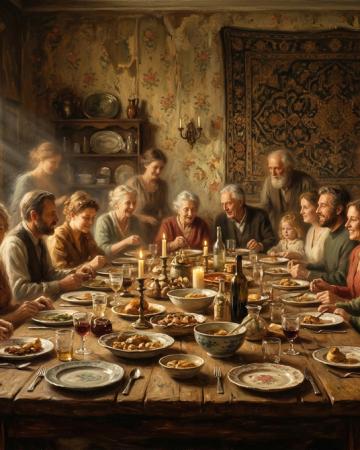


You don't see him every day. You run into him at Christmas, at a wedding, sometimes at a funeral. And now he takes up a whole night: he talks, he laughs, he looks at you as if he had kept a close eye on your life all along. When you wake up, that surprise is often what stays. Why him, and not your father or your brother? The answer has less to do with the man than with the place he holds in your family, and the title of this page sums it up: a mirror held at an angle, showing you your own image without looking you in the face.
Why would your mind pick an uncle instead of a father or a brother?
Because an uncle is family without being household. He knows your parents' story from the inside, without their everyday authority over you, so the dream uses him to talk about your family from a little distance.
Think about what it means to be your father's or mother's brother. He grew up in the same house they did, and he knew the kid they were before they became your parents. He also has a freedom that neither they nor you have: he can advise without having to raise you, and judge without having to punish. English even has a phrase for it, a "Dutch uncle," someone who tells you hard truths for your own good. That's why I like to think of him as a mirror set at an angle. Facing the authority of a father, you see yourself head-on, which can be rough. With an uncle, you see yourself from the side, and sometimes that's enough to catch a detail.
What the uncle does in the dream points the way. Advice usually signals a need for support, a reproach the weight of a family expectation, and an object handed over or a skill taught, something being passed down. Ready-made formulas like "uncle equals an inheritance of money" leave me skeptical. The more useful question, I think, is this: what did you get from him, a discipline, a sense of humor, a trade, a way of carrying yourself, and what have you done with it?
Does it matter whether he's your father's brother or your mother's?
It can, if the two sides of your family played different roles. No rule settles it. What counts is the place that particular uncle holds in your life.
English has one word, "uncle," which comes from the Latin avunculus, the mother's brother (it's also where "avuncular" comes from). The Romans had another word, patruus, for the father's brother. Arabic separates them the same way, the ʿamm on the father's side and the khāl on the mother's, and Chinese tells the father's brothers (伯父 for the elder, 叔父 for the younger) apart from the maternal uncle (舅舅). Many languages keep a trace of a difference that ours has blurred.
Anthropologists noticed it too. In many societies the mother's brother plays a special part in the lives of his sister's children, and in 1945 Claude Lévi-Strauss made him one of the four relationships in his "kinship atom." The dream dictionaries attributed to Ibn Sīrīn also keep the two sides apart (see the traditions below).
Ask yourself the question in your own family. Does this uncle bring you closer to your father's side or your mother's? On which side do you feel invited, and on which a little like an outsider? If an aunt walks into the scene, her page adds to the reading.
How should you read a dream of an uncle who has died?
Most often, the dream brings back your bond with him more than the man himself: what he stood for in your life, a quality, a place, a habit, and the way you carry his absence.
In grief, seeing the person who died in a dream is common, and it can happen long afterward. What matters then is his condition and what he's doing. If he's calm, sitting with you, busy with his old routines, it's a dream of reunion, and people often wake up comforted. If he's sick, rushed, silent, or angry, he's more likely carrying something that was left unfinished between you. I can't tell you whether it's a visit, and I won't pretend to know. What I can tell you is that your state in the moment you wake is your best clue.
Ask yourself which of his qualities you're missing today: his patience, his humor, his practical sense. It often hides in the choice of place and gesture. If the pain comes back strong, and even more if it keeps you from sleeping or from getting through your days, tell a friend or a therapist. The page on dreaming of a deceased parent continues this reading, and so does the one on mourning.
Why does your uncle's face look like someone else's?
Because dreams readily fuse two people into one, and the uncle often serves as the mold: he's the one you see, but the face, the voice, or the walk also belong to someone else.
Freud gave a famous example. In a dream he tells in chapter IV of The Interpretation of Dreams, he thinks "Friend R. is my uncle," and sees a face that is at once R.'s and that of his uncle Joseph. He compares the image to Francis Galton's composite photographs, which laid several portraits on the same plate to bring out what the faces have in common. The reasoning works for your dream whatever you think of the theory: if your uncle reminds you of someone, write down who, then look for what the two share. That is probably what the dream is about.
Freud notes a second detail. In his dream he feels great affection for R., which he finds exaggerated, and he reads it as a feeling placed there to cover a contrary thought. That's his reading, not a rule, but the idea is useful: when the dream gives you a tenderness or an anger toward your uncle that seems out of proportion, ask who it's really aimed at. The whole story of that dream, which grew out of a rivalry between colleagues, is told on the page about dreaming of a colleague.
What does it mean when your uncle doesn't act like the uncle you know?
He lends his shape to a voice that is yours: the dream borrows a familiar face to tell you something you're already telling yourself.
A jovial uncle who turns stern in the dream may be voicing your own inner judge, the one who finds you too carefree or not serious enough about your responsibilities. A tight-lipped uncle who suddenly talks freely gives a voice to what you wish someone would tell you. An uncle who is always around but stays silent or drifts away points more to support you fear losing. In every case, the gap between the real uncle and the dream uncle is the information. Write three words for one and three for the other, and compare: what the dream added or took away comes from you.
What are you looking for in an uncle's house or workshop?
A place where you can be different. At an uncle's, the rules of your parents' house don't apply, and the dream takes advantage of that neutral ground.
Imagine you're sorting old tools in your uncle's garage, in a smell of rust and gasoline. The man matters little in this scene and the atmosphere a lot: you can get your hands dirty, try things, fail, without it turning into a family affair. The same dream in a dusty attic is more about what has been stored away for a long time and never looked at.
Compare it with your parents' living room, or the house you grew up in. If you breathe more freely at the uncle's, ask what your own home doesn't allow you, and whether that comes down to the walls or to habits you could change.
What should you do with an uncle dream when you wake up?
Three questions are enough to start: who is this uncle to you, what did he do or say, and how did you feel next to him.
The first places him in your family: his side, his role, the real distance between you. The second tells you what you're looking for, support, judgment, or something passed down. The third breaks the tie when the other two hesitate. Add the place where the scene happened, and you have about everything you need to read your dream without locking it into a formula.
My advice: take a sheet of paper, write your uncle's name, then three things you got from him, a way of acting, a taste, maybe a fear. Underline the one you recognize in yourself. That's the thread to pull. If you'd like to leave your dream somewhere, it will find its place in the Midnight Mind app, where I'll stay with what makes yours singular, the place, the uncle's condition, your reaction.