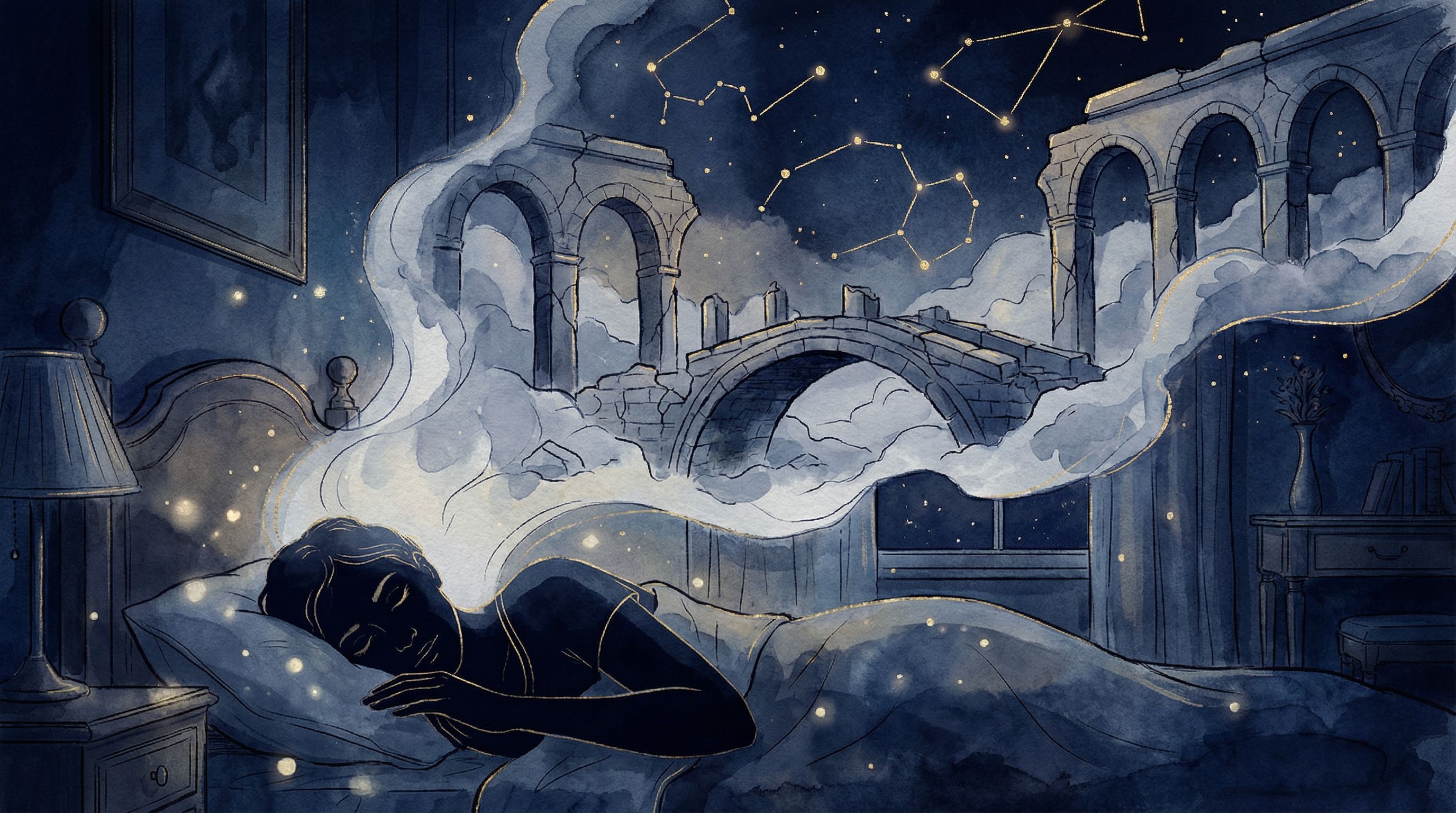
When Your Inner Theater Performs a Scene of Forgiveness
Do you know what I taste when I devour a nightmare of conflict that ends in an embrace? It is a delicate blend of salt and honey—the salt of tears long shed, and the honey of a resolution finally found. To me, seeing you reconcile in a dream is one of the most beautiful mechanisms of the human spirit.
It is a form of psychological Kintsugi. You might know this Japanese art of repairing broken ceramics with gold, where the cracks are not hidden but celebrated. When you dream of making up with someone, your mind is applying that gold to the fractures of your own story.
I am often asked if these dreams are a sign to pick up the phone and call an ex or a distant relative. My answer is almost always the same: not necessarily. Your dream isn't a phone directory; it’s a mirror. The person you are reconciling with often represents a facet of your own character.
If you reconcile with an authoritarian figure, perhaps you are finally making peace with your own need for structure or authority. If it’s with a childhood friend, maybe you are rediscovering a spontaneity that you had suppressed for too long. Like clouds, these figures shift and change, reflecting the weather of your internal world rather than the reality of your external relationships.
---
The Nuances of Reconciliation: From a Whisper to Grand Forgiveness
Every detail in the dreamscape carries its own weight. I don’t believe in simple dream dictionaries that claim "Reconciliation = Good News." The truth is much more subtle and personal to you.
Sometimes, the reconciliation is silent. A simple look, a hand placed gently on a shoulder, or a shared nod. These are my favorite dreams to witness. They suggest that words are no longer necessary because the conflict has been fully "digested" by your subconscious. It is a sign of profound maturity; you have moved past the need for explanations.
Other times, the reconciliation is difficult and laborious, even in the dream. You talk, you explain, you cry. This often means the process of forgiveness is currently underway in your waking life, but it still requires conscious effort. Your mind is practicing; it is rehearsing the scene to give you the courage to live it or to close that door once and for all.
🌙 Yume’s Echo: A dream of peace is a bridge built in the dark, allowing you to cross over the rivers of your past without getting your feet wet.
And what about those dreams where it is the other person coming toward you? This is often your deep desire to be recognized in your suffering. You don’t need the real person to validate your feelings; your subconscious creates this version of them to offer you the apology or the embrace you need to move forward. It is a self-soothing mechanism that allows you to let go of a burden that no longer serves you, much like the symbolic release found when toilets.
---
Concrete Example: Reconciling with the "Ghost of the Past"
Imagine you dream of reconciling with a childhood bully. In the dream, you sit together in a quiet park, and they apologize with sincerity. You wake up confused—you haven't thought of them in years. This dream isn't actually about the bully; it’s about the part of you that felt small or powerless back then.
By accepting that apology in your sleep, your mind is validating your own past pain. You are telling your younger self that it’s okay to let go of the defensive walls you built. It’s a profound act of self-parenting that allows you to reclaim the energy you once used to hold onto that old resentment. You aren't forgiving the person; you are freeing the version of "you" that was stuck in that moment.
---
Why Your Mind Chooses This Path Now
You might wonder why these faces from the past continue to visit your nights. Dreams do not ask for permission. They show you that even if you have banished someone from your waking life, they still occupy a space in your internal geography.
Making peace in a dream is a decision to no longer let that person be a haunting ghost. Instead, they become a statue in the museum of your past—present, but no longer capable of hurting you.
Some specialists in dream psychology suggest that these reunions occur when we reach a new level of emotional stability. Your brain finally feels "safe" enough to process the old trauma. It’s a sign of growth. You are no longer in survival mode; you are in the restoration phase.
Honestly, I find it fascinating to see how capable you are of healing yourself. Even if reality remains complex and messy, these few minutes of nocturnal peace are a powerful balm. They remind you that reconciliation is, above all, a state of mind—a decision to no longer let conflict define who you are today.
So, the next time you wake up with that sense of peace after shaking hands with an old "enemy," don’t immediately try to figure out if it’s a premonition. Simply appreciate the calm. Your mind has just cleaned a dusty room in your memory, and that is a gift you have given to yourself.
Sleep peacefully; the bridge has been built, and the water flows beneath it, carrying away the old sorrows. If you want to explore these symbols and your own inner landscape more deeply, your Baku is waiting for you.
Have you noticed the temperature of these dreams? They rarely happen in shivering, drafty spaces. More often, the air is thick with a heavy, amber warmth, a sensory reflection of dreaming of the color gold which represents the refined, valuable pieces of your integrated self. When you embrace your former enemy in the dream, there is often a physical sensation of unburdening—a sudden lightness in your chest, as if a stone you’ve carried since adolescence has dissolved into warm water. I find it fascinating how the body remembers what the mind tries to lock away. Even as you sleep, your muscles untangle, releasing the physical memory of old armor. This is not just a mental trick; it is a somatic sigh of relief, a gentle shedding of ancient, useless weight.
I once watched over a dreamer who spent years agonizing over an unspoken apology to her deceased father. She was haunted by the silence. Then, one night, she dreamt they were simply sitting on a porch, sharing a cup of tea. No words were spoken, yet when she woke, the jagged edges of her grief had been smoothed. Some might dismiss this as mere wish-fulfillment, but I see it as something far deeper: the subconscious stepping in to perform the rituals that waking life denied you. When physical closure is impossible, your mind creates its own altar. This internal theater doesn't need the other person's physical presence to grant you a quiet state of acceptance; it weaves the peace you deserve out of the threads of your own memory, proving that healing is ultimately an inside job.
Yet, I must admit, some of these dreams leave a bitter taste in my mouth. There are nights when a dreamer meets an old tormentor and feels forced to hug them, waking up with a stomach knotted in quiet anger. I strongly dislike those rigid interpretations that claim every dream embrace is a blessing. Sometimes, your dreaming mind is actually warning you against a forced harmony. It is a simulation of pressure—your psyche testing if you are truly ready to let go, or if you are merely pretending to be healed to please others. If the dream reconciliation felt oily or hollow, do not force yourself to mimic it in daylight. It is okay to keep your walls up. Your anger is a guardian too, and it deserves as much respect as your capacity to forgive.