
Firefighters learn early that a fire stands on three legs: fuel, oxygen, and heat. Take one away and it goes out. You cool it with water, smother it under a blanket or a lid, or starve it by pulling the fuel away. Your dream picked one of these, and that choice often says more than the flames themselves. First, though, you need to know what kind of fire you were putting out, because a house fire and a fire in the fireplace tell very different stories.
What does it mean to dream of putting out a fire?
Most often, you're getting a handle on something that was running too hot: an argument, anger, a situation that threatened to spread. The dream shows you acting instead of just taking it.
In dreams, a spreading fire often stands for a feeling or a conflict that's getting out of hand. Putting it out shifts the focus: you're no longer watching, you're stepping in. Older dream books lean the same way. In the Islamic dream manuals credited to Ibn Sirin, putting out a fire means calming a feud or bringing a war to an end.
There's one condition, though, and to me it's the deciding one: the fire has to have been dangerous. A fire in the fireplace, a candle, the flame under a cooking pot are useful fires. They warm, they light, they cook. Putting them out in a dream reads almost the other way around. Artemidorus saw a dead hearth as a sign of hard times, and the Arabic dictionaries as work grinding to a halt. So the question for you becomes: what warmth did you cut off, and did you still need it? It might be a desire you've put on hold, a project you dropped for lack of time, a relationship you've stopped putting anything into.
So before anything else, go back to the scene. Was the fire threatening something, or was it doing its job?
What did you use to put out the fire?
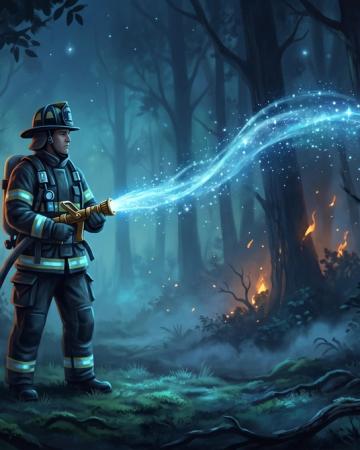
Water, a blanket, or pulling away the fuel match three ways of calming a situation down: cooling it, silencing it, or cutting off what feeds it. Notice which one your dream chose.
With water. This is the most common move, and the gentlest. Water brings the temperature down without making what was burning disappear. In waking life, it looks like a calm conversation after a blowup, or sleeping on it before you answer a message that stung. If the water was easy to get, a faucet or a bucket within reach, the means to settle things are likely already in your hands. If you had to run a long way for it, calming things down is costing you more effort than you'd like to admit.
By smothering it. A blanket, a lid, dirt, sand: the fire dies for lack of air. It works, and sometimes it's exactly what's needed. But smothering also means silencing. Ask yourself whether you actually calmed the situation or just covered it up. Anger that gets covered up without being heard often keeps smoldering.
By taking away the fuel. This one is rarer: you drag the logs apart, shut off the gas, dig a trench in front of the flames. This dream is interested in what feeds an argument more than in the argument itself. A single Bible verse holds the whole idea: where there's no wood, the fire goes out, and where there's no gossip, the quarrel dies down (Proverbs 26:20). Who, or what, keeps adding fuel to your fight? Someone who carries words back and forth, an old story that keeps getting dragged out, a conversation you replay alone at night.
Why does the fire get bigger when you throw water on it?
Because that move doesn't suit that fire. This dream often means you're handling a situation with a tool that makes it worse.
A very real case shows it well: the grease fire. Every safety guide says the same thing: never throw water on a pan of burning oil. The water flashes into steam, throws the burning oil out of the pan, and the flames double. You turn off the heat and slide a lid over it. English kept the image too: adding fuel to the fire means making a fight worse, sometimes while trying to help.
In the dream, the reversal is striking: you do what looks like the right thing, and everything goes up. In my view, the kind of calm you're offering just isn't the kind that's needed. Explaining yourself one more time to someone who won't listen, reassuring at all costs, playing down anger that first needs to be acknowledged: all buckets of water on a grease fire. Sometimes turning off the heat and stepping away for a while works better than pushing.
And if the fire flares up again after it seemed to be out, look at the embers. A "settled" argument that comes back at the slightest word, a grudge you thought was over: something is still smoldering, and the dream spots it before you do.
What does it mean to put out a fire in your house?
Most often, you're defending your private life (your relationship, your family, your home) against a tension that's trying to move in. The room where the fire started often points to what's affected.
Back in the second century, Artemidorus was already reading a burning house room by room: the bedroom for the wife or the master of the house, the storerooms for the household's supplies. You don't need to follow him to the letter to keep the idea. A fire in the kitchen often has to do with what keeps the household going: daily life, money, shared meals. In the bedroom, it's more about intimacy or your relationship. In a child's room, about a worry for that child.
The fact that you put it out matters a lot. You don't run, you stay and act. If you did it calmly, the dream often shows that you have what it takes to get through this stretch. If you were fighting it alone while everyone else slept or watched, it raises another question: are you always the one who handles the crises at home?
What does it mean to put out a fire at someone else's place?
This dream is often about your role among the people around you: the one everybody calls when something's burning. It's generous, but it isn't always your job.
We say someone spends their days "putting out fires" when they run from one emergency to the next, at work or at home. Sometimes the dream takes the phrase literally: you cross the street with a bucket toward your neighbor's house, you hose down a coworker's desk, you put out the fire in your parents' kitchen.
The Menglin Xuanjie, a Ming-era collection of Chinese dream readings, makes a point here that I like: staying away from your neighbor's fire is a good sign, while going to fight it costs you some of your authority. There's a lesson in it that still holds. Put out enough other people's fires and you can end up with less say in your own life: you decide less for yourself, you become indispensable without being listened to any more than before. If that sounds familiar, ask yourself which of these fires is really yours. And if you were wearing the uniform in your dream, the entry on the firefighter takes this further.
What does it mean to put out a fire with your bare hands?
It's a dream of sacrifice: you stop the danger with whatever you have, your own body included. It often points to a situation where you're taking the hit to protect other people.
Some read it as a kind of mastery, and that's possible when it all happens without pain. I'm more hesitant once your skin is hurting. Slapping at the flames, stamping them out, smothering them with your own jacket: you're getting hurt so the fire doesn't win. In waking life, it looks like someone who soaks up everyone's anger so the family holds together, or who does the work of three people so the team doesn't crack.
Think back to your hands at the end of the dream. If they were burned, the dream is showing you the cost of stepping in, and the entry on a burn can help you read that wound. And if the exhaustion of carrying it all has been with you for weeks, don't keep it to yourself: a friend, your doctor, or a therapist will help you put the bucket down.
What's left once the fire is out?
Ashes, smoke, and often a deep quiet. How you feel about that quiet, relief or emptiness, tells you where you stand.
You'd expect to wake up relieved, and you often do: the crisis is over, you can breathe. But sometimes a fire you've put out leaves a strange sadness behind. It doesn't worry me. A conflict, even an exhausting one, takes up space; when it stops, it leaves a gap you have to get used to. Peace can feel cold at first, like a room where the fire has just gone out.
The ashes have something to say too. If you keep dousing a fire that's already dead, pay attention. Ibn Sirin's tradition has a precise image for this: putting out a fire that's already out stirs up trouble, because of the ash and smoke it kicks up. Going back over a finished argument, asking the touchy question one more time, is a bit like that: you think you're cleaning up, and you send the smoke flying again.
Before you file this dream away, make two columns on a sheet of paper. On the left, the fires you were right to put out lately: a quarrel, a habit, a worry that was taking up too much room. On the right, the ones you might regret letting die: a desire, a friendship, a project. The right-hand column is usually the shorter one, and the more useful. Whenever you want, bring your own fire to the app: tell me how you put it out and what was left afterward, because those two details are where my reading starts.