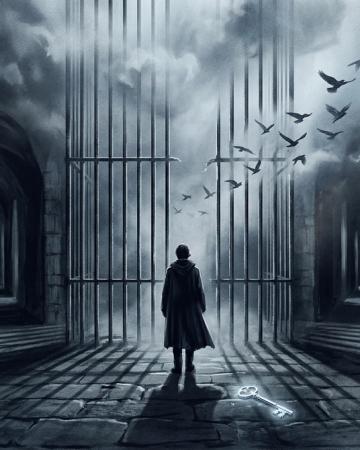


Two different experiences go by the name paralysis, and each calls for its own reading. In the first, you are dreaming: the scene is underway, your legs stop answering, your voice stays stuck, and the dream carries on around you. In the second, you are awake, sometimes with your eyes open in your real bedroom, and your body won't move for a few minutes. This page starts with the dream, then explains the episode on waking, which has its explanation in how we sleep.
What does it mean to dream of being paralyzed?
Most often, this dream pictures helplessness: you feel you can't move forward, answer, or leave.
I read it as being stunned into stillness. When a decision overwhelms you or someone puts you on the spot, you can freeze, head full and body silent; the dream simply gives that state a body. So the useful question is: what is leaving me without a reaction right now? A conversation you keep putting off, a job where you've stopped saying no, a choice that has waited too long. The answer often comes fast.
The emotion in the dream steers the reading. Plain fear points more toward a threat or acute stress. Frustration points toward something you want to do and won't allow yourself. A dull heaviness with no panic looks more like tiredness piling up. If the clues contradict each other, the state you wake up in counts for more than the scenery.
Look at who was there, too. Alone in a familiar place, the dream is mostly about you and what you don't dare want. Surrounded by people, it is more about other people's eyes and the weight you give them. If it comes back several nights, watch what varies between nights: a door that opens, a finger that twitches, someone stepping closer. Those small shifts show whether the situation is moving.
Does the setting change what a paralysis dream means?
A lot. The scene tells you what is holding you back.
- While running away. Your legs turn heavy while something chases you. The dream shows avoidance hitting a wall; look at what you are trying to get away from right now, as in dreams of being chased.
- In front of a crowd. Every eye is on you and you can't move. This is the fear of being judged, the one you meet in dreams of giving a speech.
- In a tight space. An elevator, a booth, walls closing in: the paralysis comes with a lack of air, which the dream of suffocating looks at in more detail.
- In water. You sink and can't swim. The stillness says you are letting an emotion swallow you; drowning has its own page.
- In your bed. If you dream you are lying in your room and can't get up, read on: it can be a dream, or a real episode.
When only one part of the body is affected, the hand tends to point to what you do or hold, and the legs to how you move forward. That is one lead among others: first ask what that arm or leg kept you from doing in the scene.
Why can't you scream in the dream?
Because the dream lines up what you feel with what you live: a scream that won't come out often stands for words that have not found their way out.
Imagine someone speaks harshly to you, you open your mouth, and no sound comes. It's an uncomfortable scene, and it resembles those moments when you realize too late what you wanted to answer. Look for who that scream was meant for, and what held you back from letting it out. The page on the muffled scream goes into this neighboring dream.
What does it mean to dream that someone close to you is paralyzed?
Often it points to worry about that person, or a sense that their situation is stuck.
Look at who is frozen: a parent, a child, a coworker? The dream speaks as much about your bond with them as about them. If you felt guilty for not helping, ask what you would want to say or do for them in real life, and whether that is yours to do. Sometimes the frozen person is also a mirror: you lend them the stillness you refuse to see in yourself. A worry that returns every night is worth telling the person concerned, simply.
What is happening when you are awake but can't move?
That is sleep paralysis: you are conscious but can't move or speak, as you fall asleep or wake up.
To understand it, you have to go through REM sleep, the stage when we dream the most. During REM, the body is almost entirely paralyzed: the neurons that command the muscles are inhibited. When this muscle paralysis is missing, some people act out their dreams while asleep. In sleep paralysis, it is the other way around: consciousness returns while the paralysis is still on. The brain is awake, the body not quite. The eyes can move, speech can't.
An episode usually lasts a few minutes at most. Dream images often mix in: a figure in the room, a presence, a weight on the chest, a humming sound. A 2011 review of 35 studies by Brian Sharpless and Jacques Barber estimated that about 8 percent of the general population has had at least one episode, and 28 percent of students. Episodes are more likely after short nights, irregular schedules, stress, or sleeping on your back.
How can you tell a dream from sleep paralysis?
Ask yourself whether you knew you were awake.
In sleep paralysis, you usually perceive your real room, the ceiling, the light, and you try to move. In a paralysis dream, the setting often changes (a street, a stage, an unfamiliar hallway) and you don't wonder whether you are asleep.
These clues aren't absolute: the two sometimes blend, since dream images can spill over into waking. A figure at the foot of the bed belongs to that case. You can then ask what a dark presence evokes for you, and the page on shadows comes back to it, but the phenomenon itself is explained by sleep. The fear is real; the images come from the dream.
Where does the Japanese word kanashibari come from?
From esoteric Buddhism, before it came to mean sleep.
Kanashibari (金縛り) translates literally as "metal binding." According to the Japanese Wikipedia article, the word refers to a practice called kanbaku-hō, in which the noose of the deity Fudō Myōō immobilizes enemies and, by extension, the passions. Its use for sleep came later, because of the sensation of a body tied up. The image fits what sleepers describe: a body held, with no visible bonds.
What can you do, and when should you see a doctor?
A single episode is frightening and harmless: the UK's National Health Service describes sleep paralysis as scary but harmless. Talk to a doctor if episodes come often, if you dread going to bed, or if you are constantly tired.
A sleep specialist can look for a cause: insomnia, narcolepsy, anxiety. If you fall asleep against your will during the day, tell them. To space out episodes, the advice is that of good sleep in general: seven to nine hours a night, regular hours, no alcohol, caffeine, or heavy meal right before bed, and avoiding sleeping on your back.
As for the dream, write down this morning in one sentence what was holding you still (a crowd, a door, someone), then look for where in your week you feel the same. To dig deeper, bring your dream to me in the app, with the place, the people there, and the part of your body that wouldn't respond: those details are what I need to answer you.