

In 1796, the German novelist Jean Paul needed a word for people who see themselves, and he coined Doppeltgänger, which he explains in a footnote to his novel Siebenkäs as "people who see themselves." The word became Doppelgänger, but the dream it describes is far older. If you woke up after meeting someone with your face, your walk, sometimes your voice, here is a way to sort out what that scene might mean, and what nobody can claim to know for you.
What is a dream of your double telling you?
Most often, this dream gives you the distance you don't have when you live your life from the inside: you watch yourself act, speak, hesitate, the way someone else would. What the double does counts for more than its resemblance to you.
A reflection in a mirror copies you. A double acts on its own: it can smile at you, ignore you, speak in your voice, sit in your seat. Each behavior asks a different question. A kind double speaks for a part of you at home with itself. An indifferent one, of a part you keep pushing aside. One that takes the controls, of the feeling that you've stopped deciding. I'd rather read these scenes as questions than as verdicts: what am I letting this other me do in my place?
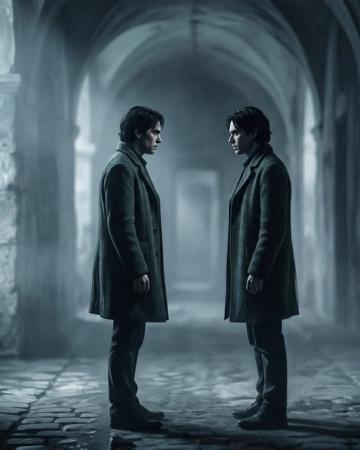
Seeing yourself in a dream is also less rare than you might think, and position changes everything: from far away, from behind, or from a height, you mostly observe the look you cast on yourself; face to face, you live an encounter, with an exchange that is possible or refused. Keep that difference in mind before hunting for a meaning.
To sort it out, hold on to three markers: what the double does, how old it seems, and what you felt on seeing it. For the shadow, the hostile double, or the lookalike who frightens, there is a separate entry: dreaming of a doppelgänger. This one covers the rest.
Why is meeting yourself so frightening?
Because the double touches one of humanity's oldest fears: not being unique, and seeing yourself from the outside. In 1919, Freud gave it several pages in his essay "The Uncanny," building on Otto Rank's 1914 study of the double.
For Rank, as Freud reports, the double was first "an insurance against the destruction of the ego," a way of denying death by doubling oneself. Once that belief faded, the double changed its face and became "the uncanny harbinger of death." Freud also tells a story from his own life: on a train, a jolt swings open the washroom door, an elderly man walks in, and Freud gets up to send him back to his own compartment before he realizes it is his own reflection in the door's glass. He then wonders whether his dislike of the stranger was a remnant of that old reaction to the double.
You don't have to accept the theory to keep the useful part. The unease comes from the resemblance: seeing from the outside what is most familiar, your face, the way you move, is enough to unsettle you, even when the double does nothing at all. And nothing in that idea says a misfortune is coming: Freud describes an effect of perception.
What does it mean when your double lives the life you didn't choose?
Often, a fork in the road: the double makes the choice you didn't make, or plays the role you don't dare to take, and you watch it happen in your place.
Imagine you walk into your office and another you is already sitting at your desk, answering your messages with ease while you stand in the doorway. There are two ways to read it. If you feel relief, maybe part of you would like some of your load to happen without you: exhaustion, a wish to delegate, a need to step back. If you feel irritation or alarm, the question becomes: what am I letting someone else do? A double who talks to your family in your voice amounts to asking: to whom, and in what area, are you handing your place?
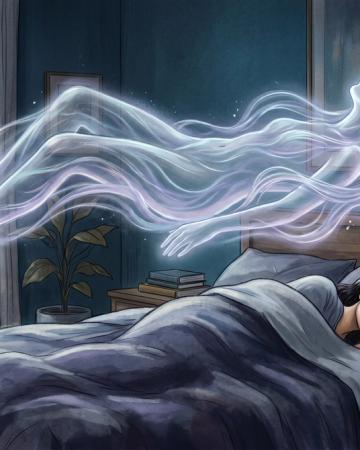
When the double leads a different life (another city, another career, another partner), it can also condense a "what if": a road you left behind. I don't necessarily see a regret to settle, more an inventory of what you haven't let yourself live. And if the scene simply shows you watching yourself sleep or act like a spectator, the entry on dreaming of seeing yourself sleeping goes deeper into that observer position.
Does an older or younger double point to another time in your life?
Often, yes: the double's age puts the question in time. A younger one points to what you left behind; an older one to who you are becoming or fear becoming.
A child double, met on a street you know, looking at you without asking for anything, often leads back to a wish or a promise from earlier: drawing, speaking up, playing. Ask yourself how old it is and what was going on in your life then. The entry on dreaming of the inner child takes that thread further.
An older double looks more like a projection. If it seems calm, it may say that you trust yourself with what comes next. If it seems tired or bitter, it may voice a specific worry about how you live today. Either way, look at what it wears, what it holds, and where it stands: those details tell you more than age alone. No age has a fixed meaning, and I'd rather say so plainly.
Can the double be a soul that travels?
Several cultures have told it that way: a double that leaves the body and goes elsewhere. These stories don't explain any dream, yet they show just how old the image of an other self, gone off on its own, really is.
In China, a Tang-era tale, Lihun ji (離魂記, "The Separated Soul"), attributed to Chen Xuanyou, features Qiannü, promised to another man while she loves her cousin Wang Zhou. When he leaves, she joins him by night, and they live together for five years and have two children. On their return, it turns out her body has stayed sick in her room: the young woman who left was her spirit, and the two come together as one. In Japan, in The Tale of Genji (early eleventh century), the living spirit of Lady Rokujō, the ikiryō, leaves her body and turns on her rival. In both stories, the double is the form taken by a desire or a pain too strong to stay in place.
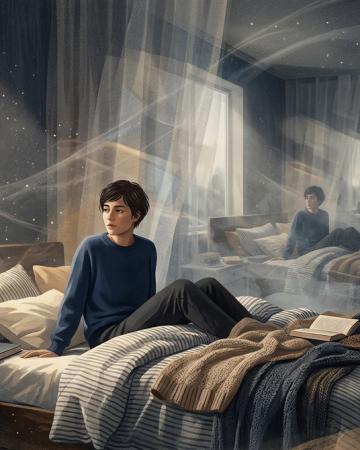
If your dream had that floating quality, with a splitting in space rather than an encounter, you'll find more in dreaming of splitting yourself.
What if the double appears in a mirror?
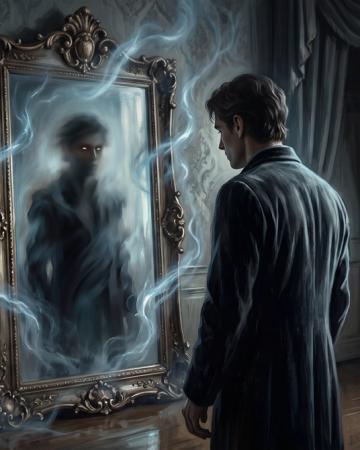
Then the image no longer moves on its own: it gives something back to you, and its condition does the talking. Asking whether what you see looks like you is already a reading.
Artemidorus, in the second century, has no entry for the double, but he does treat your own image in a mirror, and he reasons as he always does, according to the dreamer's situation. Seeing yourself looking like yourself suits someone thinking of marriage, and also for someone in grief, since people rarely look in the glass when they are sad. Seeing yourself uglier or in worse shape is good for no one. I read it instead as an old way of saying that the state of the image says something about the state of the person looking.
If the reflection feels foreign, the entry on dreaming of not recognizing yourself goes further. And if it was the glass itself that struck you, dreaming of mirrors is about that.
What should you do with this dream when you wake up?
Before your coffee, write down three things: what the double was doing, what it wore or how old it seemed, and what you felt on seeing it. Then ask yourself one question: what does that other me allow that I don't? Pick one detail of its conduct (an outfit, a sentence, a place) and borrow it, in a small way, this week.
If these encounters keep coming back and leave you anxious on waking, a friend or a therapist can hear it out with you. And if you see yourself doubled with your eyes open, go to a doctor, because that isn't a dream anymore.
To see what is particular about your double, you can also write the scene down in Midnight Mind. Yume will read it with its own details (the double's age, what it was doing, how you felt), and you can set it next to your other nights.