

In the second century, Artemidorus of Daldis wrote down a dream whose outcome he knew. A slave receives a soft-boiled egg from his mistress, peels it and eats it. She later had a son, then died, and the dreamer raised the child, which gave him his living. The shell, Artemidorus concluded, was worthless; what was inside had fed the dreamer. Nearly two thousand years later, it's still the best key to an egg dream: look at what happens to what's inside. Whole, cracked, hatched, swallowed or rotten, each fate tells a different story.
What is a whole, unbroken egg telling you?
A whole egg is about something taking shape that isn't visible yet: a project, a wish, a change you haven't announced. Depending on how you feel holding it, it speaks of calm waiting or of fragility.
You'll read everywhere that eggs mean "fertility," end of story. Some traditions do say that, but it leaves out almost everything that happens in the dream. To me, an egg is first of all a shell: a thin wall between what's forming and what could harm it.
If you look at it with curiosity, without fear, the dream often comes with a quiet stretch of growth. The image is very old. In third-century China, Xu Zheng described heaven and earth as still mixed together "like a hen's egg," before the giant Pangu split them apart. Before the world, there was an egg. Ask yourself what's ripening in your life right now, even if you haven't told anyone yet.
If instead you're carrying it in both hands, afraid of dropping it, the dream is about vulnerability. Whatever you're working on feels precious and easy to damage: a brand-new relationship, a project you haven't shown anyone, confidence slowly coming back. It's walking on eggshells, turned inward. What are you afraid of for it? Other people's opinions, your own impatience, one wrong move?
Where you find it matters too. Laid by a hen, it's often tied to family and everyday life. Sitting in a nest, it says you've found a place safe enough to let something grow. Out of nowhere, on a table or at the bottom of a pocket, it keeps some of its mystery, and that mystery is often what woke you up.
What does it mean to see a lot of eggs, or to gather them?
Lots of eggs point to abundance: several projects, several possibilities at once. Sometimes the dream is also saying it's a bit much to carry.
Older traditions were already torn. For Artemidorus, a few eggs meant profit, but many meant worry and trouble, often even lawsuits, because the chicks that hatch from them spend their days scratching around for whatever is hidden. On the Islamic side, eggs read as prosperity, or as the fear of watching your wealth run out. Having a lot also means having a lot to keep an eye on.
Gathering eggs one by one, in the straw of a barn or under the leaves in a garden, is a gentler scene. Picture yourself finding them where you didn't expect any. You tend to have it when you're rediscovering talents or ideas you'd set aside for lack of time or confidence. Look at your basket. If it fills up without effort, you probably have more resources than you think. If it gets too heavy, ask yourself which projects you can set down for now.
What does it mean when an egg cracks, or slips out of your hands?
It depends on how it breaks. An egg cracking from the inside points to a change that's starting; an egg you drop is more about the fear of damaging something fragile.
Plenty of people worry after dreaming that they dropped a carton of eggs. I don't believe it's a bad omen. The dream mostly shows a worry: that a project, a relationship or a newfound confidence will be exposed too soon, or ruined by a clumsy move. Watch what happens next. If you pick up what you can, the dream is about your ability to repair things. If you stand frozen over the mess, it's about a fear that's keeping you from acting.
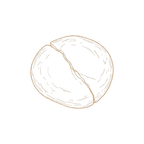
A crack that appears on its own, on an egg sitting perfectly still, is a different dream. A thin line runs across the shell, then widens. Nothing has gone wrong here: what was being protected has grown, and the protection has become too tight. It's often the moment you sense you need to leave a situation, a role, a habit, even if you don't know yet what comes next. That passage is uncomfortable, a bit like a birth: there's mess before there's something new.
What can come out of an egg when it hatches?
A hatching means an idea or a project is moving from intention to reality. What comes out of the shell tells you how you're living through that shift.
A chick or a baby bird is the simplest case: something new and still fragile needs care. If you're going through a pregnancy or thinking about one, the dream may simply reflect that; it doesn't predict one. And if the hatching reminds you of dreams about giving birth, that's because they're about the same moment: when what you've been carrying finally comes out.
But what comes out of the egg isn't always cute. Picture a huge shell splitting open and a snake sliding out, or something slimy you don't recognize. It's frightening, and yet there's nothing monstrous about it. What's born in us isn't always presentable: anger held back for a long time, a desire you didn't dare admit, a part of yourself you'd pushed aside. The dream shows you it's trying to get out. The question isn't how to push it back into its shell, but what you'll do with it now that it's here.
Why doesn't a raw egg mean the same thing as a cooked one?
Because one is ready and the other isn't. Eating a cooked egg is about what you're reaping; swallowing a raw one, about something you've taken before it was ready.
A hard-boiled or soft-boiled egg is food someone took the time to prepare. The dream is then about comfort, about what sustains you after an effort. Artemidorus already took a few eggs as a sign of profit, because eggs are nourishing. For Ibn Sirin, a cooked egg promises comfort and income. In China, the Menglin Xuanjie treats eating eggs as a lucky sign, one that promises many children.
A raw egg reads differently. You swallow it as is, without transforming it, and plenty of people find that unpleasant. The same Islamic dictionaries see it as ill-gotten gains or worry. I'd read it more as something you accepted too fast: a rushed decision, news you haven't digested yet, a situation you're putting up with without understanding it. If the taste turned your stomach in the dream, ask yourself what you've had to "swallow" lately without really wanting to.
Is a rotten or empty egg a sign of failure?
Not necessarily. A rotten egg points to waiting that has gone on too long, an empty egg to waiting that won't deliver what you hoped; both invite you to make room.
A rotten egg isn't a pleasant image, I'll grant you. It suggests an opportunity that waited too long, a project kept under wraps for so long it has gone stale. We often hold on to things out of caution, and that's understandable. The dream is simply inviting you to look at what you're still keeping out of habit, and to let it go without guilt.
An empty egg is more unsettling. You crack it open and there's nothing inside: no white, no yolk. This dream often comes with a disappointment, an effort that didn't pay off. But an empty egg isn't always a loss. Empty shells at the bottom of a nest also mean the bird has flown. If you've just been through a departure (a job you left, children who've grown up, a chapter that's closed), those shells may be about a change that has already happened and that you haven't fully acknowledged yet. And if the emptiness leaves a sadness that settles in, until nothing seems worth getting up for, don't sit alone with it: a friend, or a therapist, can help you find your way into this new chapter.
Before you look any further, ask yourself one question: in your dream, what happened to the egg? Write the answer down this morning, along with how you felt holding it, before the image fades. You can describe your own egg to me in the app, down to the color of the shell or where it was sitting: that tiny detail is often what steers the reading, and if the egg turns up on other nights, the app keeps it with the symbols you've already dreamed.