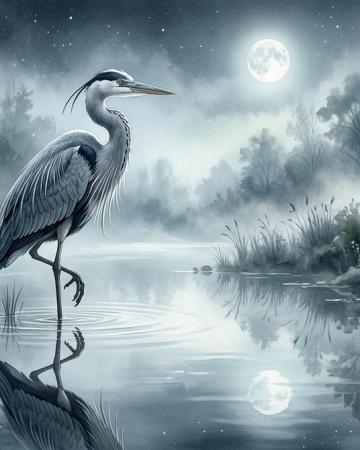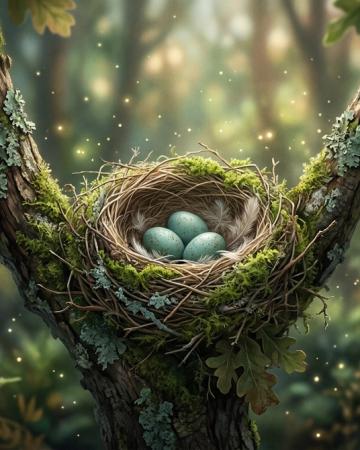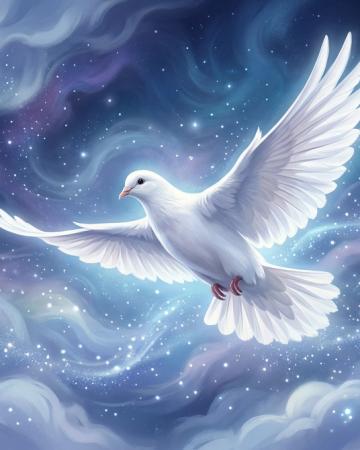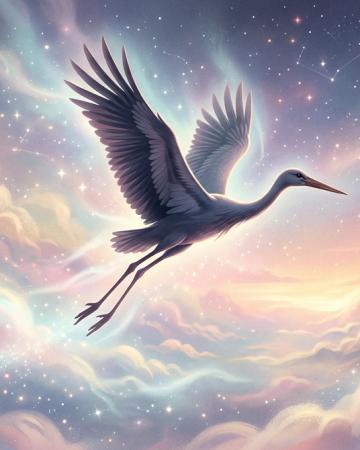
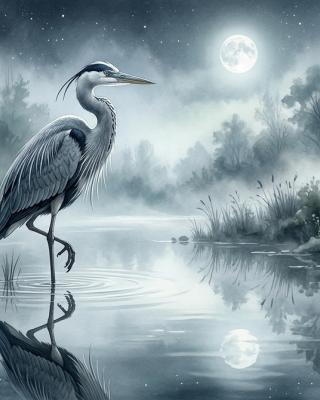

Picture a bird sitting on your windowsill, perfectly still, looking at you. You can't tell whether it came to warn you, to ask for something, or just to rest. That uncertainty is the whole symbol: a bird is one of the few dream animals whose intentions you can't read right away. So instead of handing you one meaning, I'd rather start from what you actually saw: the color, the bird's condition, where it was, and how you felt.
What does it mean to dream of birds?
Most often, a dream bird stands for something moving inside you that you didn't decide on: a craving for air, a message trying to get through, a fragility you're protecting. The exact meaning depends on the bird's condition and on your reaction.
A bird goes where you can't, and it does it without visible effort. That's where the idea of freedom comes from, and it shows up in almost every reading. I take it with caution: a bird gliding through a clear sky and a bird flying into a window have nothing in common, even if they are the same species.
Three simple questions will get you further than a list of meanings. Where was the bird: outside, in a room, on you? What shape was it in: lively, still, hurt? And how did you feel: relieved, worried, tender? A bird you wanted to follow and a bird you wanted to protect don't tell the same story. If your dream took place mostly in the air, with you doing the flying, my page on dreaming of flying like a bird is a better fit.
Why do people say birds carry messages?
Because for a very long time, people have read the flight and the calls of birds as a kind of language. The idea turns up in cultures that never copied each other.
In ancient Egypt, the ba, one of the parts that make up a person, is shown from the 18th Dynasty on as a bird with a human head that slips out of the dead person's body and moves between the tomb and the world of the gods. In Rome, augurs "took the auspices": they watched how birds flew, listened to the calls of some of them, and noted how eagerly the sacred chickens ate before an election or a battle. The word auspicium literally means watching birds. Among the Greeks, the seer Calchas already reads the signs of birds in the Iliad. In Genesis (8:6-12), Noah releases a raven first, then a dove that finally comes back with an olive leaf in its beak.
These texts say nothing about your dream, and I'm not claiming your bird announces anything. But when you feel it "meant" something, you are falling into a very old human habit, and it comes with a good question: what is trying to get through to me right now? News I'm waiting for? Something I haven't dared to say? Someone I keep thinking about? Jot down whatever answer comes first, even a silly one.
What does a black bird or a white bird mean?
Color sets the tone of a reading without deciding it. Black tends to point at something you've been avoiding, white at a search for calm, or sometimes at a separation.
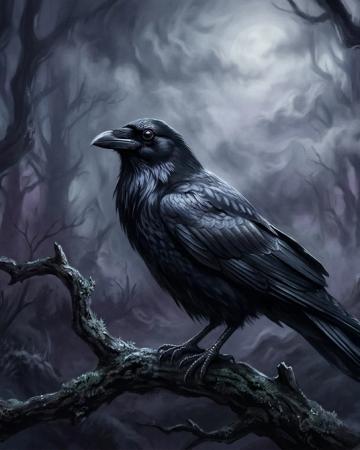
A black bird frightens us out of cultural reflex, so look first at what it does. If it sits quietly at the edge of your path, it often points to a subject you keep pushing away: a conversation, a decision, an old grief. If it dives at you or circles over your head, it is worry that fills the whole space. The crow, with a history of its own, has its own page.
A white bird reads the other way around. Most often it brings relief, but a white bird that is too still, too clean, almost unreal, can also point to emptiness or to someone drifting away. The dove, with its long history of peace and return, is covered in dreaming of a dove.
What really settles it is your reaction. A black bird that left you calm is rarely a bad omen; a white bird that tightened your chest deserves a closer look.
What does it mean when a bird flies into your house or lands on you?
In a dream, a house often points to your private life. A bird that comes in says that something from outside is entering your space, and your reaction shows whether you welcome it or try to push it out.
You may have heard that a bird in the house foretells bad luck. I don't build on that belief: it scares you without teaching you anything. Look at the scene instead. A bird that flies in through an open window and circles in a panic looks like a situation that arrived faster than you expected, a project, a piece of news, a person, and that you are scrambling to catch up with. A bird sitting calmly on a shelf suggests a presence settling in, maybe a welcome one. And if you are trying to shoo it out, ask yourself what you'd like to keep outside right now.
When the bird lands on you, on your shoulder, your hand or your head, the scene gets even more intimate: the bird comes into contact with you. Notice the weight. A light, trusting bird that you let stay often matches a trust that is settling in, or an idea that finally lands after circling for a long time. A bird that grips, with claws you can feel, looks more like something you carry without having chosen it. What stirred in you the moment it arrived is your best lead.
Place matters too. In the house you grew up in, the bird probably speaks about the past; in your current home, about what is happening now. To see what a house means in your dreams in general, you can read dreaming of a house.
What does a dead or injured bird mean?
An injured bird often speaks of a part of you, or of someone close to you, that needs care. A dead bird suggests more of an impulse or a hope fading out. In both cases, what you felt during the dream counts as much as the image.
If you felt compassion, you are probably carrying something fragile that you want to keep safe. If you felt nothing, that is sometimes exhaustion: after holding on for long enough, you stop feeling. And if you picked the bird up to nurse it, look at what that gesture says. You already want to act for something. What is it?
A dead bird doesn't announce anyone's death. It can, however, go along with a very real grief, and then the dream is working on what couldn't be said. If that sadness weighs on your days, you could talk it over with someone you trust, or with a doctor or therapist. To go further on what grief does to dreams, there is dreaming of mourning.
Why does the bird sometimes stay in its cage with the door open?
A bird that stays when nothing holds it back can express a need for safety while you recover your strength.
Reading "cage equals prison" strikes me as too short. If the door is locked and the bird is thrashing, yes, that is a constraint: a job, a relationship, a rule you accepted and that no longer fits. But if the door is wide open and the bird stays on its perch, the question becomes the leap. Staying can be a way to protect yourself during a transition, and in that case I wouldn't push the bird: there's no shame in preferring the familiar before a big change.
Ask yourself honestly: are you being held back, or are you hesitating? The answer isn't the same, and the cage, with all its variations, is covered in dreaming of a cage.
What should you do with a bird dream when you wake up?
Describe the bird in five details before they fade: the species if you know it, the color, what it was doing, where it was, what you felt. Those five lines are worth more than any general meaning.
Then a small gesture: sometime today, watch a real bird for thirty seconds, a pigeon on a roof, a sparrow on a patio. Don't look for anything; just notice how it holds itself, how it keeps watch, how it takes off. That puts the symbol back in its place as an ordinary animal and leaves the dream free to tell you the rest.
To read your own bird, tell me the scene in the app, with the species, the color and the setting, and I'll look with you at what each detail changes.