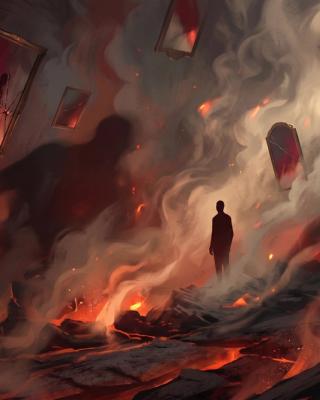


It's a sight that can truly chill the blood, isn't it? You often wake up with a start, your heart pounding, feeling as if a sentence is hanging over your head. Yet, in the vast and sometimes dramatic theater of your unconscious, the executioner isn't there to hurt you, but to bring an end to something that no longer serves you. He is a blunt messenger, certainly, but his appearance is an invitation to look directly at what, within you, is crying out for justice or liberation. As you read these lines, you'll discover that this menacing figure is less an enemy and more a mirror of your own demands upon yourself.
The inner judge and the weight of the axe
When I wander through the dreams of sleepers, I often see this hooded shadow. It fascinates me as much as it saddens me. Why are we so quick to inflict such symbolic violence upon ourselves? The executioner, in the world of dreams, is almost never a real person from your daily life. He is a projection of your "Superego"—that part of your psyche that spends its time measuring whether you are "good enough" or "too much of this or that."
If you feel hunted by this figure, it’s often because you are going through a period where guilt weighs on your shoulders like a heavy cloak of lead. Perhaps you feel you've made an irreparable mistake, or perhaps you are under external pressure that you have finally internalized. It’s a bit like finding yourself trapped in the turmoil of an inner war: parts of you are at odds, and the executioner arrives to settle the debate by force.
Honestly, I find it tiring to see so many people flagellating themselves like this in their sleep. Your mind isn’t trying to frighten you just for the sake of fear; it uses a powerful symbol to tell you: "Stop punishing yourself." The executioner's axe is a tool for a clean break. What are you trying to cut out of your waking life? An old grudge? A regret eating away at you? Sometimes, the mind has to pull out all the stops—the symbolic execution—so you finally understand it’s time to let the past die.
The nuances of the execution: Victim or executioner?
The interpretation changes radically depending on the role you play in this macabre staging. I remember a dreamer who told me he saw himself on the scaffold, not terrified, but strangely relieved. For him, the executioner wasn't a monster, but a liberator. In his case, the execution represented the end of an unbearable period of stagnation—a way to break through that form of emotional paralysis that had kept him from moving forward for years.
Here are a few variations I have often encountered in the winding paths of the unconscious:
Being the condemned: This is the most common form. It speaks of a fear of sanction. You may be waiting for a judgment in your professional or personal life, and you fear the punishment will be disproportionate. It is an expression of extreme vulnerability.
Being the executioner: This is more unsettling, isn't it? Wearing the hood often means you are repressing a part of yourself. You are trying to eliminate a character trait or an emotion (like anger or sadness) that you judge unacceptable. You are simultaneously the one striking and the one receiving the blow.
Seeing a loved one executed: Be careful here—the wisdom of the Baku is required. This does not mean you wish harm upon this person! It generally means that your relationship with them is undergoing a profound mutation. A part of the image you had of them is "dying" to make room for something else.
I must confess, I’m not a fan of dream dictionaries that simply say "Executioner = Betrayal." It’s far too simplistic. The human psyche is a dense forest, not a marked highway. The executioner is a figure of radical transformation. It’s the caterpillar that must die for the butterfly to be born, just with a slightly more... medieval presentation.
Taming the shadow to find peace again
So, what should you do after such a nightmare? My advice, as a dream eater, isn't to flee from this image, but to invite it to sit down (symbolically) for a chat. If you could speak to this executioner, what would he tell you? Is he angry? Is he just doing his job? Often, we realize that the executioner is exhausted from carrying his axe. He only wants to set it down.
Guilt is a strange emotion. It gives us the illusion of paying a debt, but in reality, it only fuels the vicious cycle of self-deprecation. If your dream shows you a punishment, it might be a sign that it’s time to grant yourself your own pardon. Dreams are messages, not threats. They use violent contrasts to wake us up to our own need for gentleness.
I sometimes wonder at the human capacity for self-forgiveness. You are so gifted at creating monsters out of your own doubts. But never forget: in your dream, you are the screenwriter, the actor, the set designer, and even the executioner. If you have the power to create the condemnation, you also have the power to sign the amnesty. The day you stop judging yourself so harshly, the executioner will take off his mask and vanish into the morning mist, where he truly belongs.
Take the time to observe these shadows without fearing them. They are merely passing clouds across the moon of your mind. By understanding what summoned this figure, you transform a night of anguish into a step toward greater self-knowledge.
I once watched over a dreamer who kept returning to a stone courtyard, smelling of damp earth and rust, waiting for an executioner who never actually struck. The tension was unbearable, far worse than any blow. We often forget that the mind is a master of dramatic suspense. In these quiet, terrifying moments, what you are actually experiencing is the agonizing transition of waiting for the inevitable. You are holding your breath, clinging to a dying phase of your life like a shackled prisoner waiting for his cell door to open. The executioner’s presence is simply your soul’s way of forcing you to stand still. He forces you to stop running from the transition, to feel the cold breeze on your neck, and to admit that the waiting—the constant, exhausting anticipation of failure—is much more painful than the clean break itself.
It honestly bothers me how standard dream books paint this figure as a pure omen of doom or simple self-punishment. They miss the beautiful, tragic history of the role. Historically, the executioner was an outcast, living outside the city gates, yet he was also sought after for his knowledge of anatomy and healing. He was the one who touched what others feared to look at. In your night, this dark shadow might actually be your own inner healer in a terrifying disguise. When your mind chooses this archetype, it is calling upon a force strong enough to handle your deepest shame, someone who can carry the burden of the heavy chains of guilt you’ve forged. He doesn't hate you; he is simply doing the dirty work your conscious ego is too polite, or too frightened, to accomplish during the day.
If this dark figure continues to haunt your nights, why not record the details of his outfit or his gaze in your collection of symbols on Midnight Mind? Sometimes, by putting words or images to what frightens us, we realize that the executioner was only a part of us that needed to be heard, not banished.