AT A GLANCE
TL;DR
The leopard teaches you to observe and analyze before taking decisive action in your waking life.
Its spots represent the beautiful complexity of your hidden traits, secrets, and the parts of yourself you keep camouflaged.
Unlike pack animals, the leopard symbolizes a move toward self-reliance and the courage to walk your path alone.
It reflects your capacity to adapt to difficult or "high-altitude" environments with grace and precision.
The Hidden Meaning of Dreaming About a Leopard: Unleashing Your Inner Power and Agility
The Velvet of the Subconscious and the Art of Strategic Patience
To be honest, the leopard has fascinated me for centuries. When I approach a dreamer to taste their nocturnal visions, the leopard has a distinct flavor—something like licorice and musk. It is a dream that requires a certain level of maturity to digest. Often, you might ask me: "Yume, why is this animal following me in the dark?"
Your first instinct might be fear. You see a predator, and your brain triggers a survival response. But in the fluid world of dreams, the predator is rarely there to devour you. Instead, it acts as a mirror. It is there to show you that you, too, possess claws, night vision, and a coat of changing colors that allows you to blend into any situation.
The leopard's agility in your dream doesn't just concern your physical movements; it is, above all, about your flexibility of mind. Do you feel stuck in a rigid situation right now? The leopard appears when your subconscious whispers that it is time to change your perspective.
Perhaps you need to climb onto a higher branch—metaphorically speaking—to observe your social or professional landscape from a greater height. It is an invitation to strategy. The leopard never wastes its energy. If it runs, it is because it is sure of its move. If it sleeps, it is totally still. This dream might be asking you to stop restless, unnecessary movement and to find that surgical precision in your decisions once again.
---
The Ambiguity of Spots: Wearing Your Shadows with Grace
What often strikes me as limited in classic dream interpretation is the habit of wanting to label a leopard as "good" or "bad." Life is rarely that monochrome, and your dreams are no exception. The leopard is the very incarnation of ambiguity. Look at its coat: dark rosettes on a golden background. It is the perfect marriage of shadow and light.
In your dreams, this spotted coat speaks of what you show and what you hide. We all live with secrets, desires, or talents that we camouflage to blend into the social backdrop. If the leopard in your dream seems threatening, I invite you to ask yourself: what truth are you trying to conceal from yourself?
Ambiguity isn't a lie; it's a form of protection. There is an old saying that a leopard doesn't change its spots, and there is great wisdom in that for you. The dream is telling you to accept your true nature, even the parts that seem "spotted" or imperfect to the outside world.
🌙 The echo of Yume: The leopard does not ask the jungle for permission to be beautiful; it simply exists in the perfection of its own design. Perhaps your dream is asking you to do the same.
I like to think that the leopard is the guardian of the threshold between what you know about yourself and what you have yet to discover. It prowls at the edge of the jungle of your mind. If it approaches you without aggression, it is because it recognizes you as one of its own. This is a sign of great inner strength. You no longer need the validation of the "pack"; you are ready to forge your own path, solitary but sovereign.
---
Concrete Example: The Leopard in the Library
I once encountered a dreamer—let's call her Elena—who was a young architect. She kept seeing a leopard pacing silently between the shelves of a vast, dark library in her dreams. She felt hunted and paralyzed by the animal's presence.
When we looked closer at the "flavor" of her dream, we realized the leopard wasn't growling; it was waiting. Elena was rushing a major project out of fear of failure, working late every night in a state of panic. The leopard was her own suppressed intuition, a manifestation of her "wild" creativity that felt trapped in the rigid structures of her office life.
The leopard was telling her to wait for the "golden hour" of her inspiration rather than forcing the process. Once she acknowledged that she needed to step back and observe her work with the leopard's patient gaze, the animal in her dream finally sat down and began to groom itself, signaling that her internal strategy was finally aligned with her external actions.
---
When the Wild Cat Transforms: Variations and Nuances
Not all leopards look the same in the mist of dreams. I have seen visions of snow leopards pass by, of a spectral whiteness, evoking a very pure, almost frozen spiritual solitude. This might appear when you are going through a period of deep introspection or when you feel isolated in your brilliance.
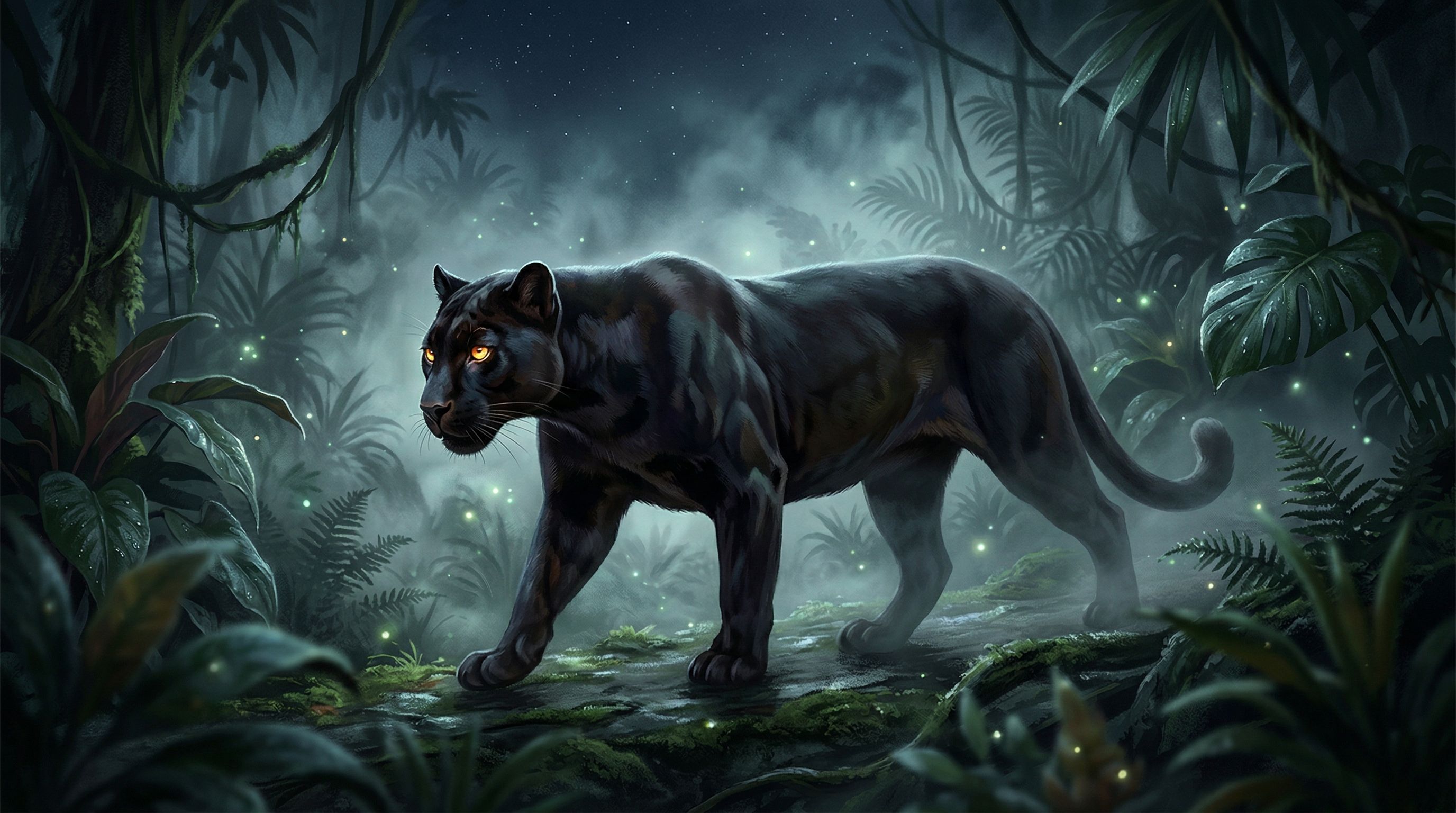
And then, there is the black panther—which is actually a leopard whose spots are drowned in ink. There, we touch upon absolute mystery, upon what some psychologists refer to as the "Shadow." This is the part of your psyche that contains everything you have pushed aside—your rawest desires, your deepest fears, and your most potent untapped power.
If you dream that you yourself are the leopard, it is an incredible sensory experience. I have often felt it while tasting the memories of dreamers: the sensation of powerful muscles beneath the skin, the weightless leap, the vision that pierces the darkness... It is your spirit testing its own power.
If, on the contrary, you are being pursued, I suggest a different approach: do not run. In the dream world, turning around to face the feline often changes the dynamic entirely. Often, the leopard stops as soon as you look it in the face. It doesn't want to hurt you; it wants you to acknowledge its presence—that is, to recognize the urgency of acting with more independence in your waking life.
---
A Scientific Perspective on the Predator Dream
While the mystical side of the leopard is captivating, there is also a grounding logic to why your brain chooses this specific imagery. Some researchers in the field of evolutionary psychology suggest that dreaming of predators may be a form of "threat simulation."
According to the Threat Simulation Theory (Revonsuo, 2000), our dreams serve as a biological defense mechanism. By "practicing" an encounter with a leopard in the safety of your sleep, your brain is actually honing its ability to perceive and respond to social or emotional threats in reality.
When you see a leopard, your brain is processing high-level concepts of "stealth" and "observation." It isn't just a random image; it is a sophisticated mental rehearsal. It allows you to experience the neurochemical rush of a high-stakes encounter so that when you face a "predatory" situation at work or in a relationship, you have already navigated that emotional terrain.
---
Integrating the Leopard's Wisdom into Your Rituals
If this spotted visitor continues to haunt your nights, it is a sign that the dialogue with your subconscious is just beginning. The leopard doesn't come to frighten you; it comes to restore your own agility—the agility you may have forgotten in the chaos of daily life.
How can you honor this messenger? You might consider a small evening ritual before you sleep. Light a candle, sit in the silence, and try to channel the leopard's stillness. Ask yourself: "Where in my life do I need to be more silent? Where do I need to wait for the right moment to pounce?"
Dreams are messages, not threats. They are a reminder that even in total darkness, there is a path that only you can see. You are the master of your own jungle, and the leopard is simply there to remind you of the crown you already wear.
If you want to explore your dreams more in depth and keep a record of these powerful symbols, your Baku is waiting for you.