The Direction of the Soul: Ascending and Descending
In my world of mists, we rarely distinguish between "up" and "down" as being good or bad. Instead, I watch the movement itself. However, I know that for you, the climb often feels more noble. You are taught to "climb the ladder" from a young age, aren't you? It is a very human vision, though it can be quite exhausting—this constant pressure to reach a summit that keeps moving higher.
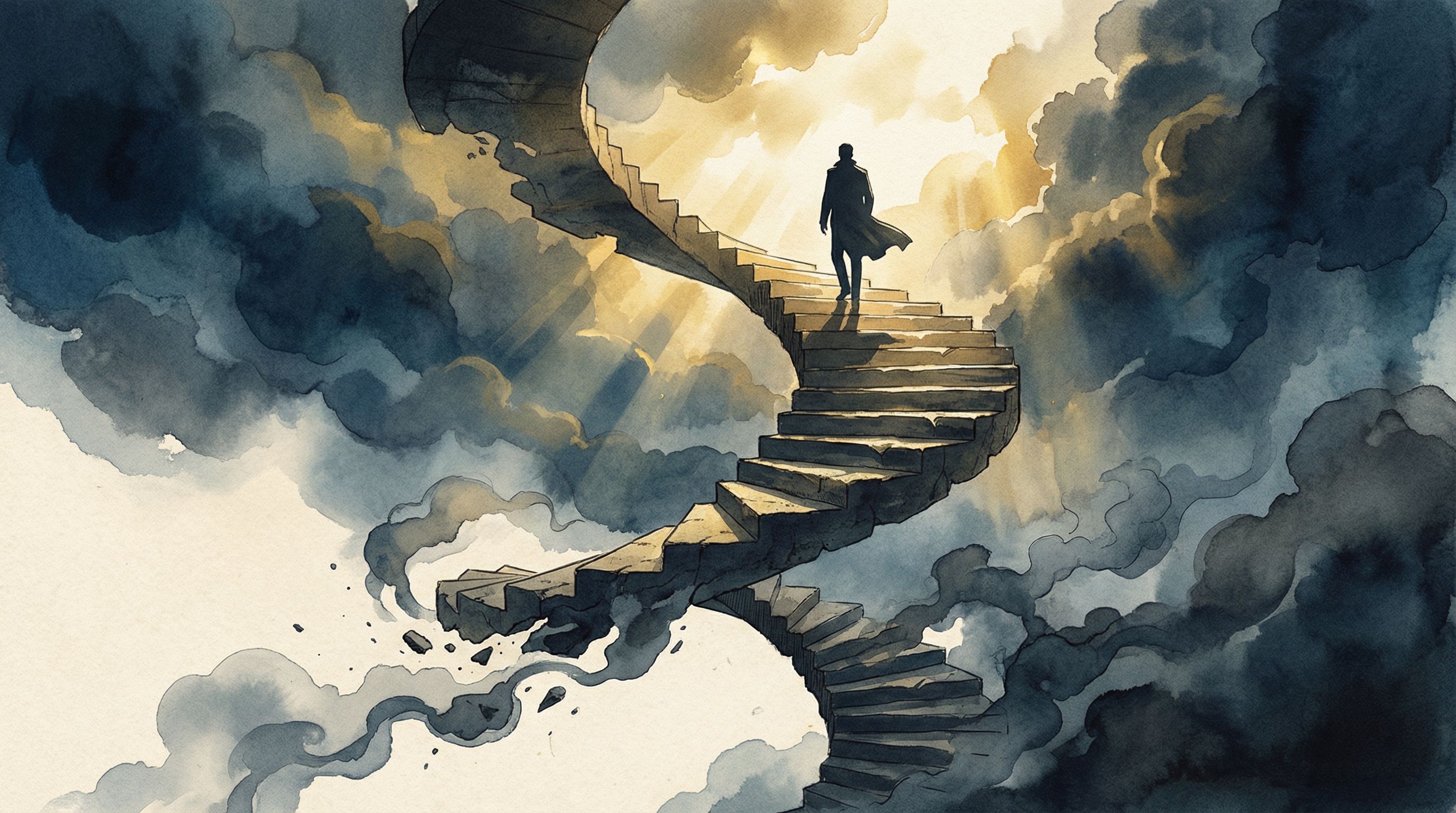
To dream of an ascent is to feel the call of change. It is rarely just about a career or social status, despite what some rigid interpretation manuals might tell you. Often, it is simply your mind’s way of telling you that you need to gain height. You might feel as small as a salamander at the base of a giant wall, yet you choose to climb. If you feel breathless in the dream, perhaps the effort you are currently exerting in your waking life is weighing on you. I have seen dreamers climb with a disconcerting lightness, as if they were floating. In those cases, the ladder is just a pretext: you are already ready to take flight.
But I want you to hear this clearly: do not fear the descent. Sometimes, to better understand what is blocking you, you must know how to go back down into the cellars of your subconscious. It is like searching for a hidden treasure in a forgotten box at the back of an attic. Descending the ladder means returning to the source, anchoring yourself once more. It is never a regression; it is a necessary introspection.
The Rungs of Doubt and the Fragility of Effort
What fascinates me most about this symbol is not the ladder itself, but the space between the rungs. That is where the void resides. It is the place where your courage manifests. When you dream of a ladder where the rungs break beneath your feet, a specific kind of panic sets in. It feels as though the ground of your reality is giving way.
Yet, this is usually a metaphor for your own doubts. Your mind is whispering: "Are you sure your supports are solid?" Sometimes, you might try to climb too fast without checking the stability of your inner structure. It is a bit like trying to reach a high window with the precision of an operating room procedure, but without having sterilized your past failures first. You want to move forward, but you are carrying too much dust with you.
🌙 Yume’s Echo: A ladder is the only bridge that requires you to use both your hands and your heart to cross.
Effort is at the very heart of this dream. Unlike an elevator that carries you passively, a ladder demands your physical and mental involvement. Every step is a deliberate choice. If the ladder trembles, it doesn't necessarily mean it will fall; perhaps it is simply a reflection of your own shiver when facing the unknown. I love the way the dream forces you to look at your hands: are they gripped tight? Are they confident? The dream does not judge you; it simply shows you how you stand in the face of the void.
The Science of the Vertical Journey
While I see the world through the lens of symbols, there is a grounded reality to why you feel these sensations so vividly. Some specialists in dream psychology estimate that dreams of navigation and physical effort are the brain's way of processing "spatial memory." When you are in REM sleep, your brain is highly active, simulating movements to help you navigate your waking world more effectively.
Furthermore, the sensation of "falling" or "slipping" on a ladder can sometimes be linked to a hypnic jerk or a slight shift in your physical body as you sleep. However, the fact that your mind chooses a ladder specifically—a tool of human invention designed for progress—suggests that your subconscious is focusing on your personal agency. You aren't just falling; you are falling from something you were trying to master.
I occasionally encounter dreamers who find themselves on a ladder leaning against nothing, rising toward the emptiness. It is a magnificent image, though unsettling. It speaks of pure faith, a movement toward something not yet defined. It is ambition without an object, the pure desire for growth. In those moments, I often sit on a cloud to watch: it is proof that your soul possesses an upward force that nothing can truly stop, not even the absence of a wall.
Take the time, upon waking, to ask yourself: "Where was I placing my feet?" The answer is often gentler than you imagine. Your dreams are not steep cliffs, but hands reaching out toward yourself.
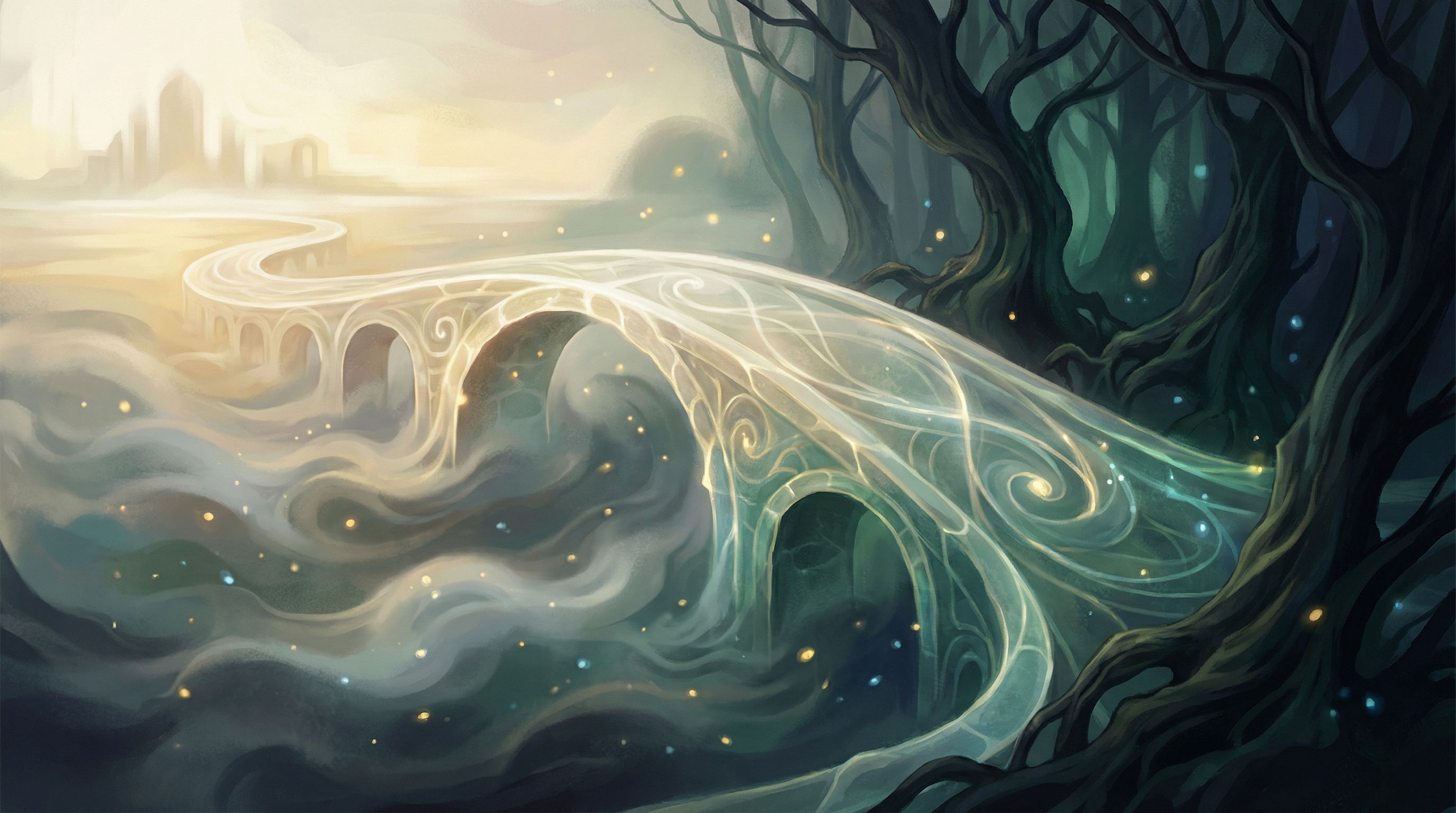
Have you ever touched the rungs in your dream? I often wonder why dream interpreters ignore the texture of the wood or the cold sting of iron beneath your palms. It matters. A wooden ladder, creaking and splintering under your weight, speaks to your ancestral roots—the raw, imperfect materials of your upbringing. But then there are those who dream of a swaying rope ladder, suspended from an unseen point in the sky. Honestly, these dreams of unstable rope fascinate me. They force you to abandon the illusion of absolute control. You cannot climb a rope ladder with rigid steps; you must sway with it, aligning your breathing with its rhythm. It behaves less like a solid tool and more like crossing a fragile bridge made of wind, asking you to trust the motion rather than the structure itself.
A dreamer once told me about a ladder she climbed for hours, only to find it ended abruptly in a ceiling of solid, unyielding stone. She was devastated, interpreting it as a sign of permanent failure in her creative life. But when we looked closer at the damp, cool texture of that stone, we realized it wasn't a dead-end; it was a threshold. She was trying to force her way into a space she wasn't ready to inhabit yet. Sometimes, being stopped mid-climb is a quiet mercy from your subconscious. It is an invitation to pause, to look around at the view you have already earned, and perhaps focus on building a safe nest right where you are, rather than endlessly striving for an unreachable summit.
It mildly irritates me when popular dream dictionaries claim that looking down from a ladder and feeling vertigo simply means "you fear success." What a clinical, lifeless way to translate the poetry of the body. Vertigo in a dream is not a psychological defect; it is a profound somatic awakening. It is the sudden, dizzying realization of your own expansion. When you look down and the ground seems miles away, your spirit is registering the vast distance you have traveled from your old self. It is natural for the heart to race. That trembling in your knees is just the physical echo of your soul adjusting to a new altitude. If you feel dizzy, do not rush to climb down. Just hold the rungs, close your eyes in the dream, and let the wind of your own growth pass over you.
If you want to explore your dreams more deeply and keep a record of these nocturnal ascents, your Baku is waiting for you within the Midnight Mind app.