The Paradox of the Closed Box: Why the Elevator?
Sincerely, this symbol has fascinated me for millennia. Why does your subconscious choose this small metallic box rather than a simple fall through the air? Unlike the dream of Flying: Hubris or Liberation? where you are the actor of your own movement, the elevator is an automaton. In waking life, you step inside, press a button, and entrust it with your destiny. You make no effort to ascend.
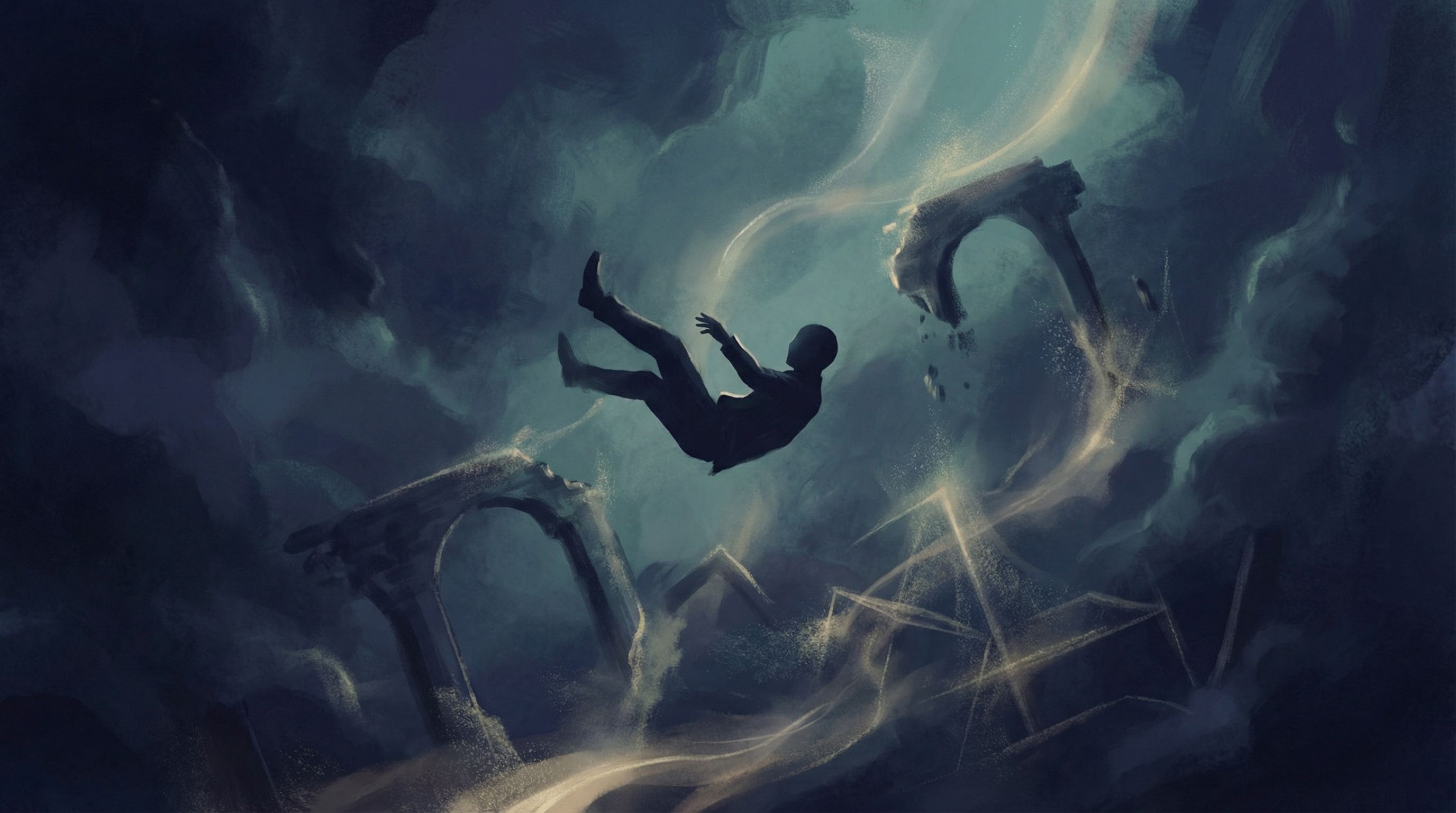
And therein lies the rub. To dream of a falling elevator is often to realize, in the vivid language of sleep, that you have placed your security in the hands of external structures: your company, a relationship, or even an image of yourself that you are struggling to maintain at arm's length. When the cable snaps, it isn't you who breaks; it is the mechanism that was carrying you.
I met a dreamer once who had this dream every time she received a promotion. She felt like an impostor. Her "ascent" wasn't organic; it was mechanical, forced. Her subconscious used the fall to tell her: "Climb back down on your own terms before the machine fails you." This is a nuance I find missing from most simplistic dream dictionaries, and it bothers me a little to see this symbol reduced to a mere "fear of failure." It is far more poetic than that: it is a sudden return to the gravity of reality.
The Vertigo of the Descent: Between Anxiety and Liberation
The feeling of vertigo in the elevator is a physical sensation so powerful that it often wakes the sleeper before impact. This is known as a hypnagogic jerk, but from a spiritual perspective, it is the moment your soul refuses to face the shock. Yet, is the impact truly so terrible?
In the world of dreams, one never truly dies from a fall. You either wake up, or the scenery shifts. This fear of loss of control is often linked to what I call The Vertigo of the World: Decoding Collective Anxiety Dreams. We live in a society obsessed with verticality. We must climb, progress, and reach the summits. But who is looking after the foundations?
If you dream that your elevator is plummeting toward the basement, ask yourself: what am I trying to avoid down there? Often, the fall brings us back to the cellars of the subconscious, where our purest truths reside, far from the artificial light of office floors. It isn't a punishment; it’s a call to order from the Earth. Your mind may be telling you it’s time to stop aiming for the 50th floor when your roots are thirsty.
Honestly, I don't always know if the fall is an end in itself. Sometimes, it is simply a sign that the path you chose is no longer the right one. An elevator is a transitional space; it wasn't meant to be lived in. If you stay there too long, if you define yourself solely by your upward movement, the subconscious will eventually cut the cable to remind you that you have feet to walk upon the ground.
Taming the Void
The next time you feel yourself falling in that iron box, try—if your awareness allows—not to tense your muscles. Imagine that the elevator isn't crashing, but is simply in a hurry to bring you home, back to the center of yourself. Dreams are never threats; they are messengers that shout because we have forgotten to listen to their whispers.
Have you ever noticed the absolute silence that fills the shaft just before the cable snaps? In my travels through your sleeping minds, I have felt this silence countless times—it is heavy, sterile, and smells of old grease and cold copper. This windowless box is a laboratory of dissociation. When you are suspended in mid-air, stripped of any view of the outside world, your subconscious is forcing you to look inward. There are no distractions here, no passing clouds, no landscape to soothe your eyes. Your mind strips away the external noise until all that remains is the raw, unvarnished truth of your breathing. The crushing gravity that presses against your knees as the floor drops away is not a punishment. It is a somatic release, a sudden and violent grounding of the nervous system that has been vibrating at too high a frequency for far too long.
It honestly tires me to see how modern psychology treats every descent as a pathology, a "crisis" or a "failure." In older traditions, particularly in the quiet wisdom of Taoism, the valley is the most sacred place because it is where all water flows and where life gathers. The elevator is plunging because you have spent too long trying to live on the peaks, breathing thin air that cannot sustain your soul. You worry about the crash, but what if the bottom of the shaft is simply the earth? Returning to the dark, fertile soil of your origins is not a defeat; it is a necessary hibernation. Sometimes, the only way to find your true footing is to let the machine take you all the way down, beneath the noise of ambition, to the quiet place where you no longer have to perform.
There is a strange, almost comforting paradox in being trapped inside this falling room. Why does your mind choose a box rather than a frightening open-air descent? I suspect it is because the elevator, even in its failure, remains a container—a metal womb that keeps you separate from the void. You are terrified of losing control, yet you cling to the very walls of the vehicle that is betraying you, much like the anxiety of riding in a driverless car in your sleep. You would rather fall within the familiar constraints of your old anxieties than step out into the vast, unpredictable freedom of the open air. Your subconscious is gently teasing you here: it shows you that the structures you built to protect yourself have become your falling prisons. Perhaps it is time to open the doors before they reach the basement.
If this feeling of falling persists and you feel as though your collection of nightly symbols is becoming a labyrinth, you might find some clarity in the Midnight Mind app. It features a log for the people you've dreamed of, allowing you to see who was with you in that elevator—because deep down, the fall is always softer when you aren't experiencing it alone.
Do not fear the void, little dreamer. It is within the void that we finally learn how to carry ourselves.