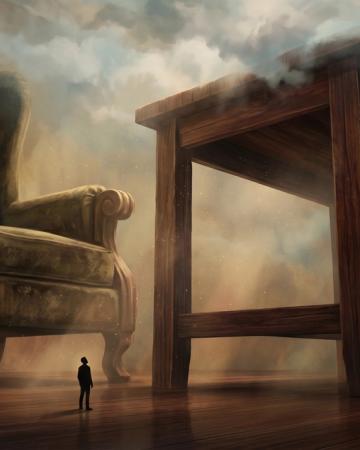

The ground trembles before you see anything. Then a leg taller than a building steps into view, or you find that your own hands are the size of houses. In a giant dream, the first thing that changes is the scale of everything else, and that's what to read before the story. Who is big, compared to what, and what do you do in front of it? Those three questions run through this whole page.
What does it mean to dream of a giant?
Most of the time, a giant gives a visible size to something that looms over you in waking life: a deadline, a person who dominates a room, a responsibility, a loss. The heavier the stakes feel in your head, the taller the figure gets.
I'm wary of pinning one identity on it. Lists that stamp "tyrannical boss" or "authoritarian father" on every colossus are sometimes right, since authority is a serious lead: if your giant looks like a boss or a parent, start there. But it can also stand for a project too big to hold, a fear of commitment, or a grief that has outgrown a human chest.
One detail strikes me: the giant fills your whole field of vision. In the dream you see nothing but him, the way in waking life a single difficulty can take over your attention. Imagine taking a few steps back. You might see his feet, his proportions, what he's hiding behind him. In a dream, stepping back is already a change of perspective. If the giant is more like a mountain on the move, that dream carries the same weight in another shape.
The setting matters as much as the size. A giant on a street in your neighborhood is probably about your daily life, while one standing in an empty landscape or by the sea feels more like an emotion, or a whole period of your life. If you recognize the face, it may be a person: start there. If it has no face, or a blurred one, think of a situation instead.
What does it mean to be chased by a giant?
Most often, a giant chasing you stands for a problem or a deadline you keep putting off, and it grows the more you run. Each of its strides eats up the lead you thought you had.
Watch what your body does in the dream. Are you running without getting anywhere, hiding, turning around? When the ground shakes under its steps, I read that as the dream making you feel the urgency before you can even see the cause. A chase can also be read more broadly; I go into that in the piece on being chased.
Ask yourself when you wake up: what have I been putting off for weeks? The answer often comes before you finish the sentence.
One useful detail: does the giant catch you? If you slip away just in time, the threat feels manageable for now. If you're caught or crushed, the deadline feels like it's already here. Neither ending predicts what will happen; they mostly say where you stand with whatever is pressing on you. When the dream returns and wakes you in a sweat, you're dealing with a nightmare that deserves attention. If it wears on your sleep or your mood, a doctor or therapist can help.
Is a kind giant a good sign?
Generally, yes: a friendly giant reads as protection or support. It carries you on its shoulders, steps between you and the storm, or just stays next to you without frightening you.
The real question is who plays that role in your life. A person who helped you without being asked, an institution, a belief, or a strength you're discovering in yourself. The dream may also point to help you haven't dared accept. Notice what the giant does with its hands: an open hand that lifts you or shelters you from the rain suggests help received, while a hand that holds you too tight, even gently, suggests protection that smothers. If the giant is kind but you feel tiny, awkward, or dependent, the kindness may be hiding a sense that you can't carry your own weight alone.
Stories of builder giants are plentiful: in Japanese folklore, Daidarabotchi digs lakes with his footsteps, and the traditions section says more.
What does it mean to become a giant yourself?
Becoming a giant in a dream reads sometimes as an ambition looking for room, sometimes as the discomfort of being too big for the people around you. How you feel is what decides it.
If you feel proud, strong, finally your real size, the dream is probably about a need for space or recognition. If you walk carefully for fear of crushing houses and people, it's more likely about a responsibility that arrived fast, too large for your current life, and an isolation setting in. One detail helps decide: who is looking at you? If the others look up, in awe or in fear, the question is how much room you take up. If they ignore you, or shrink as they back away, it's about the loneliness that height brings. Either way the useful move is the same: learn to measure your strength rather than hide it.
Scale can also run the other way: dreaming of being tiny, or of meeting a dwarf, asks the same question in reverse.
What does the story of David and Goliath tell you?
It gives the model for the small facing the big, and it's probably the image that comes to mind when people look up a dream of Goliath. In the first book of Samuel (chapter 17), Goliath of Gath is "six cubits and a span" tall in the King James Version, close to ten feet. Some old manuscripts, including the Greek Septuagint, say four cubits, about six and a half feet: even the giant's height changes depending on the copy.
David turns down King Saul's armor, too heavy for him. He goes with what he knows: his staff, his sling, five smooth stones from the brook (17:40). One throw hits Goliath in the forehead (17:49). The story adds that Goliath came forward morning and evening for forty days (17:16), and that Saul and his men were dismayed and greatly afraid (17:11). Fear had time to grow just from watching the giant.
If your dream reminds you of this scene, the reading is practical: facing your giant, what is your sling? A skill you underrate, an ally, a simple gesture that fits you. Saul's borrowed armor is the opposite trap: fighting with someone else's weapons.
Where does "feet of clay" come from?
From the book of Daniel, chapter 2, and it comes from a dream in the first place. King Nebuchadnezzar sees a great image: head of gold, chest and arms of silver, belly and thighs of brass, legs of iron, feet part of iron and part of clay (2:31-33). A stone cut without hands strikes the feet, and the whole image collapses (2:34).
The phrase "colossus with feet of clay," familiar in French, borrows this image: enormous power resting on a weak point. For your dream, the instruction is simple: look at the feet. What is holding your giant up? A giant frightens by sheer mass, and mass sometimes hides fragility. An obstacle that seems impossible often rests on less than it shows, though that doesn't make it any lighter to carry.
What should you do after a giant dream?
Take three minutes on waking to write down its size next to yours, its gestures, then your own. Those three lines usually say more than a dictionary entry.
Then give your giant a name in one sentence: "my giant is…". If you get stuck, pick whatever has crowded your thoughts this week. Next, look for the smallest piece of it within reach today: an email, a call, a page written. A giant comes apart in pieces, and David's sling only ever took one stone at a time.
If you want to go further with your own dream, bring it to the Midnight Mind app and I'll ask what's missing: the size, the setting, what you felt. And if these dreams return relentlessly or wear you down, don't stay alone with them.